People under the age of 35 can’t remember a time without the globally networked communication enabled by the World Wide Web, yet smooth data transfer, typically occurring in milliseconds, may soon be augmented by the unique properties of quantum physics. Instead of relying on strings of zeros and ones, this new network will use quantum bits, or qubits, exploiting superposition and entanglement to enhance security. Experts at Perimeter Institute, like Lucien Hardy, have already laid theoretical groundwork for teleporting the quantum state of a bit, though not in the way depicted in science fiction.
National Research Council Advances Quantum Network Development
The National Research Council of Canada is focused on advancing functioning quantum networks, extending from on-chip links to metropolitan fibre networks and, ultimately, satellite-based links. This commitment manifests in the Quantum Internetworking Challenge program, a collaborative effort uniting quantum science, technology and metrology experts with industry specialists and academics. The program’s central aim is to translate research into commercially viable quantum networking materials, devices, components and systems.
This initiative acknowledges the fragility inherent in quantum systems, where even cosmic rays can introduce errors by disrupting superposition states. Researchers are actively addressing the challenge of qubit errors through the development of quantum error correction codes, an important step toward building reliable quantum communication infrastructure.
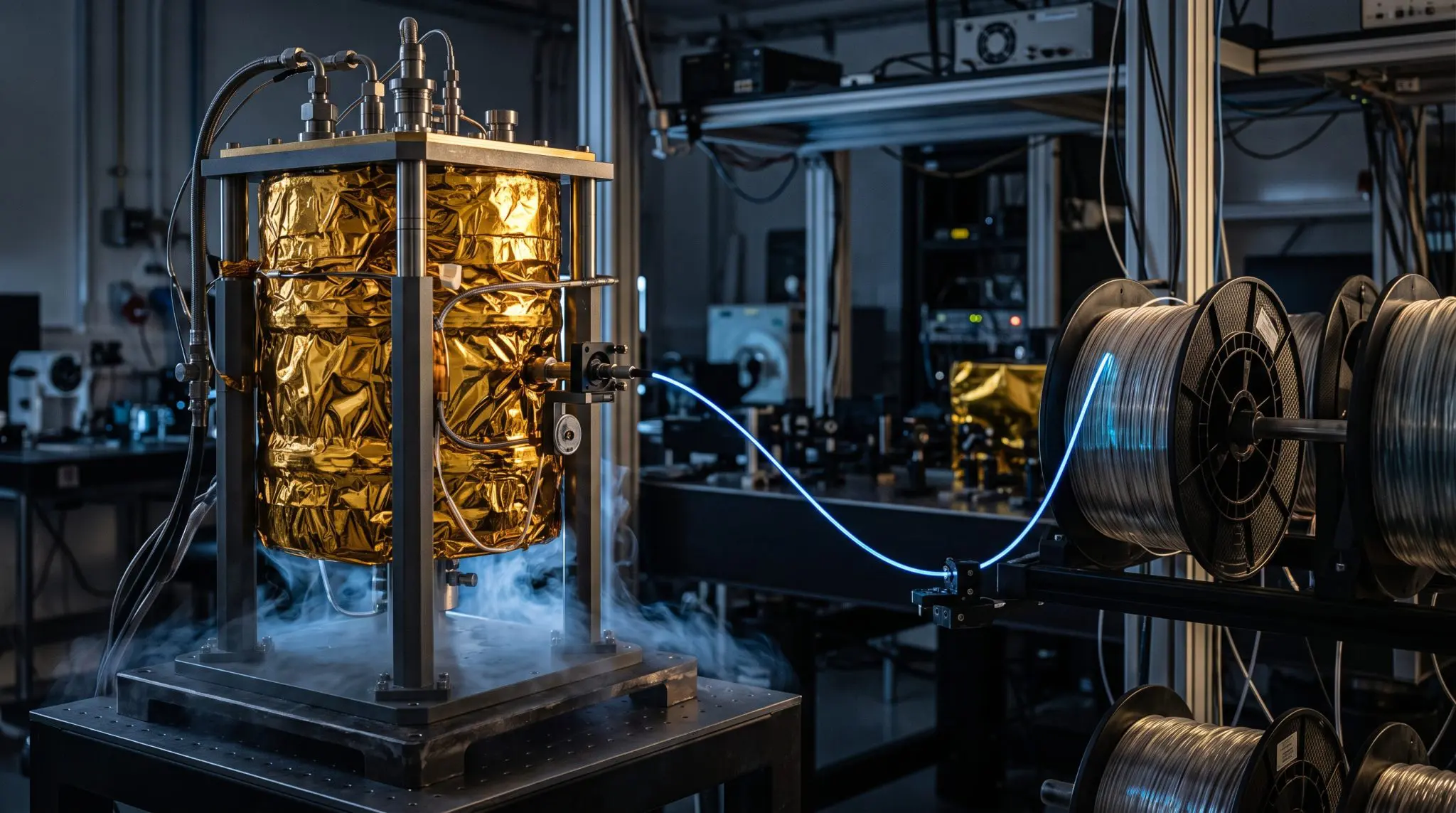
Experimental quantum networks already exist across North America, Europe and Asia, with some networks coexisting with conventional internet traffic on the same fibre optic cables. These networks, however, represent early stages of development, and substantial work remains to ensure reliability and security. The potential for enhanced security is a key driver behind quantum communication systems, enabling the creation of secret encryption keys that alert users to any tampering.
“spooky action at a distance,” as Einstein called it, is now understood to be a real property of quantum systems. Experts in the field of quantum foundations at Perimeter Institute, such as Lucien Hardy, have done theoretical work on this. But this isn’t like Star Trek teleportation: You are not physically beaming the particle from one place to another. Current communication technology relies on bits, the basic unit of information in classical computing, formed by electrical charges representing zeros or ones.
It is typically smooth, happening in milliseconds, even across multiple international borders. The development of qubits, which use the superposition principle to encode information as a combination of zero and one, represents a fundamental shift in how information is processed and transmitted. A qubit’s ability to exist in a superposition of 0 and 1 allows for richer representations of information beyond the limitations of classical bits.
The implications of this technology extend beyond faster and more secure communication; quantum computers, powered by these quantum properties, hold the potential to solve complex problems currently intractable for even the most powerful supercomputers. These include modelling detailed chemical structures and tackling other computationally intensive tasks. However, maintaining the delicate quantum state of qubits remains a significant hurdle, requiring ongoing research into error correction and robust system design.
The program’s long-term vision anticipates a future where quantum communication profoundly reshapes global society, mirroring the impact of the internet. The expectation is that this transformation may occur sooner than many anticipate, driven by the convergence of scientific advancements and industry collaboration. The goal is not simply to replicate the functionality of the existing internet but to augment it with levels of security and computational power.


See today’s quantum computing news on Quantum Zeitgeist for the latest breakthroughs in qubits, hardware, algorithms, and industry deals.