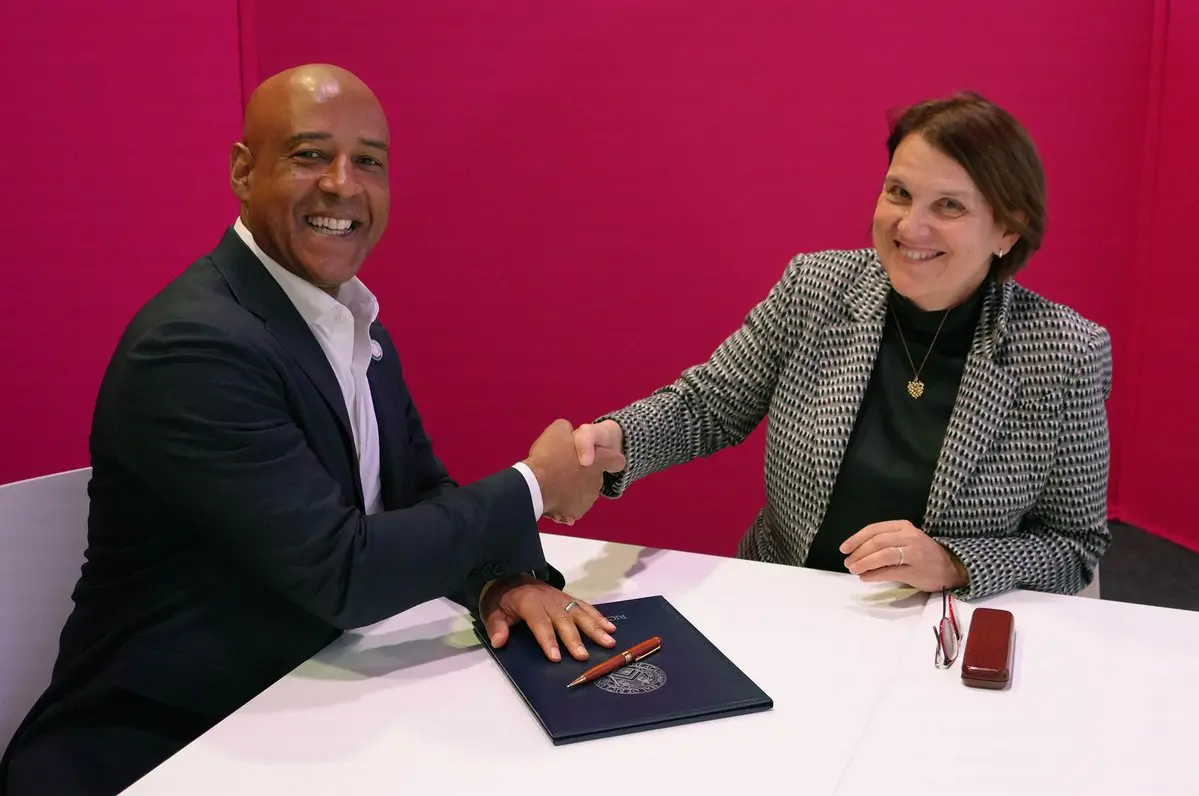
On June 19 in Paris, Claudia Felser, Vice President of the Max Planck Society, and Reginald DesRoches, President of Rice University, signed a cooperation agreement establishing the Quantum Materials, Rice and Max Planck Partnership, formally known as Q-RaMP. The collaboration aims to overcome a significant obstacle in materials science: while theoretical models predict numerous potential quantum materials, actually identifying those materials for practical application remains a major hurdle. “Breakthrough technologies begin with breakthrough discoveries, and those discoveries are made possible through bold partnerships,” said DesRoches. Through Q-RaMP, the institutions will combine resources to accelerate discoveries in computing, sensing, and energy technologies, focusing on supporting young researchers and fostering a dynamic academic culture.
This partnership intends to foster a synergistic environment, combining the long-term, curiosity-driven research approach of the Max Planck Society with the dynamic, tenure-track culture prevalent at Rice University. The collaboration will manifest through joint faculty appointments, student exchange programs, and regular visits between researchers at Rice and multiple Max Planck institutes, including those focused on the structure and dynamics of matter, solid state research, and chemical physics.
“Breakthrough technologies begin with breakthrough discoveries, and those discoveries are made possible through bold partnerships,”
The pursuit of functional quantum materials is currently hampered by a significant disconnect between prediction and realization; computational methods routinely suggest promising candidates, but pinpointing those materials exhibiting desired quantum properties presents a formidable obstacle. The collaboration aims to bridge this gap, concentrating on the difficult task of translating theoretical predictions into tangible materials suitable for advanced technologies. The partnership also prioritizes nurturing the next generation of scientists, recognizing that “talented minds are one of the few things on Earth that grow when shared,” according to Philip Moll, managing director for the Max Planck Institute for the Structure and Dynamics of Matter. This emphasis on cultivating young researchers, combined with a commitment to both long-term fundamental research and a dynamic academic environment, is intended to accelerate the identification and development of quantum materials with applications in sustainability, energy efficiency, and information processing.
This partnership extends beyond simply combining resources; it directly addresses a critical bottleneck in quantum materials research, namely the difficulty in translating theoretical predictions into tangible materials. While models readily propose candidates, “discovering the right materials with the right properties is like finding a needle in a haystack,” explains Emilia Morosan, trustee professor of physics and astronomy at Rice, and founding director of Q-RaMP. This emphasis on early-career researchers reflects a shared belief in the power of collaborative learning; Claudia Felser, director at the Max Planck Institute for Chemical Physics of Solids, stated that “The greatest investment we can make is in young scientists.” DesRoches noted that this collaboration will create an international effort that will accelerate discovery and create lasting global impact.
“Quantum materials drive the next generation of breakthroughs in many areas, from energy and sustainability to information technologies, but discovering the right materials with the right properties is like finding a needle in a haystack”, said Emilia Morosan, trustee professor of physics and astronomy at Rice, director of the Rice Center for Quantum Materials and founding director of Q-RaMP.
Emilia Morosan, trustee professor of physics and astronomy at Rice, director of the Rice Center for Quantum Materials and founding director of Q-RaMP


See today’s quantum computing news on Quantum Zeitgeist for the latest breakthroughs in qubits, hardware, algorithms, and industry deals.