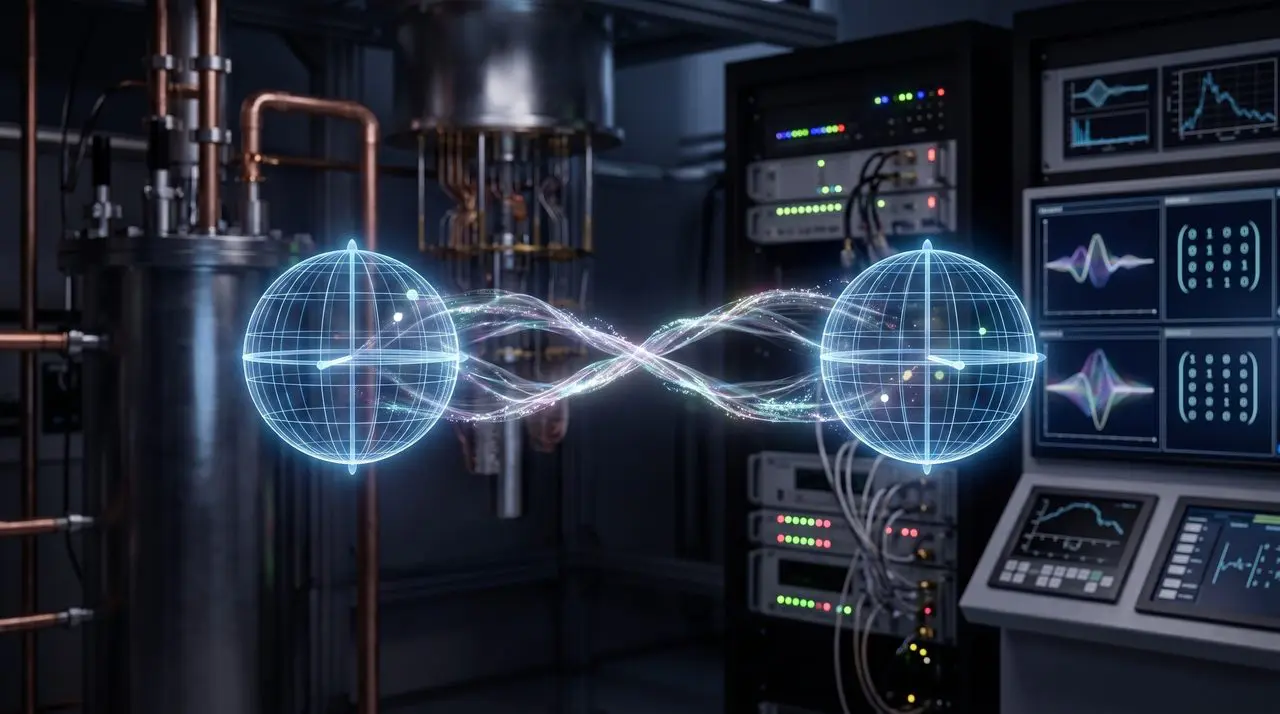
A new method generates entangled pairs of microwaves and optical photons, termed MO-NODE, enabling teleportation-based quantum transduction without associated thermal noise or signal degradation. This scheme utilises either a spin or atomic system coupled to resonant cavities to create these Bell pairs; it functions across diverse physical systems including colour centres, atomic ensembles, and phonon-mediated arrangements. The technique simplifies creating entangled pairs of photons, essential for transferring data between processors within a quantum computer network.
By eliminating pumping requirements, the team enabled more strong devices suitable for future networks designed to connect diverse quantum systems. This innovation simplifies creating entangled pairs of photons; these linked particles are vital resources for transferring data between processors within a future quantum computer network because measuring one instantly reveals something about the other, like two coins flipped at once where heads on one guarantees tails on the other.
The core concept, termed MO-NODE, or Microwave-Optical No-Optical-Drive Entangler, relies on generating these Bell pairs using either spin or atomic systems coupled to resonant cavities, achieving kilohertz-range heralding rates analogous to reliably receiving confirmation that a message has been delivered.
Kilohertz heralded entanglement via a pump-free microwave, optical conversion scheme
Scientists from University of Chicago, alongside collaborators at the USA⁵James Franck Institute and Argonne National Laboratory, have achieved a major leap forward in quantum transduction. Heralding rates now reach the kilohertz range, a substantial improvement over previous methods limited to much lower frequencies. This breakthrough surpasses a vital threshold previously hindering reliable connections between superconducting processors and optical networks.
Earlier systems struggled with signal degradation caused by conventional ‘optical pumping’. The team’s MO-NODE system, or Microwave-Optical No-Optical-Drive Entangler, generates microwave-optical Bell pairs without this problematic process using resonant cavities coupled to either spin or atomic systems.
Published details reveal how their MO-NODE system achieves these kilohertz heralding rates through a pump-free method utilising resonant cavities linked with both spin and atomic systems; across various material platforms, including colour centres, atomic ensembles, and phonon-mediated systems, the assembly consistently delivers high fidelity alongside the improved rate. Specifically, they highlight an amplitude-based scheme where maximal reflection occurs when cavity loss equals internal losses, achieving success probabilities up to 0.5 multiplied by cooperativity squared divided by (cooperativity plus one) squared. Alternatively, employing a phase-shift protocol can yield greater than seventy-five percent probability of Bell pair creation under ideal conditions though at some cost to state fidelity.
Resonant cavity coupling facilitates direct generation of entangled photons
MO-NODE, or Microwave-Optical No-Optical-Drive Entangler, is central to this advance; it generates entangled pairs of microwaves and optical photons without needing an external energy source typically required in similar systems, known as an ‘optical pump’. This is achieved through careful coupling of a spin or atomic system to resonant cavities which are specifically designed structures that amplify certain frequencies of light and microwaves.
These act as intermediaries for creating the linked photon pair. Resonantly linking the spin/atomic system with both microwave and optical cavities created conditions where interactions within the combined setup directly produce entanglement, circumventing limitations imposed by conventional methods reliant on driving the process with additional radiation.
The team employed this approach to generate entangled pairs of microwaves and optical photons, eliminating the need for an external energy source traditionally used in such systems. Utilising spin or atomic systems resonantly coupled to both microwave and optical cavities, structures amplifying specific frequencies of light and microwaves, enables entanglement. It offers advantages over earlier techniques limited by thermal noise from ‘optical pumping’.
Entangled photons generated without optical pumping facilitate future quantum networks
Efficient methods for converting information carried by different types of photons are essential for establishing dependable links between quantum processors and conventional communication networks. This work represents a promising step towards that goal through its pump-free approach to generating entangled microwave and optical photon pairs. The team acknowledges limitations within their current demonstration of entanglement swapping however; achieving high overall efficiency when transferring a quantum state sequentially through multiple stages remains challenging.
Despite these acknowledged difficulties in consistently maintaining high efficiency across numerous quantum state transfers, particularly during sequential data transmission, this pump-free method signifies significant progress. Conventional methods rely on ‘optical pumping’, essentially shining a laser to enable communication. A key benefit is the avoidance of this complication altogether. By creating entangled pairs without external stimulation, issues related to energy loss and signal degradation inherent in pumped systems are sidestepped. This simplifies device construction and reduces potential errors caused by excess heat or signal degradation as demonstrated by the team’s novel approach for generating linked microwave and optical photons without an ‘optical pump’.
The researchers successfully generated entanglement between microwave and optical photons without requiring optical pumping. Avoiding this process simplifies quantum transduction, the conversion of information between different photon types, and potentially improves performance by reducing energy loss and signal degradation. The authors note that maintaining efficiency during sequential quantum state transfers remains a challenge for future work.
👉 More information
🗞 Pump-Free Microwave-Optical Bell Pair Generation for Teleportation-Based Quantum Transduction
✍️ Fangxin Li, Jaesung Heo, Zhaoyou Wang, Benjamin Pingault, Xingyu Gao, Tengyang Ruan, Anjun Chu, David D. Awschalom, Andrew N. Cleland, Andrew P. Higginbotham, Alexander A. High and Liang Jiang
🧠 ArXiv: https://arxiv.org/abs/2609.16364


See today’s quantum computing news on Quantum Zeitgeist for the latest breakthroughs in qubits, hardware, algorithms, and industry deals.