
Photonic Inc. and Microsoft are combining expertise to tackle a critical challenge in scaling quantum computers: accurately estimating the resources needed for complex algorithms. The companies are integrating Photonic’s SHYPS code family, a new approach to error correction, with Microsoft’s Quantum Resource Estimation framework to model qubit counts, runtime, and system overhead in distributed architectures.
“As the industry moves from individual quantum processors toward interconnected, distributed systems, understanding the resources required to run meaningful applications becomes increasingly important,” said Paul Terry, Chief Engineering Officer at Photonic. This collaboration aims to provide a clearer picture of the infrastructure needed for practical quantum applications.
SHYPS Code Reduces Qubit Overhead for Scalable Quantum Computing
Photonic Inc.’s SHYPS code family reduces the qubit overhead needed for large-scale quantum computation, a critical step toward practical applications. The code, a Quantum Low-Density Parity Check (QLDPC) error-correction approach, allows systems to potentially achieve more computational power with fewer physical qubits, addressing a key bottleneck in scaling quantum processors. This advancement is being integrated with Microsoft’s Quantum Resource Estimation (QRE) framework to provide a more accurate picture of the resources required for future quantum algorithms, the company says.
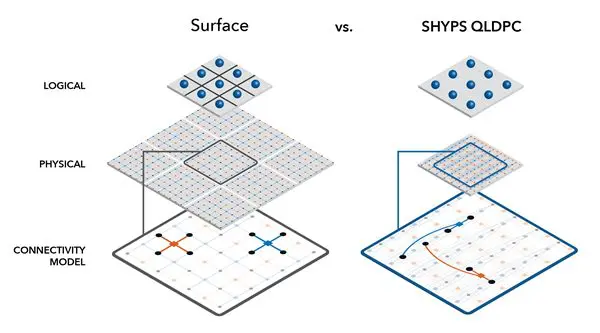
The collaboration between Photonic and Microsoft focuses on understanding how architectural choices and networking requirements impact the scalability of quantum systems. Resource estimates must now account for the complexities of running algorithms across interconnected, modular systems, which the companies are specifically addressing with this combined effort.
The Microsoft Quantum Resource Estimator, an open-source tool, allows developers to benchmark and compare different quantum solutions by assessing the physical resources and runtime needed for specific algorithms. This tool is being used to explore how distributed architectures and advances in error correction, like SHYPS, will influence the future scalability and performance of quantum systems. Photonic’s recent proposal of a $500 million semiconductor facility in Canada, dubbed Project VANGUARD, underscores the company’s commitment to domestic quantum and AI technology manufacturing.
Don Mattrick, appointed CEO in March, is leading the company through a period of growth, backed by over CA$475 million in funding, including a CA$180 million Series B round led by Planet First Partners. Matthias Troyer, Technical Fellow and CVP at Microsoft Quantum, highlighted the broader implications of this work. “Quantum resource estimation helps developers understand the real-world requirements of quantum applications before large-scale quantum computers are available,” he said. This collaborative effort is particularly timely given the industry’s shift toward interconnected systems, where understanding resource allocation across multiple nodes is paramount.
As the industry moves from individual quantum processors toward interconnected, distributed systems, understanding the resources required to run meaningful applications becomes increasingly important.
Paul Terry, Chief Engineering Officer at Photonic



See today’s quantum computing news on Quantum Zeitgeist for the latest breakthroughs in qubits, hardware, algorithms, and industry deals.