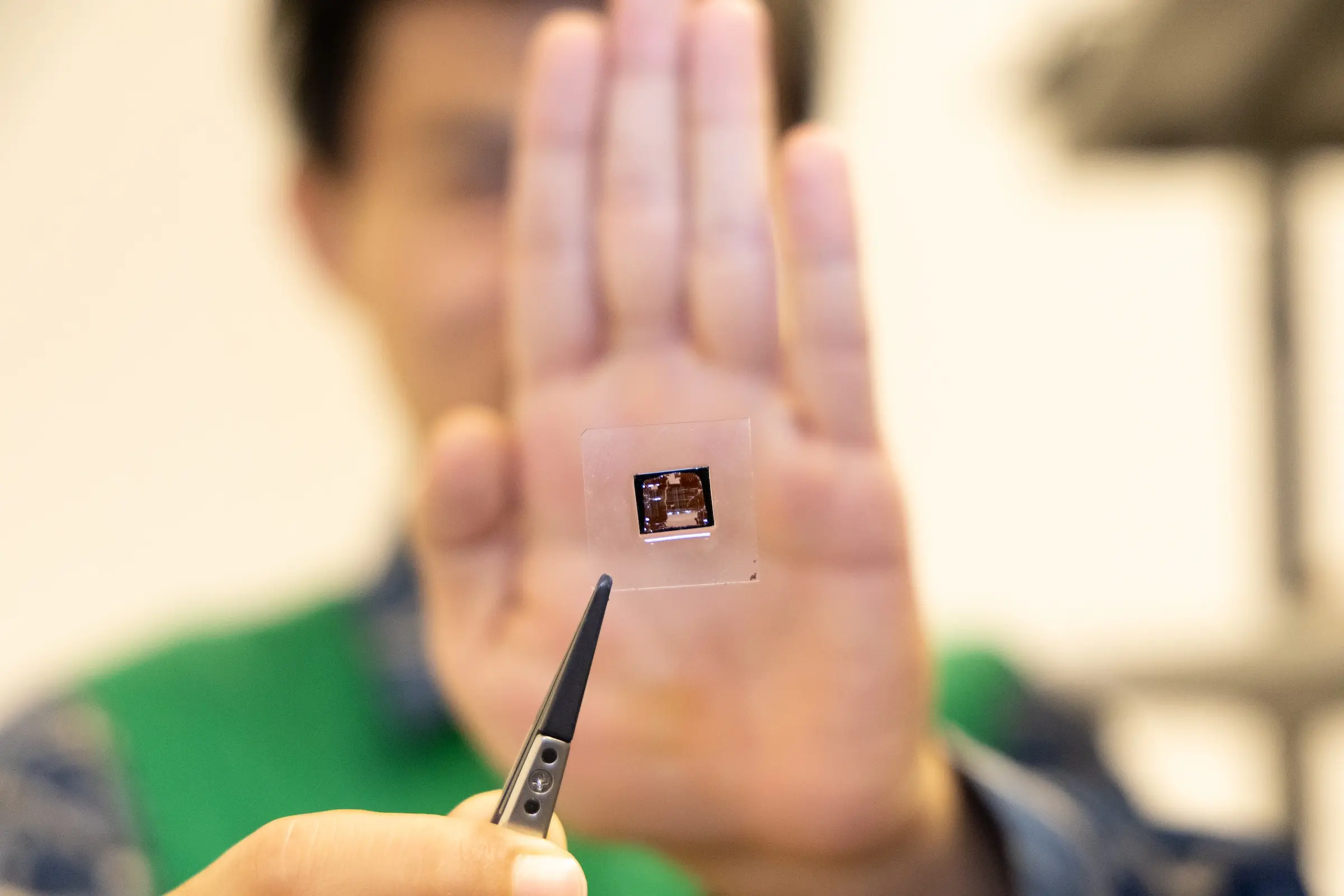
Engineers at the University of Pennsylvania have demonstrated a method for potentially stabilizing quantum networks by imprinting a pattern known as a “skyrmion” onto entangled photons. The team built a chip that generates entangled photons and then polarizes the light of one in a particular way, successfully transferring the skyrmion’s pattern from a single photon to the quantum state shared by both remotely.
Even when entanglement was severed by disruption, the topological property of the skyrmion remained intact. “It’s as if one dancer’s unique movement suddenly became part of a duet,” says Liang Feng, Professor in Materials Science and Engineering and the paper’s senior author. This suggests a new path toward resilient quantum communication.
Chip Fabrication Sustains Skyrmions Beyond Entanglement Disruption
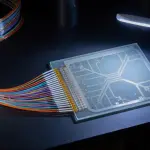
This transfer represents a critical step toward bolstering the resilience of quantum networks, as the topological pattern persisted even after induced disruption severed the initial entanglement between the photons. Haoqi Zhao, a postdoctoral fellow and first author of the research published in Nature Physics, explains the pattern’s robustness with a familiar analogy: “It’s sort of like how regions of hair on your head grow in different directions.” The chip’s architecture was meticulously designed to integrate three key functions: it generates entangled photons, directs their propagation, and then imprints the skyrmion pattern through precise polarization control.
Yichi Zhang, a doctoral student and co-author, details the complexity of this integration, stating, “One part of the chip generates entangled photons, another directs them where they need to go, and still another creates the skyrmion pattern. The challenge was getting all the parts to work together.” The team spent nearly five years refining fabrication techniques within Penn’s Singh Center for Nanotechnology to achieve this level of functional integration, a process demanding precise control at the nanoscale. Researchers then deliberately introduced interference, including extraneous background light, to the entangled photons, observing the expected degradation of the quantum state and eventual loss of entanglement. However, the defining topological property of the skyrmion, the pattern itself, remained remarkably stable, only succumbing to disruption at a significantly higher intensity.
This resilience suggests that topological protection offers a novel pathway for safeguarding quantum information, potentially mitigating the fragility that currently limits quantum communication distances and reliability. Measurements revealed the presence of “quantum discord,” a measure of quantum correlations beyond entanglement, indicating that topological protection may rely on a broader range of quantum effects than previously assumed. This finding opens new avenues for exploring the fundamental interplay between topology and quantum mechanics, potentially leading to the discovery of even more robust methods for encoding and transmitting quantum information.
“This discovery could not only deepen our understanding of quantum physics, but also help us develop new ways to protect quantum information,” Feng adds. Unlike a physical hole, the defining characteristic of a quantum skyrmion isn’t its shape, but rather the pattern of light polarization it embodies.
Zhao elaborates on this concept, noting that the light oscillates in varying directions across the skyrmion, creating a complex pattern analogous to the swirling patterns found in human hair. This pattern encompasses all possible polarization states a fixed number of times, a property that remains unchanged even when individual components of the pattern are disturbed.
The Penn Engineering team’s chip-based approach offers a pathway toward creating compact, scalable devices capable of generating and manipulating these resilient quantum states. The implications of this research extend beyond the immediate goal of improving quantum network resilience; if they can learn to encode information in such resilient patterns, that could lay the groundwork for much more reliable quantum networks.
The team’s work suggests that the future of quantum communication may lie not in simply preserving entanglement, but in using the inherent resilience of topological patterns to safeguard quantum information against the inevitable disruptions of the real world.
We’ve shown that these patterns can survive without entanglement, revealing a deeper role of quantum correlations beyond entanglement in quantum information processing.
Source: https://www.engineering.upenn.edu/stories/quantum-skyrmions-could-help-build-more-resilient-networks

See today’s quantum computing news on Quantum Zeitgeist for the latest breakthroughs in qubits, hardware, algorithms, and industry deals.