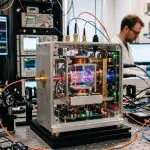
Image shows an array of about 250 gamma-ray transition edge sensors developed at NIST and used in the new study. Credit: NIST
Researchers have achieved accuracy in measuring X-ray emissions from plutonium, uranium, and neptunium using an array of about 250 quantum sensors developed at NIST. This advance allows for more precise filtering of background noise that previously obscured accurate assessment of nuclear materials at power plants and weapons facilities.
“Our measurements support international nuclear safeguards by enabling more precise accounting of material in nuclear facilities,” said Jonathan Dean, a physicist at NIST and the University of Colorado Boulder. By reducing uncertainty in X-ray energy measurements by as much as one-eighth, these ultrasensitive transition edge sensors promise to improve both the efficiency and cost-effectiveness of nuclear monitoring.
Transition Edge Sensors Measure Plutonium, Uranium, Neptunium X-ray Emissions
These sensors, functioning as exquisitely sensitive thermometers, detect minute changes in resistance and current triggered by incoming photons, allowing for precise energy determination. The team’s work focused on the energy range where X-ray emissions from these radioactive elements overlap with gamma-ray signals, a long-standing challenge in accurately assessing nuclear stockpiles. NIST’s sensors distinguish between these overlapping signals, improving the clarity of nuclear material assessments.
The core of the technology relies on superconducting films maintained at temperatures just above absolute zero, a technique NIST has refined over years of research in superconducting materials and quantum sensing. NIST’s expertise in this area extends to multiple qubit technologies, including trapped-ion, neutral-atom, and superconducting circuits, as evidenced by eight patent families currently held.
This sensor array’s sensitivity stems from its ability to detect the energy deposited by individual photons, with three photons triggering a measurable change in the sensor’s electrical properties. “Our instruments are compatible with both approaches,” explained a researcher, referencing the ability to utilize the sensors with different detection methods. The institute’s commitment to advancing quantum measurement is further demonstrated through partnerships with organizations like SRI International, with whom NIST launched the Quantum Manufacturing Engineering Center with an initial $20 million investment.
Researchers from NIST collaborated with colleagues at the University of Colorado Boulder, Los Alamos National Laboratory, Houghton University, and the Kastler Brossel Laboratory at Sorbonne University to publish their findings in Physical Review Letters. This collaborative effort highlights the growing international focus on refining nuclear monitoring techniques.
The ability to filter out X-ray background noise, previously obscuring accurate assessments, is important for verifying compliance with non-proliferation treaties and ensuring the safe handling of nuclear materials. NIST finalized three post-quantum encryption standards on August 13, 2024, demonstrating a broader commitment to securing sensitive data and infrastructure, a capability that complements the enhanced accuracy of nuclear material monitoring.
TES Technology Enables High-Resolution Nuclear Material Isotope Ratios
Precise isotope ratio measurements are now achievable thanks to newly refined X-ray emission data for plutonium, uranium, and neptunium, bolstering international nuclear material accounting. NIST physicists have quantified these emissions with a level of detail previously obscured by background interference, directly impacting stockpile monitoring capabilities and the verification of nuclear fuel cycles. This advancement allows for more rapid and accurate assessments of nuclear material composition, critical for both power plant operation and safeguards against weapons proliferation.
The ability to distinguish between isotopes, variations of an element with differing neutron counts, is central to this improved monitoring. For example, accurately determining the abundance of uranium-235, which comprises only 0.7 % of naturally occurring uranium, is essential for verifying whether a sample is intended for peaceful energy production or weapons development, requiring enrichment to 90% for the latter.
By precisely measuring and subtracting confounding X-ray radiation, transition edge sensors (TES) and other gamma-ray detectors can now more reliably characterize these isotopic ratios. This enhanced precision extends to the efficiency of nuclear power plants as well. Generating electricity from uranium fission requires continuous assessment of fuel composition at each stage of the process, and rapid evaluations are now possible. The NIST team utilized an array of about 250 gamma-ray transition edge sensors in their study, demonstrating the technology’s scalability and potential for widespread deployment.
According to Dean, these faster assessments will be particularly valuable in streamlining operations and reducing costs within the nuclear energy sector. The institute’s work builds upon decades of expertise in superconducting sensor technology, including advancements in trapped-ion and neutral-atom qubit technologies, and is supported by partnerships with organizations like TechCreate Group and General Dynamics Information Technology.
Our measurements support international nuclear safeguards by enabling more precise accounting of material in nuclear facilities.
Jonathan Dean, a physicist at NIST and the University of Colorado Boulder
NIST Quantum Sensors Enhance Nuclear Facility Monitoring Efficiency
The precision of nuclear stockpile assessment received a boost through measurements of plutonium, uranium, and neptunium X-ray emissions, achieved with sensors designed to filter confounding radiation. This advance allows for more reliable determination of a material’s isotopic composition, important for verifying adherence to international safeguards and optimizing nuclear fuel cycles. The team’s work, detailed in Physical Review Letters, directly addresses the challenge of distinguishing gamma-ray signals from obscuring X-ray emissions inherent in these elements.
These sensors operate at temperatures just above absolute zero, using superconducting films to detect minute energy changes. NIST’s expertise in superconducting sensor technology, built over decades, underpins this capability, and the institute is now collaborating with CERN to explore applications beyond nuclear monitoring, including the search for new types of fundamental particles.
The sensors’ ability to rapidly and accurately assess material composition has implications for streamlining operations at nuclear power plants, potentially reducing costs and improving efficiency. Beyond the immediate benefits for nuclear security and energy production, NIST is actively working to broaden the accessibility of this technology. Two U.S. companies have adapted and now manufacture a NIST-designed compact refrigeration system for the sensors, a critical step towards wider deployment.
Further efforts focus on miniaturization and cost reduction, aiming to make the technology more portable and practical for diverse applications. “Measuring the composition more quickly should shorten the hold-up time between steps,” the researchers report, indicating a potential for significant gains in operational speed.
Source: https://nist.gov/news-events/news/2026/09/nist-developed-quantum-sensors-improve-nuclear-monitoring



See today’s quantum computing news on Quantum Zeitgeist for the latest breakthroughs in qubits, hardware, algorithms, and industry deals.