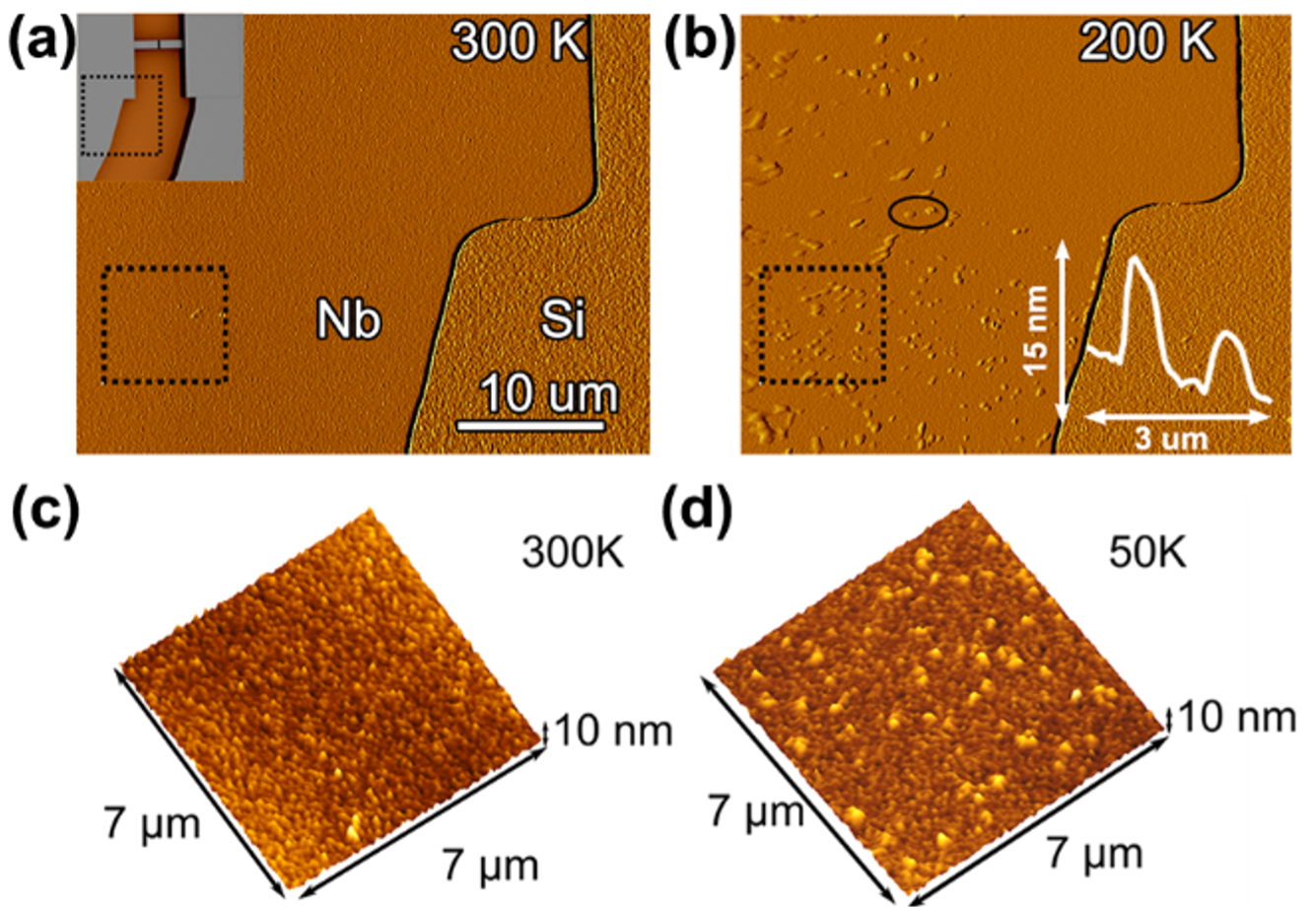
Researchers have directly linked the formation of “hills” observed on niobium superconducting qubits to the presence of niobium hydrides, a newly identified defect that contributes to quantum decoherence. Using atomic-force microscopy, X-ray diffraction, and mass spectrometry, the team pinpointed these hydrides as a specific source of noise limiting how long qubits can store information, a critical challenge in building stable quantum computers. The study, led by Zu Hawn Sung of Fermilab, examined qubits fabricated by Rigetti Computing, revealing that these hydrides commonly form in niobium thin films as devices cool from room temperature to 2 Kelvin. This discovery introduces a previously unaccounted-for source of decoherence, and understanding how these hydrides form may allow scientists to engineer materials that operate with fewer errors, ultimately improving the accuracy of quantum calculations.
Niobium Hydrides Identified as Decoherence Source in Superconducting Qubits
The emergence of distinct “hills” on the surface of niobium qubits at cryogenic temperatures has revealed a previously overlooked source of decoherence, limiting the potential of superconducting quantum computers. Researchers observed these features forming as qubits cooled from room temperature to 2 Kelvin, prompting a detailed investigation into their composition and impact on qubit stability. This was not merely surface contamination; a combination of atomic-force microscopy, X-ray diffraction, and time-of-flight secondary ion mass spectrometry definitively identified these structures as niobium hydrides, a defect that introduces unwanted noise into quantum calculations. The research team explained that identifying this type of defect allows scientists to work to prevent niobium hydrides from forming in materials, highlighting the potential for material engineering to mitigate the problem.
Addressing this issue involves refining fabrication processes to better control the gases qubits encounter and potentially introducing strategic impurities to sequester hydrogen, thereby reducing hydride formation. Zu Hawn Sung of Fermilab notes that this insight extends beyond quantum computing, promising improvements in the sensitivity of superconducting quantum sensors used to measure electric, magnetic, and gravitational fields. With less noise disrupting qubit coherence, researchers anticipate running larger, more accurate calculations, unlocking the full potential of quantum computation across diverse fields like chemistry, physics, and cybersecurity.
Multi-Technique Analysis Reveals Defect Formation During Qubit Cooldown
The pursuit of stable qubits, the fundamental building blocks of quantum computers, currently centers on minimizing decoherence, the loss of quantum information, caused by imperfections in superconducting materials. While material science has steadily improved qubit coherence times, the precise origins of this noise have remained elusive; researchers have long sought to pinpoint the specific defects responsible for limiting qubit performance. These hydrides, formed during the cooling process, manifest as “hills” observed in atomic force microscopy images at cryogenic temperatures, indicating a structural change within the material. Complementary time-of-flight secondary ion mass spectrometry confirmed an increase in hydrogen concentration concurrent with the appearance of the “hills”, while X-ray diffraction verified the formation of niobium hydride crystal phases. The study notes that the size, location, and density of these niobium hydrides can vary as researchers cool devices from room temperature, suggesting a dynamic process influencing qubit behavior.
This discovery offers a pathway toward mitigating decoherence through targeted material engineering. By adjusting fabrication processes to control gas exposure and potentially introducing impurities to sequester hydrogen, scientists hope to limit hydride formation and improve qubit stability.
Now that scientists have identified this type of defect, they can work to prevent niobium hydrides from forming in materials.




See today’s quantum computing news on Quantum Zeitgeist for the latest breakthroughs in qubits, hardware, algorithms, and industry deals.