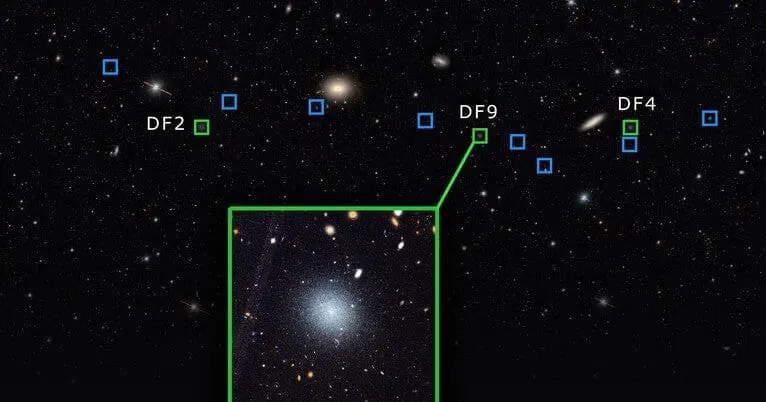
Yale astronomers have identified a third galaxy, NGC-DF9, located 67 million light-years from Earth, that appears to lack dark matter, a theorized invisible material essential to most galaxy formation. This discovery joins previously identified DF2 and DF4, and all nine galaxies including DF9 now appear aligned in a straight line. Researcher Michael Keim, a Ph. D. student in astrophysics at Yale’s Graduate School of Arts and Sciences, stated that a line of galaxies lacking dark matter has never been seen before. Researchers propose a violent collision separated gas from dark matter, allowing DF9 to form solely from ordinary matter, offering a new window into the nature of dark matter itself. This finding challenges existing assumptions about how galaxies form and suggests dark matter can act independently of normal matter.
DF9 Joins DF2 & DF4: Discovery of Third Dark Matter-Free Galaxy
This discovery, detailed in The Astrophysical Journal, follows the earlier identification of DF2 and DF4 as similarly deficient in the invisible substance thought to constitute the majority of the universe’s mass. Researchers determined DF9’s mass by measuring the velocities of stars within it, finding a total of 100 million solar masses, consistent with the visible matter alone. This contrasts sharply with the expected mass of over 10 billion solar masses if dark matter were present, reinforcing the anomaly. The team, led by Pieter van Dokkum, utilized the W. M. Keck Observatory’s Cosmic Web Imager in Hawaii to analyze the faint light emitted by DF9, initially misidentifying it as a supermassive black hole.
This careful analysis revealed the galaxy’s unique composition and confirmed its place among the dark matter-free galaxies. Keim suggested that until now, it was assumed galaxies formed within pools of dark matter called “halos,” but this system demonstrates stars and galaxies can arise outside these halos during extreme events. This challenges theories positing dark matter as a modification of gravity, supporting the idea that it is a physical substance capable of independent action. The team is now seeking residual gas from the initial collision using telescopes including the newly established Mothra telescope, hoping to further refine their understanding of this unusual galactic formation process.
This system shows that stars and galaxies can form outside of dark matter ‘halos’ in extreme events and indicates that dark matter is a physical substance that can act independently of normal matter or gas, challenging alternative theories that dark matter is gravity.
Cosmic Web Imager Confirms DF9’s Low Mass & Stellar Composition
The confirmation of DF9’s composition relied on observations from the W. M. Keck Observatory. This galaxy joins DF2 and DF4 in a peculiar alignment, forming a straight line with seven other galaxies, a configuration that has prompted a re-evaluation of galaxy formation processes. The team proposes a violent collision as the catalyst for this unusual formation, suggesting the impact stripped gas from dark matter, allowing the gas to coalesce into new galaxies along a linear path. The existence of galaxies forming independently of dark matter supports the idea that dark matter is a distinct physical substance, capable of separating from ordinary matter during extreme events. Further observations, including those utilizing the new Mothra telescope, are planned to search for residual gas from the initial collision and refine this emerging picture of galaxy evolution.
They found that DF9 has the mass of 100 million suns – which is consistent with the expected amount of visible matter in a galaxy of its size – and nothing else.
Galaxy Collision Theory Explains Linear Arrangement of Dark Matter-Poor Galaxies
NGC-DF9, a dwarf galaxy situated 67 million light-years away, has become the third known galaxy to exhibit a striking absence of dark matter, joining DF2 and DF4 in challenging conventional cosmological models. This discovery, reported in The Astrophysical Journal, extends beyond individual anomalies; researchers have identified a distinct alignment, with nine galaxies, including DF9, appearing to form a straight line across vast cosmic distances. This process, illustrated in artist renderings, accounts for the linear configuration and the shared characteristic of dark matter deficiency among DF2, DF4, and now DF9.
A line of galaxies lacking dark matter has never been seen before.



See today’s quantum computing news on Quantum Zeitgeist for the latest breakthroughs in qubits, hardware, algorithms, and industry deals.