David Deutsch, a British physicist, gave the field its definition of quantum computation. He did it in 1985, more than a decade before anyone built a machine that worked. He has never built one himself. His argument was that the laws of physics, and not the rules of mathematics, settle what can be computed, and that claim sits underneath almost everything the field has done since. It reaches a long way past the design of quantum algorithms. He set out the theory of a universal quantum computer, a machine that can run any computation a classical machine can, and some of them enormously faster.
Deutsch’s work isn’t simply about faster calculations. It is about redefining what computation is, and in doing so, challenging our understanding of reality itself. He was among the first to take seriously the consequences of quantum mechanics for information processing, leading to insights that continue to shape the field today. He argued the case in mathematics and in philosophy, and the two halves matter to him equally. That is why quantum computing has a foundational literature at all, rather than a stack of engineering results with nothing underneath.
Early Life, Education, and the Seeds of Quantum Inquiry
Born in Haifa on 18 May 1953, David Deutsch read natural sciences at Clare College, Cambridge. He then moved to the University of Oxford, where he took a doctorate in theoretical physics in 1978, and his supervisors were the cosmologist Dennis Sciama and Philip Candelas. He has never really left Oxford. He is now a visiting professor in the Department of Atomic and Laser Physics at the Centre for Quantum Computation, in the Clarendon Laboratory, and an honorary fellow of Wolfson College.
Deutsch came at computing from philosophy. He wasn’t initially focused on building computers; rather, he was grappling with the fundamental implications of quantum theory, particularly the nature of parallel universes and the limits of classical computation. This philosophical bent, coupled with a deep understanding of physics, would become a defining characteristic of his approach to quantum computing.
The Deutsch Algorithm: First Quantum Speedup and the Birth of Quantum Computation
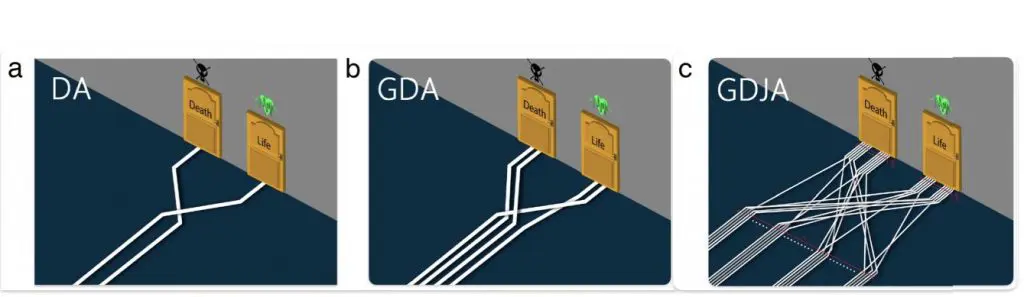
The paper was Quantum theory, the Church-Turing principle and the universal quantum computer, and it ran in the Proceedings of the Royal Society A on 8 July 1985. Most of it is about the machine, not the algorithm. Near the end Deutsch gives a small example of something such a machine could do, and that example is now called the Deutsch algorithm. It asks whether a one-bit function is constant, giving the same answer for both inputs, or balanced, giving a different answer for each. A classical machine that has to be sure must look at both inputs. A quantum machine can settle it by looking once. As Deutsch first wrote it the trick worked only half the time, and the version that always works on a single call came later, from Richard Cleve and colleagues in 1998. The problem is of no use to anyone. What mattered was the principle, and the principle was new. The method turns on superposition. The machine is put into a state that depends on both inputs at once, and the two branches are then made to interfere so that the answer falls out of a single measurement. It is not that the machine checks both inputs and hands back both results, because interference throws away everything except the one bit you asked for.
In plain terms, a single qubit is prepared in an equal mix of the state labelled zero and the state labelled one. That mix, and what interference does to it, is the whole trick.
This initial superposition state is then manipulated through a quantum oracle, representing the function to be evaluated, and finally measured to determine the function’s properties. The Deutsch algorithm, though limited in scope, established the possibility of quantum speedup and started the field, but it did not show that a quantum computer can answer questions a Turing machine cannot. Deutsch was explicit about that in the same paper, writing that the remarkable properties of such machines “do not include the computation of non-recursive functions”. The gain is speed, not reach. It comes on particular problems and does not widen the class of answerable questions.
The Deutsch-Jozsa Problem: Expanding the Boundaries of Quantum Advantage
Building upon his initial work, Deutsch, in collaboration with Richard Jozsa, formulated the Deutsch-Jozsa problem in 1992, and that one, while still contrived, provided a more substantial demonstration of quantum advantage. The question is the same, constant or balanced. The function now takes a string of bits rather than a single bit. A classical method that has to be certain may need to check more than half of all the possible inputs. That count doubles with every bit added, so the work grows exponentially, while a quantum algorithm settles it with certainty after very few calls to the function. Two things are usually left out of the telling. The one-call version is a 1998 refinement by Richard Cleve, Artur Ekert, Chiara Macchiavello and Michele Mosca, because the 1992 original used two calls. The bigger omission concerns classical machines that are allowed to guess. One that may be wrong now and then does not need exponential work at all, because a handful of random inputs gives the right answer with overwhelming probability. The exponential gap is against classical methods that must never err. The quantum circuit for this problem starts by putting every possible input into the register at once.
The register of qubits is prepared so that every possible input string is present in the state at the same weight. One call to the function then stamps a sign on each of those branches, and a second layer of interference collects the signs into a single readout.
where n is the number of input bits. Calling that state a sample of every input at once is a picture rather than a mechanism. What produces the answer is interference between the branches, which cancels everything except the property being asked about. That is where the exponential speedup comes from, and it holds only against classical methods that must be certain. The result still mattered a great deal. It gave the field a separation it could prove. The algorithms that followed, Simon’s and Shor’s in 1994, were built on the same idea of arranging interference so that a global property of a function shows up in one reading.
Constructor Theory: A Radical Reimagining of Physical Laws
Since 2012 most of Deutsch’s effort has gone somewhere else. Constructor theory, which he develops with the Oxford physicist Chiara Marletto, is an attempt to rewrite the laws of physics in a different grammar. Ordinary physics hands you a starting state and an equation of motion, then works out what happens next. Constructor theory drops both. It states instead which transformations of a physical system can be brought about, which cannot, and why.
A constructor, in the theory’s vocabulary, is any device that can bring about a change and then remain able to do it again. A catalyst is one. So is a machine tool, and so is a living cell. The point of the reframing is that some of the deepest statements in physics already have this shape. The second law of thermodynamics and the no-cloning theorem both say that a certain job cannot be done at all. Deutsch and Marletto set out the information side of it in Constructor theory of information, published in the Proceedings of the Royal Society A in 2015. That paper tries to define information from physical impossibility rather than the other way round.
The work has kept going. Deutsch and Marletto posted Constructor theory of time in May 2025 and revised it in June 2026. It argues that laws written this way need make no reference to time, and then has to explain how duration comes back at all. In June 2026 Marletto, Deutsch and Vlatko Vedral posted Tests of constructor theory, a review of the experimental proposals the principles have generated. That is the honest state of play in 2026. Proposals exist, several of them built on witnessing non-classical behaviour in systems too heavy for ordinary quantum control, and no experiment has yet confirmed a prediction that only constructor theory makes.
The Many-Worlds Interpretation and Quantum Parallelism
Deutsch is an unusually committed Everettian and has been since his doctorate, so on that reading there is no collapse of the wavefunction and no special status for a quantum measurement. The equations are taken at face value. The outcomes that did not happen to us are held to be as real as the one that did, in branches that have stopped interfering with ours. Deutsch treats that as the explanation of quantum parallelism, the reason a quantum computer gets at answers a classical one cannot reach as quickly. His stronger claim, and it is his rather than the field’s, is that a working quantum computer is evidence for the multiverse. In The Fabric of Reality he puts it to his opponents as a dare, writing “To those who still cling to a single-universe world-view, I issue this challenge: explain how Shor’s algorithm works.”
That is Deutsch’s position and it should be read as his, not as settled physics. Most physicists do not follow him to the conclusion, and many decline to choose an interpretation at all. The reason the argument cannot be closed by experiment is simple. Every interpretation predicts the same measurement statistics. No run of a quantum computer can tell Everett’s reading apart from the others. The many-worlds account has an unfinished problem of its own. It has to say where probability comes from when every outcome occurs, and Deutsch wrote a paper in 1999 trying to derive the Born rule from decision theory. That derivation is still argued over.
The Universal Quantum Computer and the Turing Limit
The central object of the 1985 paper is the universal quantum computer. It is worth being careful about what it does and does not beat, because this is the point most often got wrong. A quantum computer can compute exactly the same set of functions as a Turing machine and not one function more. What changes is how long some of them take. What Deutsch actually argued was that the Church-Turing thesis conceals a claim about physics. He stated it as a principle, that “every finitely realizable physical system can be perfectly simulated by a universal model computing machine operating by finite means”. Classical physics and the ordinary Turing machine fail that test, one being continuous and the other discrete. A quantum machine passes it. That is what opens up problems such as factoring large numbers, which matters for cryptography, and simulating complex molecular interactions.
The UQC relies on the principles of quantum entanglement and superposition to work in a way no classical machine can copy cheaply. It is tempting to say the machine searches an exponentially larger space. The picture is wrong. The state does carry an exponential number of amplitudes, but a measurement returns only one string of bits. A quantum algorithm earns its speed by arranging interference so that the wrong answers cancel before anybody looks, which is why useful quantum algorithms are rare and hard to find.
The Fabric of Reality and Deutsch’s Four Strands
Deutsch made his wider case for a general readership in The Fabric of Reality, published by Viking in 1997. The book argues that four separate theories, each the best explanation in its own field, together make one account of what the world is like. He calls them the four main strands. The claim is not that they are compatible. It is that none of the four can be properly understood without the other three.
In the closing chapter he names them as “the quantum physics of the multiverse, Popperian epistemology, the Darwin-Dawkins theory of evolution and a strengthened version of Turing’s theory of universal computation”. Chapter one gives the same four by subject rather than by author, as quantum physics, epistemology, the theory of computation and the theory of evolution, with the chapters in which each is developed. Deutsch writes that the connections run deep enough that “it has become impossible to reach our best understanding of any one of them without also understanding the other three”.
Take them one at a time. Karl Popper’s epistemology holds that knowledge grows by conjecture and refutation, never by piling up observations until a law falls out of them. What counts on that view is the quality of an explanation rather than the accuracy of a forecast, so a theory that predicts well and explains nothing is a poor one. Charles Darwin comes next. His account of evolution, in the gene-centred form Richard Dawkins gave it, says adaptation is built by replicators that copy themselves with variation and are sifted by what survives. Hugh Everett is the third. His reading of quantum mechanics says the equations mean exactly what they say, so the outcomes that did not happen here are just as real as the one that did. Turing is the fourth. His theory of computation says one machine can imitate any other, and Deutsch’s strengthened version makes that a fact about physics rather than about mathematics.
What ties the four together, for Deutsch, is not subject matter. It is a shared fate. Each is the prevailing theory in its field and is used every working day, and each is still widely treated as a calculating device rather than as a description of anything real. He makes the point sharpest about Everett, noting that the basis of Everett’s innovation “was not a claim that the prevailing theory is false, but that it is true”. Deutsch argues that the same pattern holds in the other three fields, where the best available theory is applied constantly by working scientists and yet believed only halfway. Taking all four literally, rather than instrumentally, is what produces a single picture.
The connective tissue is specific. It is the part a summary loses. Turing’s principle, in Deutsch’s strengthened form, makes computation a branch of physics, because what can be computed depends on what the laws of nature let a machine do. Everett then supplies the place where the computation happens. That is why Deutsch puts the multiverse question to his opponents as a challenge about Shor’s algorithm rather than as a matter of taste. Popper supplies the test of what counts as a good explanation. Evolution supplies the mechanism, since knowledge has to be created somewhere in the physical world, and variation with selection is the only process known that does it.
The objection is not that any strand is absurd. It is that the unification is philosophical rather than empirical, because combining four theories into one picture does not by itself predict anything the four do not predict separately. No experiment has been proposed that would come out one way if Deutsch is right about the unification and another way if he is wrong about it. Three of the four are contested inside their own fields as well. Everett’s interpretation is a minority view among physicists. Popper’s account of science has been attacked for decades. The philosophers doing the attacking think falsification does not describe what scientists actually do. The gene-centred view of evolution has never been the only one on offer in biology. Turing’s theory is the least contested of the four, though the strengthened version Deutsch needs is not the textbook one.
The Beginning of Infinity, published in 2011, extends the argument rather than replacing it. Deutsch leans hardest on the Popperian strand there, arguing that good explanations are the ones that are hard to vary and that the reach of knowledge has no natural limit. The four strands are still the frame.
Quantum Annealing and Adiabatic Quantum Computation: Alternative Approaches
While Deutsch championed the gate-model quantum computer, other approaches have emerged. Quantum annealing, pioneered by D-Wave Systems, uses quantum fluctuations to find the minimum energy state of a system, effectively solving optimization problems. Adiabatic quantum computation, a related approach, relies on slowly evolving a quantum system from a known initial state to a final state that encodes the solution to the problem. These approaches differ from the universal machine in how they are built and in how a problem is posed to them. What they share is the aim of using quantum mechanics to attack problems that defeat ordinary computers. Deutsch acknowledges the potential of these alternative approaches. He maintains that the UQC represents the most general and powerful form of quantum computation.
Quantum Error Correction: Safeguarding Quantum Information
A major challenge in building a practical quantum computer is the fragility of quantum information. Quantum states are susceptible to noise and decoherence, which can corrupt the computation. Quantum error correction (QEC) is the answer to that. It spreads one logical qubit across many physical ones, so that an error can be found and undone without anyone reading the encoded state and wrecking it. The foundations here are not Deutsch’s, and the piece is often told as though they were. Peter Shor published the first quantum error-correcting code in 1995 and Andrew Steane published another in 1996, while what Deutsch supplied was the model of computation those codes are written for.
The Role of Entanglement: A Spooky Action at a Distance
Quantum entanglement, famously described by Einstein as “spooky action at a distance”, is one of the resources a quantum computer draws on. Entangled qubits are correlated so tightly that neither has a state of its own. The distance between them makes no difference. That correlation is a large part of why a quantum machine is expensive to simulate classically, though it does not follow that every quantum algorithm needs it. Deutsch’s original algorithm uses a single query qubit, so there is no entanglement in it to speak of, and the work is done by interference effects that lead to speedups. Deutsch’s understanding of entanglement and its role in quantum computation has been instrumental in the development of quantum information theory.
Where Quantum Computing Actually Stands
Quantum computing is still early. Real progress has been made on building and controlling qubits, and the hard parts have stayed hard. The unsolved problems cluster around decoherence, error correction, and qubit connectivity.
Several companies, including Google, IBM, and Rigetti, are actively pursuing different qubit technologies, including superconducting qubits, trapped ions, and photonic qubits. Machines can now be rented by the hour. None of them has yet solved a problem of practical value that a classical computer could not have solved. The distance between a physical qubit and a reliable logical one is what sets the timetable.
Key Industry Players and Commercial Leaders
The field is crowded now, and the companies in it are betting on very different hardware. IBM has been a pioneer in superconducting qubits, offering cloud-based access to its quantum processors. Google has also made significant strides in superconducting qubit technology, demonstrating quantum supremacy in 2019 (though this claim has been debated). Rigetti Computing is another key player in the superconducting qubit space, focusing on building scalable quantum processors. IonQ is a leading company in trapped ion quantum computing, offering high-fidelity qubits with long coherence times. Around the hardware makers sits a second tier of software firms and service providers selling tools for writing and running quantum programs. Almost none of them has a business that survives if the hardware stops improving.

The Future of Quantum Computation: A Transformative Technology
The case for the future rests on error correction working at scale, and that has not been proved yet. If it does work, the fields most often named are drug discovery, materials science, financial modelling and artificial intelligence. A fault-tolerant universal machine would deliver computational power of a kind nobody has had before, though whether that arrives this decade is an open question, and the honest answer is that nobody knows. What is settled is the theory of the thing, and the theory is Deutsch’s.
Deutsch’s Legacy: A Reimagined Reality
David Deutsch’s legacy extends beyond the technical achievements of quantum computing, and he has fundamentally challenged our understanding of computation, physics, and the nature of reality itself. His work has demonstrated that quantum mechanics is not merely a description of the microscopic world, but a powerful tool for information processing and a gateway to a deeper understanding of the universe. His actual claim runs the other way round. The limits of computation are set by the laws of physics, and showing that was the work. The recognition has come steadily. He took the Institute of Physics Paul Dirac Medal and Prize in 1998 and was elected a Fellow of the Royal Society in 2008. He shared the ICTP Dirac Medal in 2017 with Charles Bennett and Peter Shor, then the Micius Quantum Prize followed in 2018 and the Institute of Physics Isaac Newton Medal in 2021. In 2023 he shared the three million dollar Breakthrough Prize in Fundamental Physics with Bennett, Gilles Brassard and Shor, for what the citation calls “foundational work in the field of quantum information”.
He still publishes. The constructor theory papers of 2025 and 2026 are current work rather than a retrospective, and the programme he set out in 1985 is still the one the field is trying to finish.
Deutsch laid down the universal quantum Turing machine in 1985. For how that fits the wider arc, see our long-form history of quantum computing.
Further reading on David Deutsch: David Deutsch’s personal site, the original source on the David Deutsch quantum computer programme covers his books, papers, and Constructor Theory work directly. See also the 1985 Royal Society paper on the universal quantum computer for the original formulation, and the 1992 Deutsch-Jozsa paper for the generalisation.



See today’s quantum computing news on Quantum Zeitgeist for the latest breakthroughs in qubits, hardware, algorithms, and industry deals.