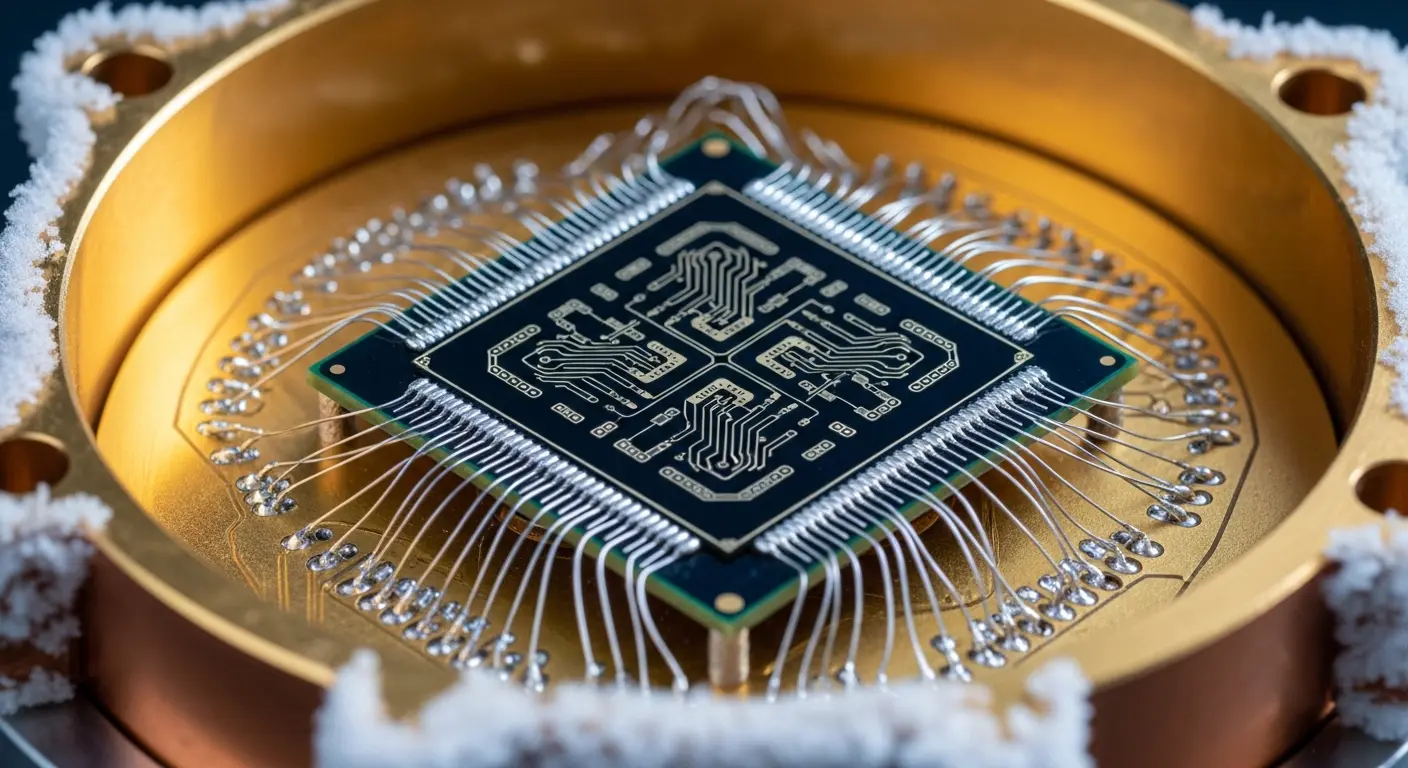
Researchers have achieved a 400 MHz bandwidth in Josephson mixers, a substantial leap overcoming a key limitation that previously restricted the processing of frequency-multiplexed signals essential for scaling up quantum processors. These redesigned mixers, based on a Josephson ring modulator and incorporating coupled-mode networks, not only broaden signal handling capacity but also exhibit power reflections above 10 dB, indicating strong signal preservation during amplification, critical for maintaining the integrity of quantum information. The team demonstrated a saturation power of about -110 dBm at 15 dB, representing a significant increase in the signal strength these mixers can manage before performance declines. Such nondegenerate Josephson mixers with enhanced bandwidths and saturation powers could serve in a variety of frequency-multiplexed settings, including high-fidelity qubit readout, unidirectional routing of quantum signals, and the generation of remote entanglement with continuous variables, enabling more complex and powerful quantum systems.
Josephson Ring Modulators Enable Phase-Preserving Quantum Operations
Researchers have long sought to overcome the inherent limitations of resonator-based Josephson mixers, devices vital for amplifying and converting quantum signals without destroying the delicate quantum information they carry. The team’s redesigned Josephson ring modulators (JRMs) address this challenge by optimizing the device’s internal inductances to minimize unwanted mixing products and carefully engineering the electromagnetic environment surrounding the modulator. This innovative approach utilizes lumped-element coupled-mode networks, strategically positioned between the JRM and the ports of the mixer, to enhance performance. Preservation of phase information is paramount, as any loss of phase coherence would introduce errors into quantum computations; this metric is particularly important for practical quantum applications, where weak signals must be amplified without introducing excessive noise.
A separate, low external quality factor resonant-mode JRM operated in conversion mode reached a maximum bandwidth of 670 MHz, coupled with power reflections below -10 dB and a saturation power of about − 86 dBm at − 17 dB. The ability to coherently amplify weak signals and convert their frequencies with minimal added noise is fundamental to analog quantum information processing, and these JRMs represent a significant step towards realizing more complex and powerful quantum systems. The researchers note that amplifying weak coherent signals with minimum added noise and converting their frequencies coherently without loss are two elementary and useful operations in the toolbox of analog quantum information processing, underscoring the foundational role of these devices in the field.
Lumped-Element Networks Enhance JM Bandwidth and Saturation
Recent advances in superconducting quantum computing have increasingly focused on scaling up the number of qubits, a challenge complicated by the limitations of existing signal amplification and transduction technologies. Josephson mixers (JMs), favored for their ability to amplify quantum signals with minimal noise and coherently convert frequencies, have historically struggled with narrow bandwidths and insufficient saturation power, impeding their use in systems requiring the processing of frequency-multiplexed signals. These constraints have presented a significant bottleneck in the development of larger, more complex quantum processors, as they restrict the amount of information that can be simultaneously handled. Researchers have now addressed these longstanding challenges through a redesign of the Josephson ring modulator (JRM), the core of the JM, and its surrounding electromagnetic environment. The team implemented capacitively coupled lumped-element LC resonators between the JRM and the device’s ports, effectively engineering the electromagnetic environment to optimize performance.
This approach allows for suppression of unwanted higher-order mixing products, a common source of signal degradation. The result is a substantial increase in both bandwidth and saturation power, critical for handling the complex signals expected in advanced quantum systems. Specifically, measurements on JMs with four coupled modes per port revealed bandwidths of about 400 MHz (700 MHz) with power reflections above 10 dB and saturation powers of about − 110 dBm at 15 dB ( − 91 dBm at − 26 dB). This result, however, signifies strong signal preservation during the amplification process, crucial for maintaining the delicate quantum information encoded within the signal.
Measured JM Performance: 400-700 MHz Bandwidth & Power Levels
Researchers are pushing the boundaries of quantum signal amplification with redesigned Josephson mixers, devices critical for scaling up the complexity of quantum processors. By implementing these strategies, measurements for JMs realized with four coupled modes per port, operated in amplification and conversion modes, show bandwidths of about 400 MHz (700 MHz) with power reflections above 10 dB and saturation powers of about − 110 dBm at 15 dB ( − 91 dBm at − 26 dB). This high reflection suggests minimal degradation of the quantum information carried by the amplified signal, a crucial factor for maintaining the delicate coherence required for quantum operations, as the researchers state. These results suggest a versatile design capable of operating effectively across a range of conditions and applications, potentially enabling more complex and robust quantum systems.
Nondegenerate JMs for Frequency-Multiplexed Quantum Systems
The demand for increasingly complex quantum processors is driving innovation in the handling of quantum information, and a critical bottleneck has been the ability to efficiently process signals carrying multiple qubits simultaneously. Traditional Josephson mixers (JMs), essential for amplifying and converting these signals, have struggled with limited bandwidth and saturation power, hindering their use in frequency-multiplexed systems. Recent advances, however, demonstrate a pathway toward overcoming these limitations with redesigned nondegenerate JMs capable of handling significantly more complex quantum states. This design allows for the suppression of unwanted higher-order mixing products, effectively cleaning up the signal and improving clarity. The result is a measured bandwidth of about 400 MHz (700 MHz) with power reflections above 10 dB and saturation powers of about − 110 dBm at 15 dB ( − 91 dBm at − 26 dB). Surprisingly, these improvements haven’t come at the cost of signal integrity.
While lower reflection is generally desired in amplification circuits, this high value suggests the redesigned JMs are exceptionally effective at maintaining the delicate quantum coherence of the amplified signal. The ability to coherently convert frequencies without loss, as enabled by the JRM, remains a fundamental advantage, and these redesigned JMs are poised to enable new possibilities in analog quantum information processing.


See today’s quantum computing news on Quantum Zeitgeist for the latest breakthroughs in qubits, hardware, algorithms, and industry deals.