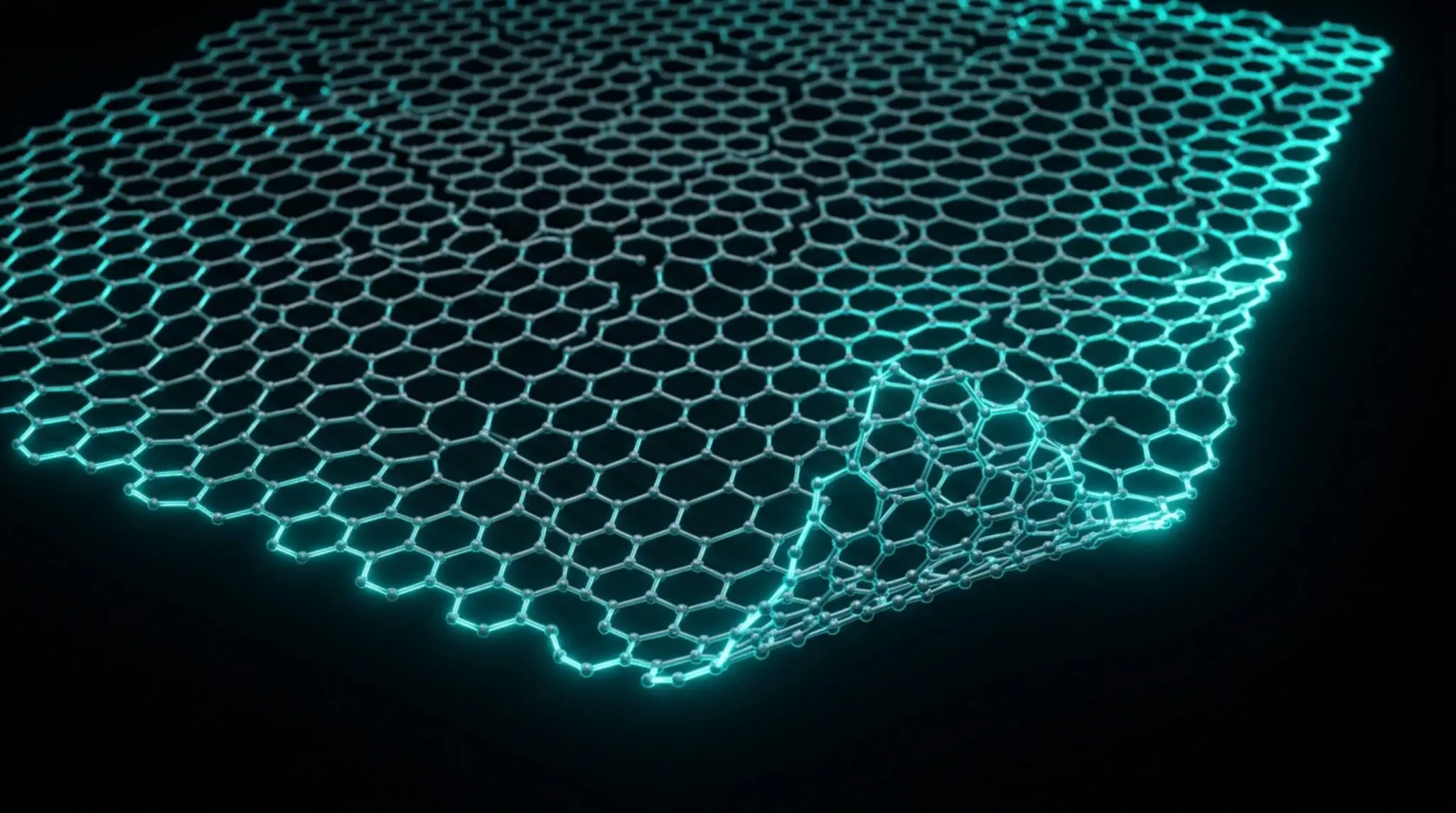
Researchers have demonstrated complete suppression of superconductivity in magic-angle twisted bilayer graphene (TBG) through tunable electrostatic screening, achieving variations in critical temperature by more than an order of magnitude. The work challenges existing theories surrounding the unconventional origins of superconductivity in this material, where the maximum of the critical temperature T C roughly coincides with the 1.1° twist angle between graphene layers where the flattened energy bands maximize electron-electron interactions.
Previous studies yielded conflicting results; V-shaped differential conductance in tunnelling spectra supported unconventional pairing, while experiments employing graphite gates pointed towards phonon-mediated superconductivity. The gates were separated by thin (6-10 nm) hexagonal boron nitride (hBN) spacers. Researchers found that the screening suppressed correlated insulator (CI) states, while superconductivity persisted. However, differing behaviors of CI and superconductivity in these experiments could arise from variations in twist angle between different devices, with superconductivity surviving in a broader range of twist angles, complicating interpretation.
It was impossible to measure the change of the superconducting critical temperature T C induced by the screening within a single device, as the screening was generally fixed by graphite’s density of states and by the thickness of the dielectric spacer, while devices with different spacers inevitably had different twist angles. This new approach utilizes stacked TBG layers with a high twist angle to maximize screening efficiency and explore the underlying pairing mechanism.
Magic-Angle TBG and Cuprate Superconductor Resemblance
The critical temperature peak in magic-angle twisted bilayer graphene (TBG) closely aligns with the 1.1° twist angle maximizing electron-electron interactions, a coincidence that initially suggested a connection to the pairing mechanisms observed in cuprate superconductors. This observation fueled speculation that similar, strongly correlated electron behavior might underpin superconductivity in both materials, prompting intensive investigation into TBG’s unusual phase diagram.
These layers were strategically implemented to decouple the two TBG layers and suppress correlated insulator states, a phenomenon previously observed in similar materials; however, superconductivity was maintained, challenging expectations that suppressing insulating behavior would necessarily eliminate the superconducting state. The decoupling was confirmed by the absence of moiré imprinting signatures, indicating the layers were effectively isolated from each other’s electronic structure. This decoupling allowed for precise control over carrier density in each layer, enabling researchers to probe the conditions necessary for sustaining superconductivity.
The sensitivity of TBG superconductivity to proximity screening, the influence of the top layer’s electronic properties, presented a puzzle, as the superconducting state diminished when the carrier density in the top TBG layer increased. This effect was particularly pronounced when the distance between the screening layer and the magic-angle TBG was minimized to sub-nanometer scales, an order of magnitude smaller than in previous experiments.
The team believes this close proximity is key, noting that screening efficiency decays exponentially over a characteristic distance of approximately 2 nanometers, demanding a high level of electrostatic control to maintain superconductivity. The interlayer screening term, β, is dependent on this distance, becoming proportional to the dielectric constant of the top layer when the separation approaches zero. The observed suppression of superconductivity through screening led researchers to consider conventional phonon-mediated pairing mechanisms, but the results do not support this explanation.
The team found that the results do not support a reversed proximity effect, where the normal-metal top layer would disrupt superconductivity through a lack of transparency at the interface. The persistence of superconductivity under strong electrostatic control, even with decoupled layers, suggests that the underlying mechanism is more complex than previously understood, potentially involving novel forms of electron correlation beyond those found in traditional superconductors.
The ability to manipulate and sustain superconductivity in TBG with such precise control over the electrostatic environment offers a unique platform for exploring the fundamental physics of unconventional superconductivity and potentially informing the search for new high-temperature superconductors. Further research will focus on refining the screening techniques and exploring the interplay between electron-electron interactions and the resulting superconducting properties, aiming to fully elucidate the mechanism driving this intriguing phenomenon.
Tetralayer Graphene Stack for Enhanced Electrostatic Screening
Recent advances in manipulating layered graphene structures have yielded a new experimental architecture combining twisted layers to precisely control their electronic properties. Scientists assembled twisted tetralayer graphene, utilizing a sequence of twist angles, approximately 1°, 10°, and 0.5°, between successive layers to create a system where interlayer interactions can be tuned.
This stack was then encapsulated within thick (30 nm) hBN crystals to maintain graphene’s electronic quality and placed on a silicon oxide substrate, enabling detailed characterization of its electrical behavior. Longitudinal and Hall resistivity measurements revealed multiple peaks correlating with the formation of electronic minibands within each twisted bilayer, a characteristic expected from small twist angles.
Characterization of the tetralayer graphene device revealed that the top layer can modify the electrostatic potential and tune the magnitude of Coulomb interactions within the stack; because the large twist angle decouples the electronic band structures of the layers, changes in the bottom TBG’s properties induced by doping the top TBG are attributed to modified Coulomb interaction. Earlier work showed that screening Coulomb interactions in magic-angle TBG reduces the gap of correlated insulator states, and the team’s findings align with this observation.
“Additionally, our approach of combining small and large twist angles within the same heterostructure shows a way to design novel electronic systems where Coulomb interactions in one layer are screened by controlling the carrier density in the other,” the paper reports.
The density of states of the top small-angle TBG is expected to be higher than that of Bernal-stacked bilayer graphene used in previous experiments, further enhancing screening efficiency, as detailed in supplementary figure S17. The team presented the equation VbTBG (q, ω) = V0 / ε as part of a larger explanation of the Coulomb interaction within the bottom TBG, where V0 represents the bare Coulomb interaction and ε is the dielectric function of the four-layer system.
This dielectric function can be expressed as ε = β − V0 ΠbTBG, highlighting the role of interlayer screening in modulating electron-electron interactions. Looking ahead, the researchers suggest exploring combinations of superconducting magic-angle TBG with monolayer graphene, leveraging the more controllable density of states of the screening layer for future investigations.
Miniband Formation Confirmed via Resistivity Mapping
The team’s resistivity measurements, detailed in a recent publication, revealed two distinct sets of peaks when varying gate-induced carrier densities, with one set primarily responding to the bottom graphene layer’s density and showing minimal sensitivity to the top layer. This initial observation suggested a simple electrostatic effect, but further analysis revealed a more complex interplay between the layers.
To accurately determine carrier density within each twisted bilayer graphene (TBG) layer, the researchers analyzed resistivity maps, ultimately establishing a coordinate system based on the density of electrons in both the top and bottom TBG layers. This refined analysis revealed pronounced vertical maxima in the bottom TBG at specific carrier densities corresponding to zero and full filling of its first miniband, alongside a weaker structure emerging around a filling of ±2.
Critically, no corresponding features were observed in the top layer, indicating that the large twist angle effectively decoupled the two layers, a configuration deliberately engineered by the team. The team measured longitudinal and Hall resistivities for n bg = 0, and for n tg = 0 at 2 K, providing a baseline for comparison with lower-temperature measurements.
Subsequent resistivity mapping at a temperature of approximately 35 millikelvin showed features associated with the layers, strongly suggesting superconductivity. These regions contrasted with the 2 Kelvin map, and the team noted the appearance of an arclike pattern at high current, attributing it to out-of-equilibrium criticalities within one of the TBG layers.
Differential resistance measurements further pinpointed the critical current and superconducting transition temperature, providing a detailed characterization of the superconducting state. “The main difference with respect to the 2 K map is the zero resistivity regions that appeared around ν = ± 2 in the magic-angle bottom TBG,” the researchers noted, highlighting the temperature dependence of the superconducting behavior. Previous studies utilized screening layers several nanometers away, sufficient to suppress correlated insulator states but potentially inadequate for fully screening superconductivity.
“In our case, l was sub-nm, that is 1 order of magnitude smaller than previously,” the researchers explained, emphasizing the importance of this precise control over electrostatic interactions. The findings support a model where miniband formation is central to the observed superconductivity, and demonstrate a new approach to manipulating these electronic states through careful layer design and electrostatic control.
Independent Carrier Density Control in Top & Bottom TBGs
The ability to independently control electron density in stacked graphene layers represents a step toward tailoring superconductivity in these materials, as demonstrated by recent experiments with twisted bilayer graphene (TBG) heterostructures. Researchers found they could manipulate carrier densities in the top and bottom layers of a tetralayer graphene device, effectively treating them as two independent electronic systems despite their physical proximity.
Analysis of longitudinal resistivity maps revealed that peaks corresponding to neutrality points, critical carrier densities where electronic properties shift, formed distinct vertical and horizontal lines when plotted against the independently determined densities of the bottom and top TBGs. This pattern confirms that the electronic behavior of the tetralayer device closely resembles that of two separate bilayer graphene systems, a result aligning with the experimental design.
The team then used this mapping to determine the twist angles within each bilayer, finding 1.15 degrees for the bottom TBG and 0.46 degrees for the top. These angles also agree well with observations of Brown-Zak oscillations, a phenomenon linked to the periodic modulation of electronic properties in twisted graphene layers.
This screening effect is crucial for suppressing correlated insulator states, which can hinder superconductivity, while surprisingly maintaining the superconducting state itself. Examining the resistivity as a function of carrier density in both layers, the researchers observed curving patterns at intersections of high resistivity states, indicating changes in screening when the Fermi level crosses a gapped state within either TBG layer.
Further experiments at 35 millikelvin, a temperature close to absolute zero, showed that the maps revealed features associated with each layer, and temperature-dependent measurements at a specific density revealed the persistence of superconductivity. The team attributes an observed increase in resistance in the top-right corner of the resistivity map to the voltage probes located outside the area influenced by the top gate, as detailed in supplemental material.
Importantly, the suppression of correlated insulating behavior observed in this study cannot be explained by changes in the displacement field within the bottom TBG layer, suggesting a more complex mechanism at play. The ability to independently tune the carrier density in each TBG layer opens possibilities for manipulating and optimizing the correlated electronic states, including superconductivity, within these materials.
Tunable Screening Suppresses Superconductivity in Twisted Bilayers
The expectation that suppressing correlated insulating states in magic-angle twisted bilayer graphene would automatically enhance superconductivity proved inaccurate; recent work reveals a surprising inverse relationship, with increased screening actively diminishing the superconducting state. Detailed characterization of the twisted tetralayer graphene device involved measuring longitudinal and Hall resistivities for n bg = 0, and for n tg = 0, revealing a complex interplay between screening and superconductivity.
The critical difference between this work and previous attempts to manipulate superconductivity in magic-angle twisted bilayer graphene lies in the proximity of the screening layer. “While a length scale of several nm is sufficient to suppress the CI state, the screening of superconductivity poses stronger requirements,” the researchers write.
Modeling of the system further supports the conclusion that conventional BCS-like pairing mechanisms are unlikely. Band structure calculations, incorporating lattice relaxation, strain, and intralayer Coulomb interactions, revealed that the density of states in the screening layer is highly sensitive to modeling assumptions, making reliable predictions challenging. The team considered electron-plasmon pairing as a potential alternative, finding that screening by the top twisted bilayer would significantly reduce the critical temperature, aligning with experimental observations.
“Accordingly, the screening behavior observed in our experiment points away from the conventional (BCS-like) mechanisms of Cooper pairing and lends support to an electronic pairing mechanism,” the researchers conclude. This finding reinforces the idea that unconventional pairing mechanisms are at play in magic-angle twisted bilayer graphene, and that precise control over electrostatic screening is crucial for understanding and manipulating its superconducting properties.
👉 More information
🗞 Coulomb Screening of Superconductivity in Magic-Angle Graphene
✍️ Julien Barrier et al.
🧠 DOI: http://link.aps.org/doi/10.1103/z9qg-287y

See today’s quantum computing news on Quantum Zeitgeist for the latest breakthroughs in qubits, hardware, algorithms, and industry deals.