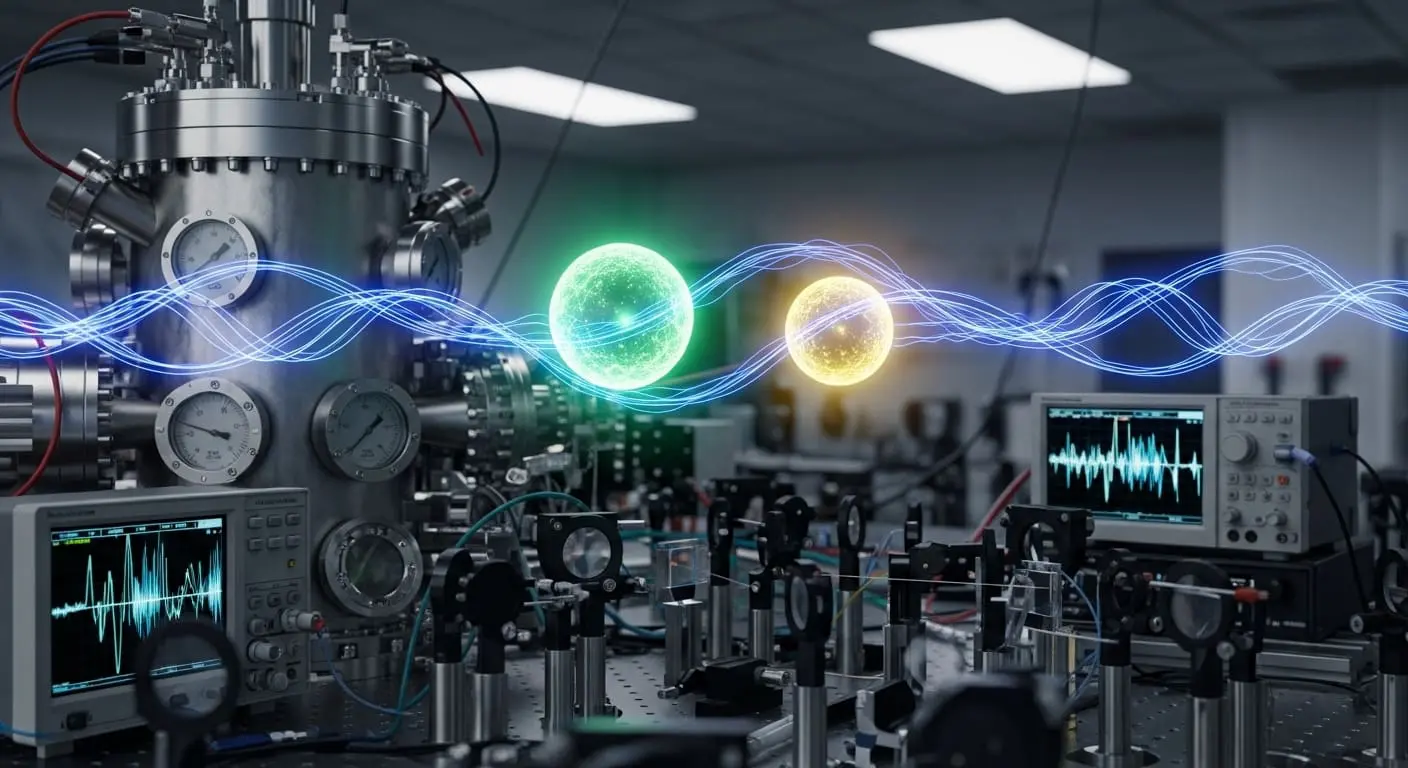
Researchers at Fujian Key Laboratory of Quantum Information and Quantum Optics have, for the first time, experimentally demonstrated entanglement sudden death induced by naturally occurring dissipation in two photonic qubits. Each qubit was stored within a leaky resonator of a superconducting circuit, a setup allowing the team to observe a phenomenon previously simulated with artificially engineered channels. The disentanglement dynamics were monitored using two ancilla superconducting qubits, controllably coupled to the resonators, a technique the researchers say allows for experimental exploration of entanglement dynamics in natural environments. This confirmation that quantum entanglement coupled to a natural reservoir may disappear in a finite time challenges the expectation of asymptotic decay and offers crucial insight into mitigating decoherence effects for future quantum technologies.
Entanglement Sudden Death in Photonic Qubits via Natural Dissipation
Confirming a long-held theoretical prediction, researchers from the Fujian Key Laboratory of Quantum Information and Quantum Optics, College of Physics and Information Engineering, Fuzhou University, have demonstrated entanglement sudden death (ESD) in photonic qubits subjected to natural dissipation, a phenomenon previously simulated with artificially engineered channels, but not directly confirmed with natural reservoirs. This experimental demonstration moves the field beyond simulations and offers crucial insights into the behavior of quantum entanglement in realistic, unshielded environments. These qubits were deliberately exposed to natural dissipation, mirroring the inevitable interaction of quantum systems with their surroundings. Unlike prior demonstrations of ESD with dephasing noises and hybrid spin systems, this setup allowed the researchers to observe the effect with a natural reservoir, a crucial distinction. The team monitored the disentanglement dynamics of the two photonic qubits with two ancilla superconducting qubits and measured the output density matrix.
As the researchers explain, “the entanglement between the two photonic qubits can completely disappear within a finite time under a certain condition, although the photons decay asymptotically.” The team meticulously measured the output density matrix of the photonic qubits after varying disentanglement times, allowing them to quantify the degree of entanglement. Their analysis revealed the disentanglement dynamics, solidifying the evidence for ESD induced by natural dissipation. The techniques developed in this experiment, the researchers state, allow for experimental exploration of entanglement dynamics in natural environments.
Circuit QED System for Monitoring Disentanglement Dynamics
The pursuit of stable quantum entanglement, a cornerstone of future quantum technologies, increasingly focuses on understanding how these fragile states behave in realistic, imperfect environments. While much theoretical and early experimental work has simulated environmental interactions, a team at the Fujian Key Laboratory of Quantum Information and Quantum Optics, College of Physics and Information Engineering, Fuzhou University, has achieved a significant step forward by directly observing entanglement sudden death (ESD) induced by naturally occurring dissipation. This demonstration, utilizing a circuit quantum electrodynamics (QED) system, moves beyond artificially engineered systems and confirms predictions made decades ago regarding the inherent limits of maintaining quantum coherence. These qubits weren’t subjected to artificially imposed decoherence; instead, they were allowed to interact with a reservoir mirroring the inevitable energy loss to the surrounding electromagnetic field.
The team meticulously measured the output density matrix of the two photonic qubits with ancilla qubits, and the techniques developed in their experiment allow for experimental exploration of entanglement dynamics in natural environments. The researchers detail this process mathematically, noting that the concurrence, a measure of entanglement, decreases until it reaches zero. The experimental setup involved a carefully calibrated circuit QED system, where the readout resonators of two superconducting qubits served as the photonic modes. These qubits were linked by a bus resonator, enabling the initial entanglement and subsequent readout. The team prepared the two photonic qubits in an X-type mixed entangled state, whose density matrix is given by a specific form. The team’s analysis revealed that entanglement can completely disappear within a finite time under a certain condition, although the photons decay asymptotically. This direct observation of natural-dissipation-induced ESD represents a crucial validation of theoretical models and opens new avenues for developing strategies to mitigate decoherence in practical quantum devices.
Theoretical Background on Entanglement & Decoherence
This counterintuitive prediction, that entanglement can disappear faster than the individual qubit coherence, has now been experimentally validated using a novel circuit quantum electrodynamics system. The core of this investigation lies in understanding how qubits interact with their environment. Any quantum system, the researchers explain, inevitably interacts with its surroundings, modeled as a “Markovian reservoir consisting of a continuum of electromagnetic field modes.” While theoretical models often simplify these interactions, the team from the Fujian Key Laboratory of Quantum Information and Quantum Optics sought to replicate a mirroring the unavoidable dissipation experienced by qubits in real-world applications. This is crucial because “understanding the disentanglement dynamics for qubits subjected to decoherence is essential to mitigate decoherence effects,” a challenge that has long plagued the development of quantum technologies. Previous demonstrations of ESD relied on artificially engineered dissipative channels, creating laboratory conditions that didn’t fully represent natural quantum decay.
Monitoring this disentanglement required a sophisticated technique: the use of two ancilla superconducting qubits, which were controllably coupled to the leaky resonators. This allowed for precise measurement of the output density matrix of the two photonic qubits, revealing the conditions under which ESD occurs. The researchers emphasize that such natural reservoirs “are the dominant decoherence source for quantum information processing with logic qubits encoded in multi-photonic states,” making this investigation particularly relevant for practical quantum computing.
Experimental Setup: Leaky Resonators & Ancilla Qubits
Unlike prior investigations relying on artificially engineered systems, this research utilizes a circuit quantum electrodynamics (QED) setup to observe ESD stemming from genuinely natural reservoirs, a crucial step toward realizing practical quantum technologies. These resonators aren’t perfectly isolated; they are deliberately designed to interact with a reservoir consisting of electromagnetic field modes, mimicking the inevitable coupling to the surrounding environment. This setup allows researchers to study how entanglement degrades not through imposed, artificial decay channels, but through the natural tendency of quantum systems to lose coherence. The team prepared the qubits in an X-type mixed entangled state, described mathematically by a specific density matrix form. As the qubits interact with the reservoir, the density matrix evolves according to a master equation, accounting for the irreversible loss of quantum information. The techniques developed in the experiment allow for experimental exploration of entanglement dynamics in natural environments.
The results show that the entanglement between the two photonic qubits can completely disappear within a finite time under a certain condition, although the photons decay asymptotically. The ability to directly observe ESD induced by natural dissipation, rather than simulated environments, represents a significant advancement in the field and offers a pathway toward building more robust quantum systems.
X-Type Mixed State Density Matrix Representation
The intuitive picture of quantum decay suggests a gradual fading of coherence, an asymptotic approach to zero as a qubit loses energy to its environment. This isn’t a failure of measurement, but a fundamental consequence of how qubits interact with naturally occurring dissipation, previously simulated with artificially engineered dissipative channels. Researchers affiliated with the Fujian Key Laboratory of Quantum Information and Quantum Optics, College of Physics and Information Engineering, Fuzhou University, achieved this demonstration using a sophisticated circuit quantum electrodynamics (QED) system. The team didn’t simply observe decay; they meticulously tracked the disentanglement process itself, employing two ancilla superconducting qubits to monitor the disentanglement dynamics and measure the output density matrix.
Crucially, the experiment focused on qubits initially prepared in an “X-type mixed entangled state.” The mathematical description of this state, represented by a density matrix, is complex, but the researchers were able to model its evolution using a master equation that accounts for the interaction with the surrounding electromagnetic field. The density matrix evolves over time, described by equations incorporating decay rates and parameters that quantify the dissipation. The researchers demonstrated that the concurrence, a key indicator of entanglement, diminishes as the system evolves, ultimately reaching zero under specific conditions.
Source: https://arxiv.org/abs/2607.08078


See today’s quantum computing news on Quantum Zeitgeist for the latest breakthroughs in qubits, hardware, algorithms, and industry deals.