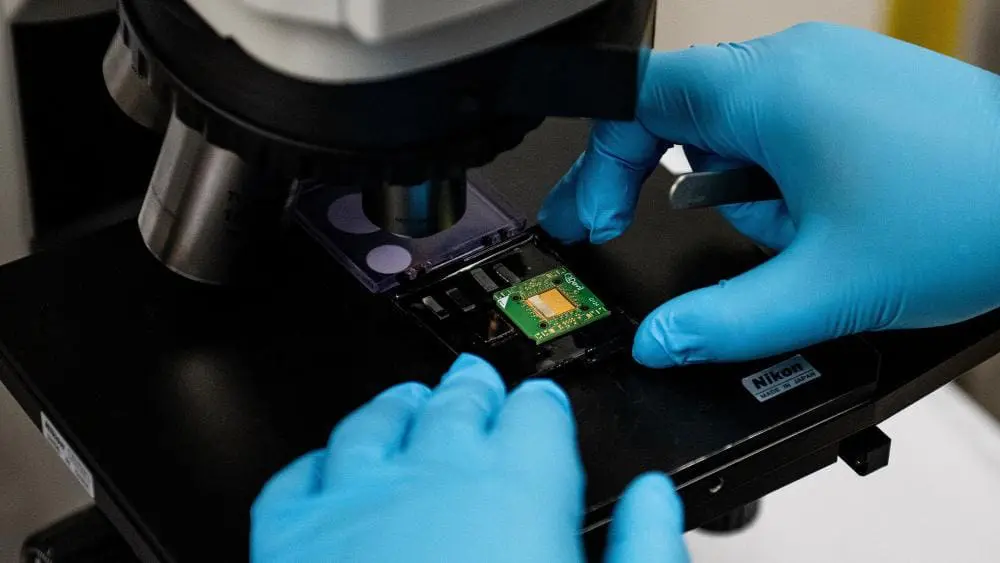
Researchers at Penn State and Saint Louis University have detailed a novel quantum material in Science Advances that exhibits concentrating quantum states at a material’s boundary instead of spreading evenly. This development combines approaches from two rapidly growing fields of quantum physics, laying the foundation for devices capable of transporting and grouping electrical signals in unconventional ways. The team focused on a magnetic topological insulator, known as a quantum anomalous Hall (QAH) insulator, which naturally enables the study of non-Hermitian dynamics; its interior stops electrical flow while current passes along the edges in a single direction. “We wanted to show that these phenomena can emerge naturally in a quantum material,” said Morteza Kayyalha, assistant professor of electrical engineering at Penn State and the paper’s corresponding author, suggesting this work offers a scalable platform beyond optical or circuit-based designs.
Quantum Anomalous Hall Insulator Enables Non-Hermitian Dynamics
A newly realized quantum material exhibits the concentrating of quantum states at material boundaries, opening avenues for novel device designs. This achievement merges the rapidly evolving fields of quantum physics and non-Hermitian dynamics, potentially enabling the creation of devices with unconventional electrical signal processing capabilities. These systems can exhibit enhanced responses to external stimuli and, crucially, the non-Hermitian skin effect, where quantum states become localized at specific points within the material rather than distributing evenly. The team’s QAH insulator achieves this through a unique internal structure; it insulates against electrical flow except along its edges via chiral edge channels, creating one-way paths for current. The QAH devices were fabricated from bismuth antimony telluride thin films, synthesized at Penn State’s two-dimensional crystal consortium (2DCC), and magnetically doped to establish the chiral edge state without requiring external magnetic fields during operation, a significant advantage.
By constructing ring-shaped devices and meticulously measuring electrical signals, the researchers reconstructed the system’s conductance network, then compared it to the Hatano-Nelson model, a standard for identifying non-Hermitian behavior. Measurements confirmed a close relationship between the QAH system’s conductance matrix and the model, and revealed the non-Hermitian skin effect, concentrating quantum states at the edge of the effective chain. Kayyalha believes the ability to tune the system via gate voltage will further facilitate exploration of the interplay between conductance and non-Hermitian dynamics, potentially leading to highly responsive sensors and other advanced applications.
Our work lays the groundwork for achieving scalable, non-Hermitian behavior with a quantum material platform rather than relying only on optical or circuit-based designs.
The pursuit of materials exhibiting exotic quantum properties has led researchers to increasingly complex designs, but a recent demonstration showcases how naturally occurring phenomena can be harnessed within a carefully constructed system. This material serves as a platform for investigating non-Hermitian dynamics, a field exploring behaviors absent in conventional physics. These materials are fabricated as thin films, synthesized in the two-dimensional crystal consortium (2DCC), a facility at Penn State funded by the U.S. National Science Foundation (NSF), and are magnetically doped, a process that introduces magnetic atoms to a non-magnetic base material, creating a quantum state in which current travels along the device boundary through a chiral edge channel. “A key advantage of this QAH platform is that, after the material is magnetized, the chiral edge state can be studied at zero applied magnetic field,” Kayyalha explained. The team constructed ring-shaped devices from this QAH insulator, meticulously mapping the flow of electricity around the perimeter to reconstruct the system’s conductance network.
That makes it a promising platform for exploring non-Hermitian physics in electronic quantum materials.
This work combines approaches from magnetic topological insulators, quantum anomalous Hall (QAH) insulators, and the study of non-Hermitian physics, laying the foundation for new device capabilities and a platform for exploring previously challenging phenomena. “We can compare the measured conductance matrix directly with theoretical models of non-Hermitian physics,” Kayyalha said. “The non-Hermitian skin effect has been observed in several engineered platforms but realizing it in a topological quantum material provides a new route for studying these phenomena using electronic transport,” Kayyalha explained.
The non-Hermitian skin effect has been observed in several engineered platforms but realizing it in a topological quantum material provides a new route for studying these phenomena using electronic transport.
The ability to finely control quantum material behavior with an external stimulus promises advancements in sensing technologies and novel electronic devices, and recent work at Penn State demonstrates a new level of control over non-Hermitian dynamics. This offers a pathway to engineer materials with enhanced responses to external signals, potentially leading to sensors. By adjusting the gate voltage, researchers effectively altered the material’s conductance, influencing the distribution of these quantum states. This tuning capability is significant because it allows for precise control over the material’s response to external stimuli. The research, published in Science Advances, suggests a future where these materials could be tailored for specific sensing applications, offering a commercially scalable platform for advanced technologies.
A key advantage of this QAH platform is that, after the material is magnetized, the chiral edge state can be studied at zero applied magnetic field.


See today’s quantum computing news on Quantum Zeitgeist for the latest breakthroughs in qubits, hardware, algorithms, and industry deals.