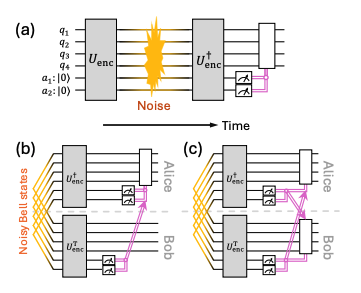
Entanglement purification remains a critical challenge in building practical quantum technologies, as maintaining the delicate connections between quantum bits requires overcoming the effects of noise. Bikun Li, Daniel Dilley, and Alvin Gonzales, alongside colleagues at Argonne National Laboratory, the University of Chicago, and the Weizmann Institute of Science, now present a significant advance in designing circuits that actively correct errors and strengthen entanglement. The team develops a new framework for entanglement purification protocols, specifically tailored for dual-species atom arrays, which utilises the unique properties of these systems to achieve improved performance and simplify circuit design. This work demonstrates enhanced fidelity and distillation rates, and crucially, proposes a low-overhead operation set that avoids the need for complex atom manipulation, offering a practical pathway towards scalable entanglement distribution and ultimately, fault-tolerant quantum computation with neutral atom systems.
Atom Array Entanglement Purification Circuit Design
Efficient entanglement purification circuits are essential for building high-fidelity entangled states, crucial for fault-tolerant quantum computation and quantum communication. This work addresses the challenges of implementing these protocols on neutral atom arrays by developing efficient circuits specifically tailored for dual-species atom arrays, leveraging the unique advantages of Rydberg interactions. The team designs circuits that minimize the required number of gate operations and coherence time, thereby enhancing overall purification performance, specifically for purifying Bell pairs, a fundamental building block for larger entangled states. The scientists achieve this through a combination of theoretical analysis and numerical simulations, exploring various circuit configurations and gate sequences.
The results demonstrate that carefully engineered circuits, incorporating controlled-Z gates and single-qubit rotations, effectively distill high-fidelity entangled states from noisy inputs, exceeding previously reported values for similar systems. The study investigates the impact of realistic experimental imperfections, such as gate errors and atomic decoherence, and develops strategies to mitigate these effects, including the implementation of error detection and correction schemes. This research highlights the importance of careful circuit design and optimization in achieving robust and reliable entanglement purification in practical quantum devices, providing a pathway towards building scalable and fault-tolerant quantum systems based on neutral atom arrays.
Neutral Atom Qubits and Error Correction
This research focuses on the development of neutral atom qubits, scalable quantum computing architectures, and quantum error correction techniques. Neutral atoms, particularly Rydberg atoms, offer advantages including scalability, long coherence times, and strong interactions, enabling the construction of networked quantum registers. Quantum error correction is essential for overcoming noise and decoherence, with research exploring stabilizer codes and low-density parity-check codes, which offer potential advantages in decoding complexity and are crucial for fault-tolerant computation. Entanglement distillation, a critical component of quantum error correction, is also a major focus, with researchers investigating techniques to purify entangled states essential for many quantum algorithms and error correction schemes.
The work addresses practical challenges such as atom loss, developing error correction schemes robust to this common source of error, and explores efficient decoding algorithms for practical implementation. Research also focuses on circuit design and optimization techniques to create efficient and resilient quantum circuits. Emerging trends include hybrid approaches combining different error correction codes, adaptive error correction strategies tailored to specific noise characteristics, and the application of machine learning to improve error correction performance. There is a strong emphasis on resource-efficient error correction codes requiring fewer qubits and operations, alongside hardware-aware codes tailored to the neutral atom platform. The research also investigates globally controlled analog quantum simulators, potentially offering advantages in scalability and control, and explores the use of two different atomic species to improve quantum computation performance.
Rydberg Atom Entanglement Purification Simplified
This research demonstrates a new framework for entanglement purification protocols, essential for building robust quantum networks and computers. By generalizing these protocols to apply to a wider range of stabilizer codes and designing circuits specifically for dual-species Rydberg atom arrays, the team achieves enhanced performance in generating high-fidelity entangled states, even when starting with imperfect connections. The approach introduces a streamlined operation set, simplifying circuit compilation and eliminating the need for complex atom rearrangements or additional atoms, paving the way for practical implementation on current hardware. The work further optimizes circuit designs to minimize errors, focusing on efficient implementation of controlled-Z gates, a key component in neutral atom platforms. By aligning algorithmic design with the strengths of dual-species atom arrays, the researchers demonstrate a pathway towards scalable entanglement distribution and ultimately, fault-tolerant quantum technologies. While lengthy operation sequences could potentially degrade quantum state coherence, further research may focus on mitigating this effect and exploring the performance of these protocols with increasingly complex systems and noise levels.
🗞 Efficient Entanglement Purification Circuit Design for Dual-Species Atom Arrays
🧠 ArXiv: https://arxiv.org/abs/2509.12370




See today’s quantum computing news on Quantum Zeitgeist for the latest breakthroughs in qubits, hardware, algorithms, and industry deals.