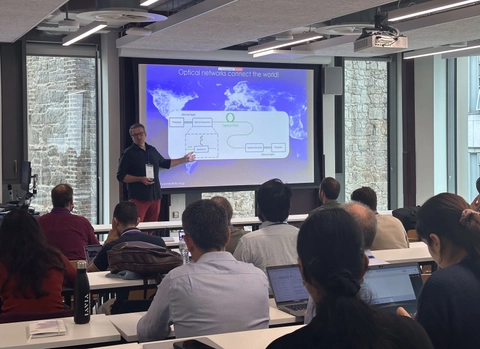
From connecting quantum computers to detecting undersea earthquakes, optical fibre technology is rapidly expanding beyond traditional communication roles. Between September 2-5, leading researchers from Ireland, Europe, and the United States convened at Trinity College Dublin for the Summer School on Optical Communication 2026, hosted by the ICON Project and CONNECT Research Ireland Centre for Future Networks and Communications. Professor Dan Kilper, Director of CONNECT at Trinity College Dublin, said: “Events like this are about much more than the technical programme.
They bring students, researchers and industry together to exchange ideas, learn from one another and build connections. This mix of perspectives is often where a conversation becomes an idea, an idea leads to collaboration and, ultimately, that collaboration leads to real-world impact.”
Optical Fibre Networks as Distributed Sensors
Mikael Mazur of Nokia Bell Labs detailed how both terrestrial and subsea fibre optic infrastructure could be repurposed to monitor environmental changes and detect seismic activity in regions lacking traditional sensor coverage. This repurposing moves beyond simple data transmission, transforming the network into a distributed observation system capable of gathering data previously inaccessible. Dr. Kaida Kaeval of Tallinn University of Technology further emphasized the importance of combining data from these communications networks with information from dedicated sensing equipment to create a more comprehensive and reliable monitoring system.
Practical implementation, however, requires careful consideration of cost, reliability and the establishment of common industry standards. Integrating sensing capabilities into existing infrastructure demands compatibility and interoperability, ensuring smooth data exchange and analysis.
Kaeval’s presentation highlighted the need for a unified approach to data acquisition and processing, facilitating the effective use of this distributed sensor network. This emphasis on interdisciplinary collaboration is central to translating theoretical concepts into tangible solutions. Kilper continued, “This mix of perspectives is often where a conversation becomes an idea, an idea leads to collaboration and, ultimately, that collaboration leads to real-world impact.” Industry involvement is proving critical in bridging the gap between research and deployment.
Aurora Telecom’s national fibre network, for example, is a live testing ground for new optical and quantum communications technologies developed by CONNECT. James Freeman, Fibre Manager at Aurora Telecom, explained, “The pace of innovation in communications technology is accelerating, making collaboration between industry and academia more important than ever.” Aurora Telecom’s support of the summer school and its commitment to providing infrastructure for research demonstrate a proactive approach to encouraging innovation. The convergence of these technologies promises a future where communication networks are not only conduits for information but also intelligent, responsive systems capable of monitoring and managing the world around us.
Photonics already connects our information world through optical fibres. The question now is how we can use that expertise to connect quantum systems and enable the next generation of quantum technologies.
Professor Marko Lončar, Harvard University


See today’s quantum computing news on Quantum Zeitgeist for the latest breakthroughs in qubits, hardware, algorithms, and industry deals.