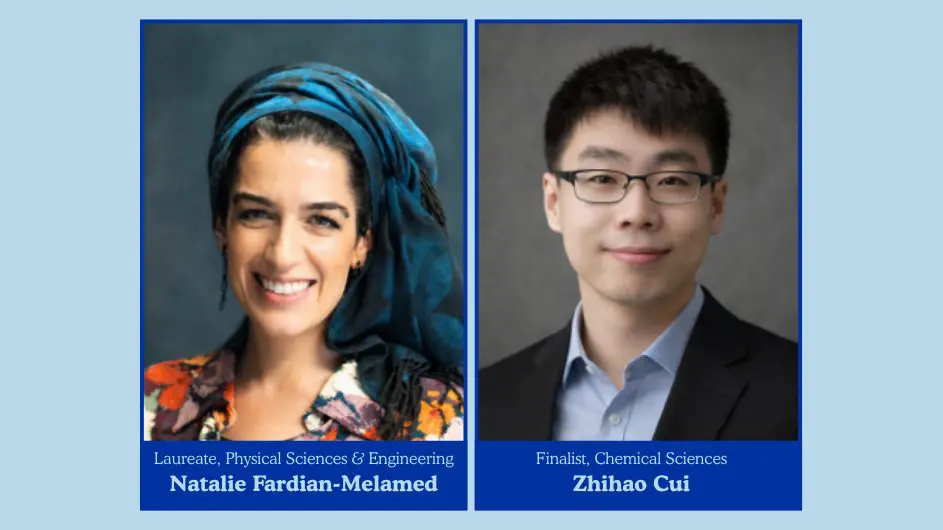
Natalie Fardian-Melamed, a Columbia University associate research scientist, has been named a 2026 Blavatnik Laureate in Physical Sciences & Engineering for engineering light-based nanosensors capable of remotely detecting mechanical forces. This work, building on postdoctoral research with Jim Schuck at Columbia, promises advances spanning biomedicine, robotics, and the development of quantum technologies.
Fellow Columbia postdoc Zhihao Cui, now at UC Irvine, was recognized as a finalist in Chemical Sciences for computational theories predicting and designing superconductors and quantum materials with unusual properties; he modeled electron interaction with vibrations and light while at Columbia with theorists David Reichman and Andrew Millis. These recognitions highlight Columbia University’s strength within the growing US quantum technology ecosystem.
Fardian-Melamed’s Nanosensors Enable Remote Mechanical Force Detection
These sensors, developed during postdoctoral work with mechanical engineer Jim Schuck at Columbia University, move beyond traditional methods requiring physical contact to measure force. Fardian-Melamed’s work focuses on harnessing light to quantify these forces, opening possibilities for non-invasive measurements in delicate biological systems and precise control in robotic applications. The technology extends to quantum technologies, where precise force control is critical for manipulating quantum states.
Columbia University’s commitment to quantum research is demonstrated through its support of this work and its recent hosting of a workshop connecting quantum research with industry on August 15. The university’s Department of Physics and quantum engineering programs actively advance quantum computing, materials, and technologies, fostering collaboration between disciplines.
This interdisciplinary approach is evident in Fardian-Melamed’s work, bridging mechanical engineering and quantum physics, and is supported by five patent families related to quantum technologies. According to Columbia News, “Discovering and engineering ultra-sensitive, light-based nanosensors that remotely detect a broad range of mechanical forces” is the basis for her 2026 Blavatnik Laureate recognition. Cui’s work advances the prediction and design of superconductors and quantum materials exhibiting unusual properties, helping to realize more robust quantum systems.
His models allow researchers to anticipate how materials will behave under specific conditions, accelerating the discovery of materials suitable for quantum applications. Columbia physicists recently used quantum microwaves to shield molecules from loss, a parallel effort demonstrating the university’s broad engagement in quantum innovation.

See today’s quantum computing news on Quantum Zeitgeist for the latest breakthroughs in qubits, hardware, algorithms, and industry deals.