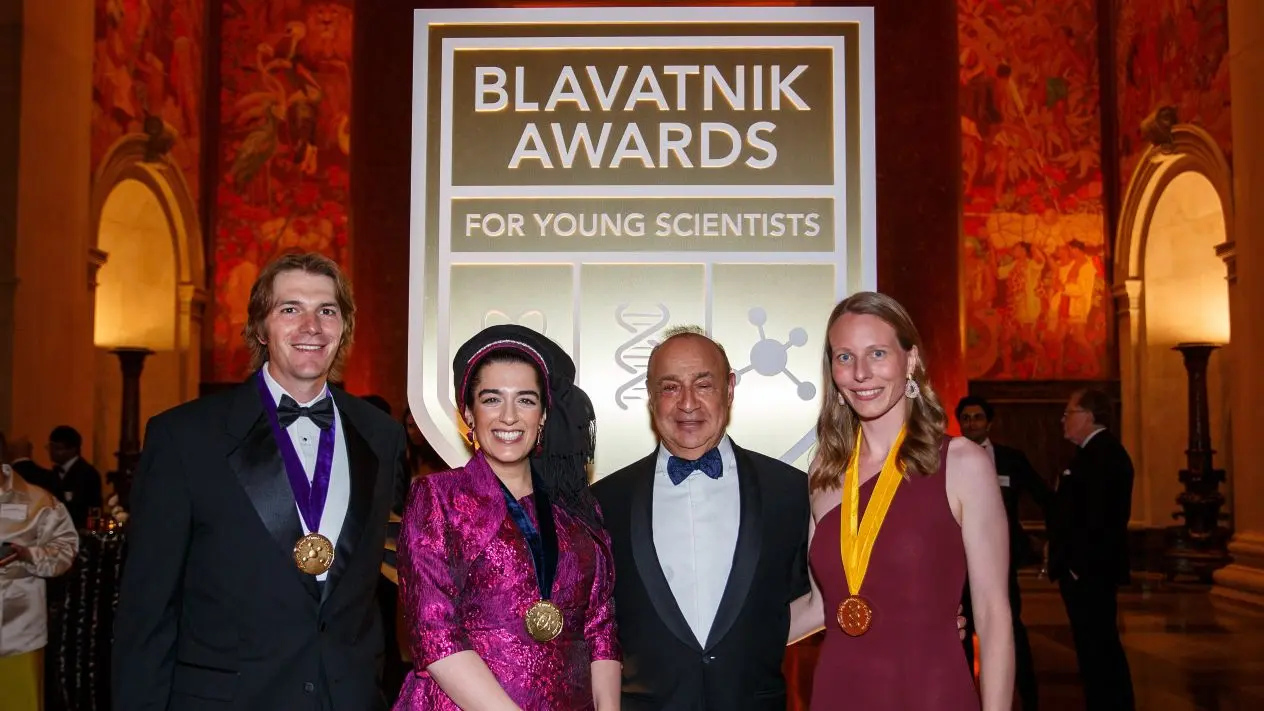
Columbia Engineering associate research scientist Natalie Fardian-Melamed will receive a $30,000 unrestricted award as the 2026 Blavatnik Regional Awards for Young Scientists Laureate in Physical Sciences & Engineering, recognizing her research into the potential of tiny crystals to detect minute forces. Honored at a ceremony held October 6th at the American Museum of Natural History, Fardian-Melamed’s work, which began as a postdoctoral fellowship with Jim Schuck, could lead to advancements spanning medicine and robotics. “The beauty of photon avalanching is that it’s both fundamentally fascinating and real-world-application interesting,” said Fardian-Melamed, describing the light-based force detection method at the heart of her research.
Fardian-Melamed Honored with Blavatnik Regional Award for Research
The discovery, initially made while a postdoctoral fellow with Jim Schuck Engineering, allows for the remote detection of minute mechanical forces at the nanometer scale using light-based sensors. This capability stems from observing that even small amounts of pressure can initiate a photon avalanche within specific nanocrystals, opening avenues for applications spanning medicine to robotics. The foundation for this technology lies in the unique optical chain reaction of photon avalanching, a phenomenon occurring in crystals containing lanthanides.
Schuck’s lab first observed this reaction in 2021, noting that a few infrared light pulses could trigger a cascade of higher-energy photons from a tiny crystal. Fardian-Melamed, joining the lab that year as a Fulbright Scholar after completing her PhD at Hebrew University, extended this understanding by demonstrating the sensitivity of this process to external forces.
This mechano-optics breakthrough allows the creation of nanoscopic sensors capable of detecting subtle changes in mechanical force, potentially revolutionizing areas like tactile sensing and precision measurement. Dean of Engineering Shih-Fu Chang highlighted the broad implications of Fardian-Melamed’s work, anticipating future breakthroughs in health, quantum technologies and robotics. “Her work in nanosensors is paving the way for future breakthroughs in health, quantum, robotics, and many applications that will affect our everyday lives,” said Chang.
The research published in Nature in 2025 details the experimental setup and findings demonstrating the feasibility of using photon avalanching as a reliable method for force detection at the nanoscale. Fardian-Melamed’s achievements extend beyond this core discovery, as she has also received a Marie Sklodowska-Curie Individual Global Fellowship and participated in the 2024 Lindau Nobel Laureates meeting.
She also won the Falling Walls Lab Pitch Competition last year, further demonstrating the recognition of her innovative approach to nanosensor technology. Her advisor, Jim Schuck, emphasized the significance of the Blavatnik Award, stating, “This is an amazing recognition for young scientists.
Natalie’s discovery of the mechanisms behind environmental sensitivity in nanoparticles will have far-reaching impacts in the fields of information technology, energy, medicine and beyond.” The development of these sensors relies on the unique properties of lanthanide-containing crystals, which exhibit photon avalanching when stimulated with infrared light. Fardian-Melamed’s key insight was to demonstrate that applying mechanical stress to these crystals also triggers the avalanche effect, creating a direct optical readout of force.
This combination of fundamental scientific curiosity and practical application potential positions her research as a promising avenue for future technological advancements in diverse fields. “There is still so much to unravel, and every day brings with it so many discoveries; it’s pure fun to just explore!” she said.
Her work in nanosensors is paving the way for future breakthroughs in health, quantum, robotics, and many applications that will affect our everyday lives.
See today’s quantum computing news on Quantum Zeitgeist for the latest breakthroughs in qubits, hardware, algorithms, and industry deals.