Researchers at Chalmers University of Technology have demonstrated a method for reducing interference in superconducting quantum processors: intentionally designing “parasitic drive capacitances.” The team found that drive crosstalk, a major obstacle to scaling up quantum computers, can be suppressed not just by minimizing qubit coupling, but also through interference between multiple coupling paths. Their work provides practical guidance for designing low-crosstalk devices by engineering these often-unwanted capacitances. The results point toward a broader strategy in which parasitic coupling paths are engineered rather than simply minimized.
Detailed Circuit Model Captures Transmon Qubit Crosstalk
A detailed circuit model developed by researchers reveals that suppressing microwave crosstalk, unwanted interference, between superconducting qubits relies on more than just minimizing direct qubit-qubit coupling. The model demonstrates that destructive interference between multiple drive pathways, enabled by what are often considered unwanted parasitic capacitances, actively reduces signal distortion. This finding challenges conventional wisdom in quantum processor design, where such capacitances are typically minimized as imperfections.
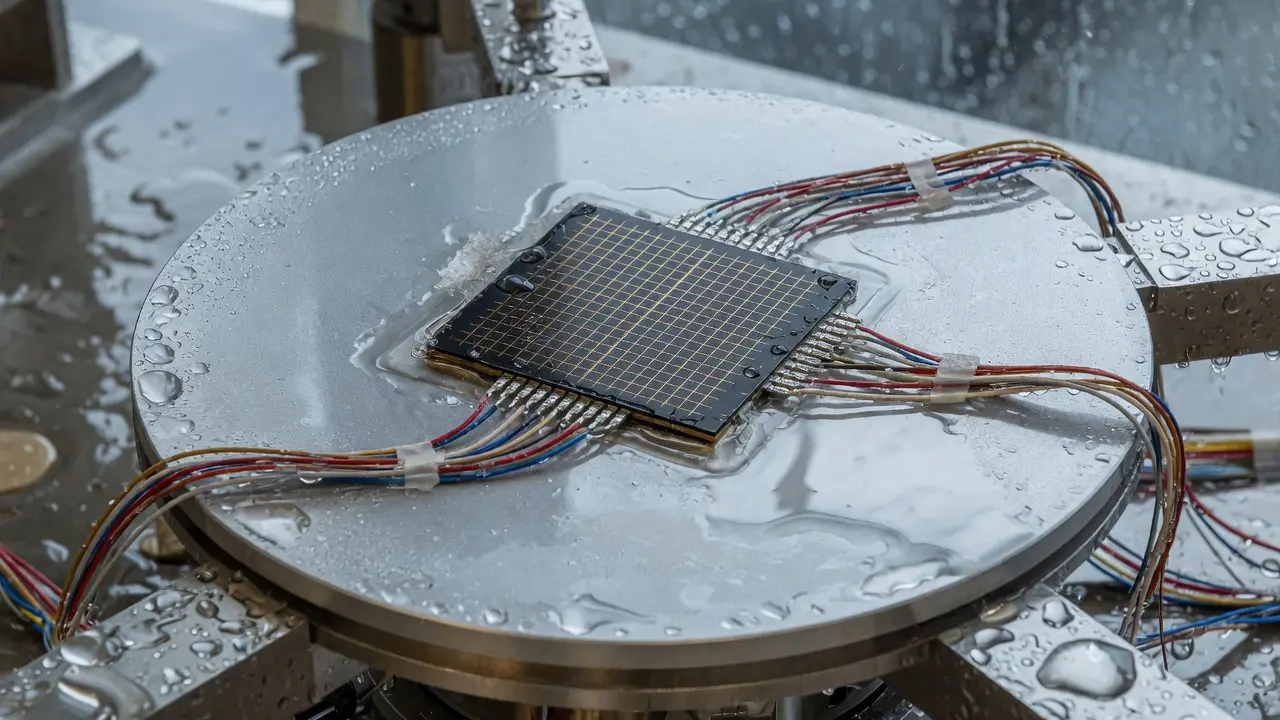
The team’s work centers on a processor containing two fixed-frequency transmon qubits linked by a tunable coupler, a common architecture for scaling quantum systems. By accounting for numerous circuit elements, the model captures how crosstalk varies with the coupler’s frequency, revealing a complex interplay of capacitive couplings. Analytical expressions derived from the circuit model predict minima in crosstalk-induced Rabi rates, a measure of how strongly the unwanted signal drives the victim qubit, and these predictions align with experimental observations.
The significance of this interference effect lies in its potential to reshape design strategies. The device under investigation included prominent capacitive couplings between each qubit and the coupler, as well as between drive lines and the target qubit pads. These parasitic capacitances, previously treated as unavoidable sources of error, can be intentionally engineered to mitigate crosstalk. The circuit model demonstrates that by tuning these drive-line coupling paths, crosstalk can be actively suppressed, offering a more targeted approach than broad shielding techniques.
The detailed model incorporates the device’s components: two floating transmon qubits, a tunable coupler, and drive lines for each qubit. The model’s accuracy is supported by the observation of clear minima in the crosstalk-induced Rabi rates, consistent with theoretical predictions.
Understanding how these coupling mechanisms combine is therefore important for characterizing crosstalk and, more practically, for identifying ways to suppress it at the device level. The team’s insights highlight the importance of accounting for unintended coupling pathways in quantum processor design, suggesting a shift toward actively managing these elements rather than simply minimizing them.
Tunable Coupler Frequency Dependence on Crosstalk
Researchers found that intentionally incorporating specific “parasitic drive capacitances” can actively reduce crosstalk, a major obstacle to building larger and more stable quantum processors. The team’s detailed circuit model revealed that crosstalk suppression stems not only from canceling direct qubit-qubit coupling, but also from interference effects along multiple drive paths. The detailed circuit model accounts for these additional pathways, specifically the parasitic drive-to-coupler and drive-to-victim capacitances.
Including these capacitances in the model yielded excellent agreement with measured self- and cross-Rabi frequencies, except for a smaller, less pronounced dip in the data. Population measurements revealed a pronounced minimum near the crosstalk-null frequency, where unwanted excitation was suppressed by several orders of magnitude, while crosstalk rapidly increased away from this point.
The team’s work demonstrates that the frequency dependence of crosstalk, including its suppression, can be quantitatively captured by accounting for these additional drive pathways. The ability to predict and control crosstalk through careful design of these parasitic capacitances offers a new strategy for scaling quantum processors. This approach moves beyond simply minimizing unwanted coupling, instead actively engineering it to improve performance.
This is particularly important as superconducting quantum processors increase in qubit count, where managing interference becomes increasingly complex. The findings provide practical guidance for low-crosstalk device design and suggest a broader strategy for engineering parasitic coupling paths rather than simply minimizing them.
Experimental Suppression of Drive Crosstalk Demonstrated
Revealing multiple pathways contributing to microwave crosstalk between qubits, the team’s circuit model moved beyond the expectation that cancellation of direct qubit-qubit coupling was the primary mechanism for suppression. Analysis of the circuit’s Lagrangian, based on node fluxes, identified the importance of parasitic capacitive coupling, both of drive lines to the coupler and of each drive line to the victim qubit, in understanding and engineering crosstalk reduction.
These previously considered imperfections are, in fact, critical components in achieving isolation. The resulting crosstalk ratios, Λ1,2 and Λ2,1, defined in the paper’s equations, were found to align with model predictions as coupler frequency changed.
The research extended beyond on-resonance crosstalk, the worst-case scenario for gate operations, to consider off-resonant conditions, which are more common in practice. This analysis revealed a relationship between the two, demonstrating that the principles of suppression developed for resonant crosstalk also apply to the more prevalent off-resonant case.
A key finding was the significant role of parasitic drive capacitances in suppressing crosstalk, a result that challenges conventional circuit design principles. As the researchers write, “We demonstrated that interference between the different drive pathways gives rise to a coupler frequency at which the cross-Rabi rate is minimized.”
Parasitic Capacitances Mitigate Microwave Interference
Engineers at Chalmers University of Technology discovered that intentionally introducing parasitic capacitances, typically considered unwanted imperfections, can actively reduce microwave interference between superconducting qubits. This approach directly addresses a growing problem as quantum processors scale to larger qubit counts, where crosstalk becomes a significant source of coherent errors. The research demonstrates that suppressing crosstalk isn’t solely achieved by cancelling the effective qubit-qubit coupling, but also through destructive interference enabled by these capacitances.
The work highlights that achieving this control is more readily accomplished with qubits designed to “float” rather than being grounded. The researchers state in their report, “Although often neglected in standard circuit designs, these parasitic capacitances can serve as practical control knobs for suppressing microwave drive crosstalk.” Beyond worst-case resonant crosstalk, the team also investigated off-resonant crosstalk, a more common scenario during quantum gate operations.
Off-resonant drive signals cause unwanted excitation of the victim qubit, limiting overall gate fidelity. The team’s analysis indicates that engineering parasitic capacitances could potentially suppress classical microwave crosstalk while simultaneously operating at a low-ZZ interaction point, a desirable condition for stable quantum computation. The study’s insights suggest a shift in design philosophy, moving away from simply minimizing parasitic couplings towards actively engineering them to improve performance.
On-Chip Coupling Paths Influence Crosstalk Cancellation
A detailed circuit model revealed that interference between multiple microwave drive pathways, enabled by previously overlooked parasitic capacitances, actively suppresses crosstalk between qubits. Experimental demonstration confirmed the model’s predictions, showing that crosstalk suppression isn’t solely achieved through cancellation of qubit-qubit coupling. The team’s analysis showed that the principles governing crosstalk suppression extend beyond scenarios with resonant coupling, applying equally to off-resonant drive signals, a more common occurrence that causes unwanted excitation of qubits and limits gate fidelity.
By tuning drive-line coupling paths, they demonstrated a method for suppressing crosstalk, a critical step toward building larger, more complex quantum systems. This interference, facilitated by the parasitic capacitances, provides a pathway to mitigate unwanted interactions. The researchers’ detailed circuit model quantitatively captured the observed suppression of crosstalk, demonstrating the importance of accounting for these often-neglected circuit elements.
Theoretical Model Validates Crosstalk Mechanisms
The detailed circuit model developed by researchers accurately predicts the frequency-dependent behavior of crosstalk, including its suppression, in superconducting quantum processors. These pathways are enabled by what are typically considered imperfections, parasitic drive capacitances, demonstrating an approach to quantum processor design. The team’s work builds on the understanding that these coupling paths can interfere with one another, potentially leading to near-complete crosstalk cancellation under specific operating conditions.
The model’s analytical expressions for crosstalk, derived using a circuit Lagrangian and high-frequency expansion, are consistent with experimentally observed minima in crosstalk-induced Rabi rates. The researchers neglected small parasitic capacitive couplings between certain circuit elements, finding they did not significantly alter the system’s effective charging energies. This finding challenges conventional approaches that prioritize minimizing these parasitic capacitances, suggesting they can instead be engineered as practical control knobs.
👉 More information
🗞 Suppressing microwave crosstalk in superconducting quantum processors by designing parasitic drive capacitances
✍️ Anuj Aggarwal et al.
🧠 ArXiv: https://arxiv.org/abs/2610.36365

See today’s quantum computing news on Quantum Zeitgeist for the latest breakthroughs in qubits, hardware, algorithms, and industry deals.