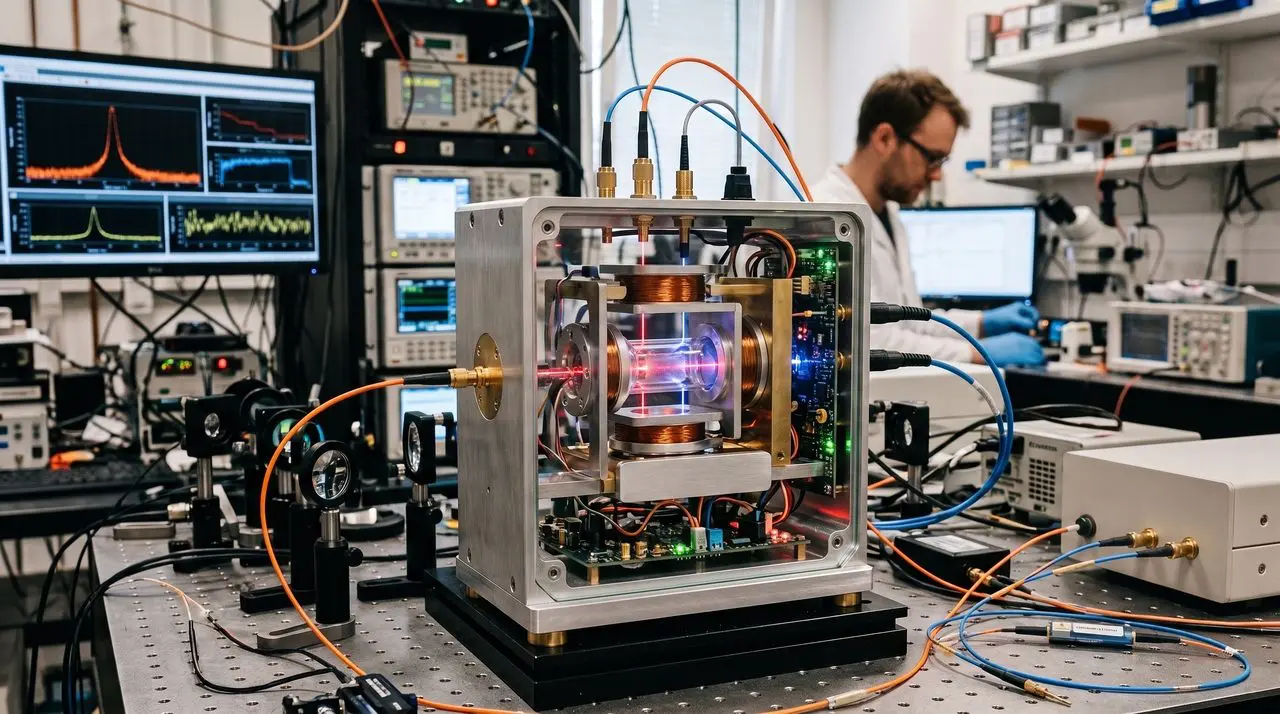
The University of Paderborn is coordinating a new collaborative project, “Detector Engineering to Enable Quantum Technology” (DETEQT), which will receive approximately six million Euro in funding from the Bundesministerium für Forschung, Technologie und Raumfahrt (BMFTR) over three years. The project focuses on advancing single-photon detectors based on nanowires, known as Nanodraht-Einzelphotonendetektoren (SNSPDs), to overcome hurdles in scalability and performance for photonic Quantum Processor Units (QPUs).
This work aims to improve the practicality of systems intended for use in quantum computers, communication, and sensing, and is part of a larger effort with seven other funded projects led by Prof. Tim Bartley to strengthen collaboration across Germany’s quantum technology sector.
Paderborn University Coordinates “DETEQT” for Quantum Technology Advancement
Nanodraht-Einzelphotonendetektoren, or SNSPDs, are undergoing focused development within the DETEQT project to address limitations in scalability, integration, and performance of photonic Quantum Processor Units. These single-photon detectors aim to overcome technical hurdles preventing wider application in quantum computing, communication, and sensing technologies. Multiple partners from both academia and industry, including the Technische Universität München and the Physikalisch-Technische Bundesanstalt, contribute to this effort.
The newly launched cluster led by Prof. Tim Bartley unifies seven funded collaborative projects to bolster cooperation across Germany’s quantum technology sector; this coordinated approach extends beyond individual initiatives, signaling a national strategy to advance photonic quantum technologies. According to the Universität Paderborn, the project’s goal is to significantly improve the practicality of these systems for real-world deployment.



See today’s quantum computing news on Quantum Zeitgeist for the latest breakthroughs in qubits, hardware, algorithms, and industry deals.