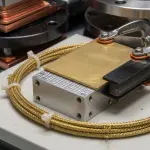
Germany’s largest national quantum computing project to date, QSolid, has exceeded its goal of developing a 30-qubit chip with low error rates, initially set in early 2022, the company says. The €75 million consortium, comprised of 26 research institutions, companies and start-ups coordinated by, has also made a 10-qubit system accessible to users via the cloud while the larger chip undergoes testing.
Researchers tested the interaction of QSolid’s hardware and software using applications like spin resonance processes used in chemical analysis and MRI. “The performance of a quantum computer depends on how many computational steps it can carry out while keeping errors to a minimum,” explains Prof. Frank Wilhelm-Mauch of, who coordinated the project.
Qubit Chip Achieved Through German Quantum Technology Collaboration
Beyond meeting its initial target of a 30-qubit chip, the QSolid consortium has already made a functional 10-qubit system available to users via cloud access. Over five years, his team worked alongside other partners to transition their quantum control system testing into continuous operation on the QSolid demonstrator, according to the company. The experience gained will now inform the development of control systems designed to achieve long-lived logical qubits, a key challenge in quantum computing. has already translated expertise gained through QSolid into a commercial product for materials analysis using nuclear magnetic resonance (NMR).
The consortium also focused on reproducible manufacturing, researching and developing fabrication processes for superconducting qubit circuits at wafer scale. Oelsner.
“Our aim was to enable reproducible manufacturing at wafer scale.” The team is currently characterizing and statistically analyzing these processes to demonstrate reproducibility and yield, with plans to integrate them into the FLUXONICS Foundry’s service portfolio, the company says. The QSolid project, part of the German Federal Ministry of Research Technology and Space’s framework programme “Quantum technologies – from basic research to market”, aimed to develop the quantum technology research landscape, create research networks and establish industrial competitiveness.
The program’s goals also included ensuring security, technical sovereignty, and supporting international collaboration, as well as engaging the German population in quantum technologies. The consortium’s work has also yielded methodological advances, particularly in gate speed, that extend beyond the project’s scope. “They demonstrate that we have highly capable components and that the integration of hardware and software has already reached a high level of maturity.”
QSolid shows what close collaboration between research and industry can achieve. Over five years, we worked side by side with Forschungszentrum Jülich (PGI-13) and our consortium partners to take our quantum control system from the lab into continuous operation on the QSolid demonstrator.
Dr Gregor Oelsner, Head of the Quantum Circuits Research Group at Leibniz-IPHT, also
Ultra-Fast Quantum Gates and Industrial Application of QSolid Results
Beyond achieving its initial goal of a 30-qubit quantum chip, the QSolid consortium has developed a quantum gate demonstrably faster than existing international benchmarks for switching speed. Quantum gates, essential for performing computations and altering qubit states, underpin information processing within quantum computers, and this advancement directly impacts the potential for complex calculations. Modelling spin resonance processes, used in both chemical analysis and magnetic resonance imaging (MRI), allowed for realistic testing conditions and revealed the potential for practical applications of the technology.
This commitment to scalability and accessibility positions the technology for wider adoption and continued innovation beyond the initial five-year project timeline. The project’s closing event, held in Jülich from October 27th to 29th, will showcase these results and encourage discussion among the 26 participating institutions, companies and start-ups. QSolid’s achievements demonstrate a collaborative model for quantum technology development, translating fundamental research into tangible industrial applications and establishing a foundation for future advancements.
The experience we gained in QSolid now feeds directly into the next generation of our control system, built to master the challenge ahead: long-lived logical qubits.
Dr Gregor Oelsner, Head of the Quantum Circuits Research Group at Leibniz-IPHT, also


See today’s quantum computing news on Quantum Zeitgeist for the latest breakthroughs in qubits, hardware, algorithms, and industry deals.