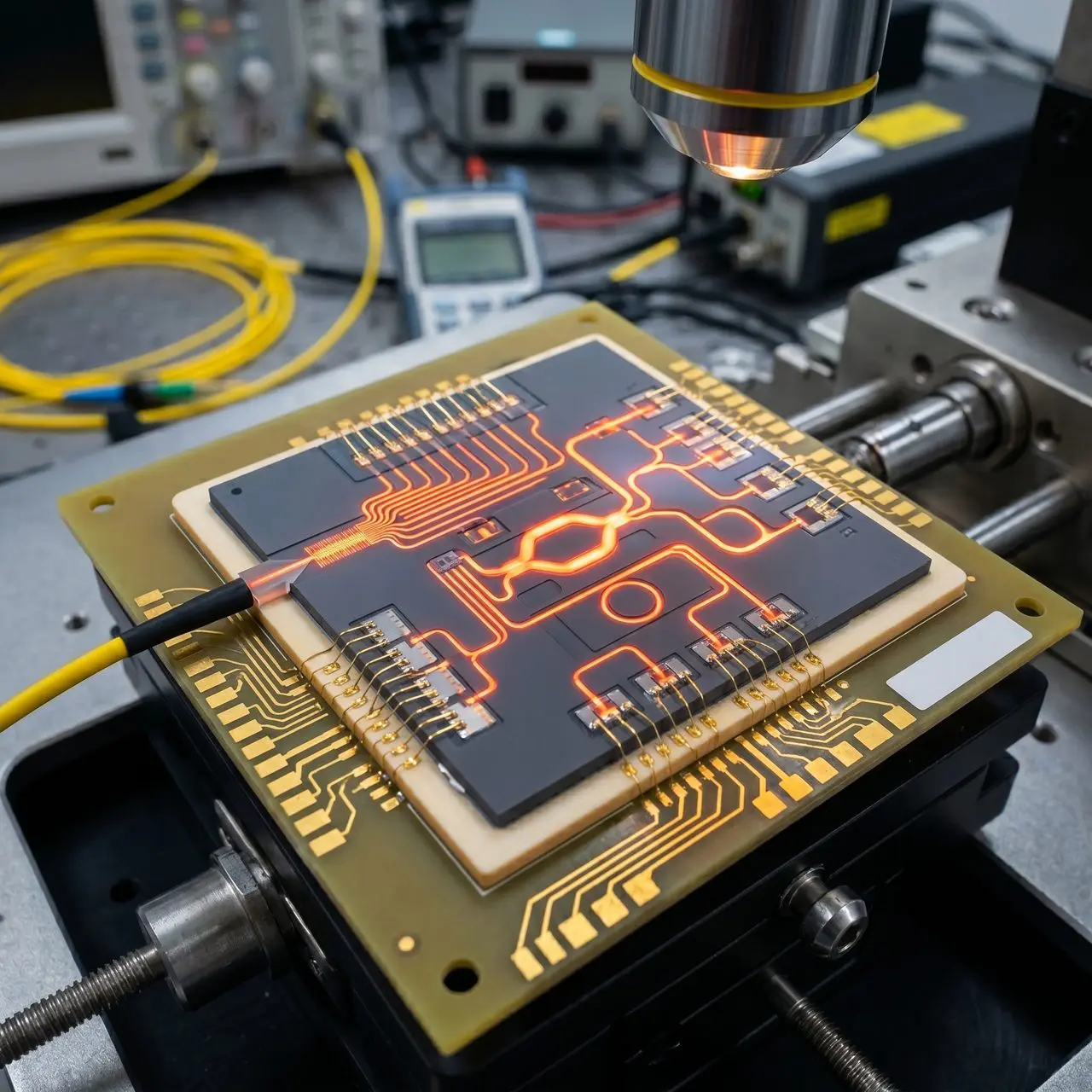
Since 2025, Roy Zektzer has led a research group at Bar-Ilan University focused on a critical challenge in quantum technology: scalability. Zektzer’s work integrates atoms and photonic chips, aiming to move beyond laboratory prototypes toward systems that can be manufactured at scale. He previously demonstrated room temperature operation of quantum photonic interfaces, a key step toward practicality given most quantum systems require near absolute zero temperatures. “Once the technology is easy to fabricate, it becomes much easier to study,” Zektzer explains, envisioning a future where quantum experiments are more accessible due to simpler, cheaper devices.
Hybrid Nanophotonic Platforms for Scalable Quantum Systems
A new batch fabrication method developed at Bar-Ilan University transforms manually assembled quantum prototypes into devices compatible with semiconductor manufacturing, potentially unlocking large-scale production of quantum technologies. This process addresses a critical bottleneck in the field, shifting the focus from individual device construction to scalable fabrication techniques. Roy Zektzer’s research group achieved this by integrating atomic and photonic chips, aiming to bridge the gap between the precision of atomic physics and the manufacturability of integrated photonics.
The team’s approach prioritizes creating systems that can be produced at a rate comparable to conventional semiconductor devices, rather than relying on painstaking, one-off assembly. Currently, the financial barrier to entry for quantum research is substantial, often requiring equipment investments exceeding two million dollars, but Zektzer envisions a future where simplified, inexpensive devices democratize access to quantum experimentation.
This accessibility extends beyond cost; the team’s focus on chip-scale integration allows for the potential attachment of diverse photonic and atomic devices onto a single platform, facilitating the construction of more complex quantum systems. While fully realized quantum computers remain a distant prospect, Zektzer argues that restricting access to high-quality quantum tools hinders progress, and scalable fabrication is key to overcoming this limitation.
The group’s work centers on hybrid integration, combining different quantum materials with standard photonic integrated devices, with a current emphasis on utilizing rubidium for generating single-photon sources, detectors, quantum memories, and other atomic applications. Understanding the fleeting nature of atoms, particularly when in motion, presents a significant challenge; the team must precisely determine their location and timing to coherently process data from multiple atoms. This complexity is compounded by the need to accurately capture and interpret information from numerous atomic sources simultaneously.
However, Zektzer’s group is actively exploring alternative materials that could yield improved quantum memories, expanding the possibilities for data storage and manipulation within these hybrid systems. The evolution of fabrication techniques has dramatically altered how quantum devices are created; researchers no longer need to rely solely on in-house cleanroom fabrication, as pre-made photonic integrated circuits are now commercially available. Until recently, silicon nitride was the dominant material for these circuits, but the field is experiencing a diversification of options, with numerous materials now being investigated for their potential to interact with quantum materials.
“When it comes to hybrid quantum systems, up until three or four years ago, the most common photonic integrated circuit was silicon nitride. Now, you have all different kinds of materials coming into play, so there are many more options for interrogating quantum materials,” Zektzer notes, highlighting the rapid pace of innovation in this area.
This proliferation of materials presents both opportunities and challenges, as researchers grapple with identifying the optimal candidates for various quantum components. Currently, the field is actively seeking to identify the best materials for generating essential components of a quantum processor, including highly efficient single-photon sources and robust quantum memories.
The next important step involves creating a hybrid platform capable of seamlessly connecting these diverse devices, leveraging the versatility of atoms as potential sources, detectors, gates, and more, all integrated onto a single silicon chip. The primary hurdle lies in establishing effective connections between these atomic elements, a challenge the Bar-Ilan team is actively addressing through their nanophotonic integration approach.
Zektzer’s contributions to integrating atomic and molecular systems with photonic devices have been recognized with Wiley’s Nanophotonics Early Career Award, a distinction awarded to young scientists demonstrating significant progress in the field. The award was officially announced during the Nano Summit 2026 in Berlin, acknowledging the impact of his work on the development of nanophotonics and nano-optics. This external validation underscores the importance of his research and its potential to advance quantum technologies.
Looking ahead, Zektzer believes that demonstrating a quantum operation, such as a quantum gate or entanglement, within a room-temperature, chip-scale atomic system would represent an achievement. The ability to operate quantum devices at room temperature is a critical factor in accelerating technological progress, as it eliminates the need for costly and complex cryogenic cooling systems.
He envisions a future where readily available photonic integrated circuits, combined with a growing understanding of diverse quantum materials, will enable the creation of increasingly sophisticated quantum devices. The team’s current work can be likened to building “Lego” parts, individual components that will eventually converge into a fully functional quantum system. This modular approach, coupled with scalable fabrication techniques, promises to expand opportunities for quantum information science and beyond.




See today’s quantum computing news on Quantum Zeitgeist for the latest breakthroughs in qubits, hardware, algorithms, and industry deals.