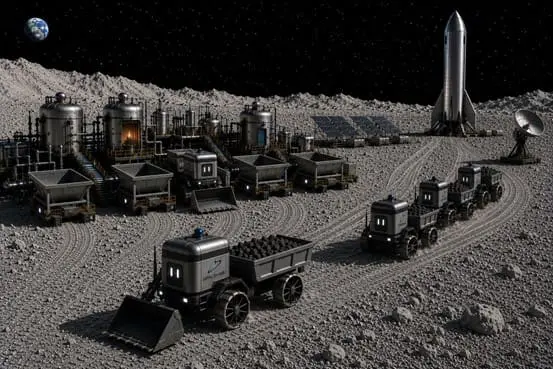
Astrotech Corporation’s Board of Directors has approved a strategic initiative to develop lunar resources, with a specific focus on enabling future Moon-based quantum computing manufacturing. The plan centers on extracting and processing silicon-28, a key material for advanced semiconductors and quantum systems, alongside helium-3 for potential quantum cooling applications. Astrotech intends to capitalize on opportunities presented by both NASA’s Artemis Program and the Commercial Lunar Payload Services program, positioning itself within a growing commercial lunar economy. “Quantum computing, artificial intelligence, and advanced semiconductor manufacturing are rapidly becoming strategic national security and economic priorities,” said Tom Pickens, Chairman and Chief Executive Officer of Astrotech Corporation. “We believe the Moon may offer unique long-term value from regolith mining, quantum computing solutions, and autonomous manufacturing infrastructure.”
Lunar Resource Focus: Silicon-28 and Helium-3 Extraction
Astrotech Corporation is pursuing a strategic initiative focused on extracting and utilizing key resources, most notably silicon-28 and helium-3, to support future quantum computing infrastructure. Beyond identifying these materials as valuable, the company is actively evaluating technologies to process them on the Moon, envisioning a self-sufficient industrial base beyond Earth’s orbit. This approach differs from simply extracting resources, aiming instead for localized manufacturing of advanced materials. Central to this ambition is ultra-pure silicon-28, recognized as a critical component in both advanced semiconductors and the rapidly developing field of quantum computing. Astrotech intends to assess infrastructure concepts supporting lunar silicon purification and isotope processing, anticipating a demand for this specialized material that terrestrial sources may struggle to meet.
Helium-3 is equally important, a rare isotope on Earth but potentially abundant in the lunar regolith. Astrotech’s interest extends beyond its well-known potential as a fusion fuel source, specifically targeting potential quantum cooling and cryogenic infrastructure applications, highlighting a nuanced understanding of the material’s broader utility in advanced computing systems. The company’s spaceflight experience, including its involvement in 24 Space Shuttle and International Space Station missions, provides a foundation for evaluating the engineering, technology requirements, and logistical challenges of lunar operations.
Astrotech Initiative: Supporting Moon-Based Quantum Computing
Rather than solely pursuing resource extraction, the company intends to build an integrated infrastructure capable of supporting advanced semiconductor processing and the unique demands of quantum systems directly on the lunar surface. This approach recognizes the potential for a self-sufficient, off-world manufacturing capability, leveraging the Moon’s distinct environmental characteristics. Securing access to key materials, notably ultra-pure silicon-28 and helium-3, is central to this ambition. The company plans to evaluate infrastructure concepts supporting lunar silicon purification, semiconductor wafer production, and the development of ultra-low-temperature quantum cooling systems. Astrotech is currently in an early evaluation and development phase, but believes its existing technology-development capabilities and expertise in autonomous chemical processing systems will allow it to pursue opportunities associated with the next phase of commercial lunar development, potentially establishing a new frontier for advanced computing.
Quantum computing, artificial intelligence, and advanced semiconductor manufacturing are rapidly becoming strategic national security and economic priorities.
Tom Pickens, Chairman and Chief Executive Officer of Astrotech Corporation
Spaceflight Heritage Enables Lunar Infrastructure Evaluation
Astrotech Corporation is leveraging decades of spaceflight experience to assess the feasibility of establishing lunar infrastructure geared toward advanced computing manufacturing, signaling a broadening scope for commercial activity beyond simple resource extraction. Building on a legacy that includes the SPACEHAB platform, supporting 24 missions with the Space Shuttle and International Space Station, and over 250 satellite launch-processing campaigns through Astrotech Space Operations, the company is now focused on evaluating technologies for a potential Moon-based industrial economy. This isn’t merely a return to the Moon; it’s a strategic pivot toward utilizing lunar resources for high-value applications like quantum computing. Central to Astrotech’s ambitions is the development of infrastructure to support semiconductor processing and quantum computing fabrication on the lunar surface.
The company anticipates that the unique combination of abundant solar energy, extreme thermal conditions, reduced gravity, and access to materials like silicon-28 and helium-3 could make the Moon an attractive location for next-generation manufacturing. The initiative extends beyond simply identifying resources; Astrotech plans to pursue technologies for scalable lunar industrial infrastructure, including autonomous excavation systems, water extraction, and sealed material-transfer systems. This holistic approach recognizes the need for a complete ecosystem to support sustained lunar operations, and the company believes its heritage provides a crucial operational foundation, encompassing engineering expertise, manufacturing drawings, and cost analysis capabilities.
We believe the Moon may offer unique long-term value from regolith mining, quantum computing solutions, and autonomous manufacturing infrastructure .
Tom Pickens, Chairman and Chief Executive Officer of Astrotech Corporation
Autonomous Systems for Scalable Lunar Industrial Economy
Astrotech Corporation is charting a course toward establishing a self-sufficient industrial base on the Moon, moving beyond simple resource extraction to focus on advanced manufacturing capabilities. This ambitious plan centers on deploying autonomous systems to not only acquire lunar materials but also to process them into components for a burgeoning off-world economy, particularly within the quantum computing sector. The company’s strategy differs from earlier concepts of solely shipping raw materials back to Earth, instead envisioning localized production of high-value goods. Astrotech plans to leverage this heritage in areas like engineering, technology requirements, and procurement, ultimately aiming to submit proposals for the NASA CLPS program. Astrotech believes these capabilities may be important to future lunar operations involving resource extraction, in-situ processing, energy infrastructure, advanced materials production, and commercial lunar logistics.
See today’s quantum computing news on Quantum Zeitgeist for the latest breakthroughs in qubits, hardware, algorithms, and industry deals.