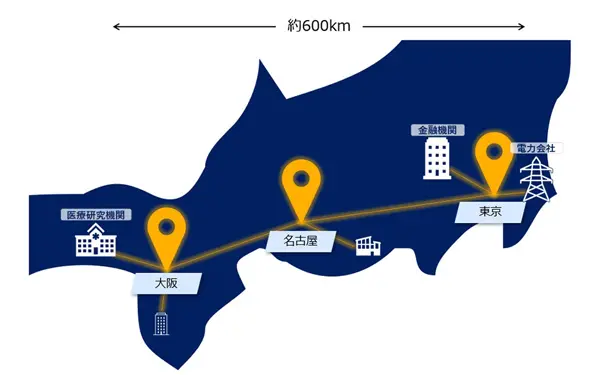
Spanning 600 kilometers, a new quantum cryptographic communication network will directly link Tokyo, Nagoya, and Osaka, representing an advance in the range of practical Quantum Key Distribution (QKD) technology demonstrations. NTT docomo Business, in collaboration with Toshiba and NEC, has begun construction of the wide-area network as part of a larger initiative spearheaded by the Ministry of Internal Affairs and Communications (MIC) and the National Institute of Information and Communications Technology (NICT). The project aims to verify secure communication using quantum technology for sectors including healthcare, finance, and electric power, addressing growing vulnerabilities in existing cryptography. NTT docomo Business states the network will undergo demonstration experiments following construction, with the goal of safeguarding highly confidential information against the emerging threat of “Harvest Now, Decrypt Later” attacks.
The planned Tokyo-Nagoya-Osaka quantum cryptographic network will stretch approximately 600 kilometers, directly linking Japan’s three largest metropolitan areas and substantially increasing the demonstrated range of quantum key distribution (QKD) technology. NTT docomo Business, Toshiba, and NEC have initiated construction of this wide-area network, with Toshiba and NEC tasked with supplying the QKD equipment and building the physical infrastructure. NTT docomo Business will manage the overall demonstration, providing the necessary network infrastructure, data centers, and application layers. This development is driven by the increasing vulnerability of current cryptographic methods to advances in quantum computing, raising concerns about long-term data security. Addressing the threat of “Harvest Now, Decrypt Later” is paramount, as intercepted communications could be stored and decrypted with future quantum computers, posing risks to national and economic security; the project seeks to establish secure operational practices and key management to mitigate this evolving threat. Collaboration extends beyond the core three companies to include NTT-ME, Exeo Group, Sakura Internet, and Deloitte Tohmatsu, demonstrating broad industry commitment to quantum-secure communications.
This project addresses the vulnerability of currently used cryptographic methods, which rely on computational difficulty and are increasingly susceptible to quantum-powered attacks. The concern centers on the “Harvest Now, Decrypt Later” risk, where intercepted data is stored for future exploitation, posing a substantial threat to national security, economic stability, and industrial competitiveness. “Harvest Now, Decrypt Later” refers to a type of cyberattack aimed at collecting and storing encrypted communication data now, with the intention of decrypting it later as technology advances, highlighting the long-term implications of data breaches. Toshiba and NEC are central to the network’s physical construction and supply of QKD equipment, while NTT docomo Business manages the overall demonstration, providing essential infrastructure like data centers and applications.


See today’s quantum computing news on Quantum Zeitgeist for the latest breakthroughs in qubits, hardware, algorithms, and industry deals.