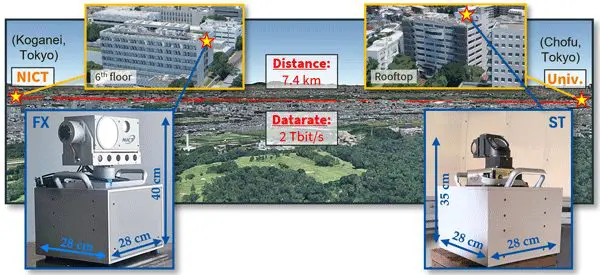
The National Institute of Information and Communications Technology (NICT) has achieved a world-first demonstration of 2 Tbit/s free-space optical (FSO) communication utilizing small optical terminals suitable for satellite and High Altitude Platform Station (HAPS) deployment. This experiment, conducted between NICT Headquarters in Koganei, Tokyo, and a site 7.4 km away in Chofu, Tokyo, employed a high-performance FX transceiver and a simplified ST transponder to maintain stable communication despite urban atmospheric turbulence. Utilizing Wavelength Division Multiplexing (WDM) transmission of five 400 Gbit/s channels, this achievement represents a significant step towards the practical application of Beyond 5G/6G Non-Terrestrial Networks (NTN).
Successful 2 Tbit/s Free-Space Optical Communication Demonstration
The National Institute of Information and Communications Technology (NICT) achieved a world-first demonstration of 2 Tbit/s free-space optical (FSO) communication. This utilized small optical terminals designed for mounting on satellites and High Altitude Platform Stations (HAPS). The experiment connected a high-performance FX unit at NICT Headquarters with a simplified ST unit 7.4 km away, maintaining stable communication despite urban atmospheric turbulence. This advancement marks a significant step towards practical Non-Terrestrial Networks (NTN) for future communication standards.
This 2 Tbit/s communication was achieved through Wavelength Division Multiplexing (WDM) transmission, successfully sending 5 channels, each at 400 Gbit/s. Notably, this is the first demonstration of terabit-class communication using terminals small enough for satellite or HAPS deployment. The successful test took place in an urban environment, presenting challenges from atmospheric turbulence that can disrupt laser beams – a condition the system overcame to maintain stable data transfer.
NICT plans to continue advancing this technology with future demonstrations. These include aiming for 10 Gbit/s communication between a Low Earth Orbit (LEO) satellite (approx. 600 km altitude) and the ground by 2026. Further tests are planned for 2027 to achieve communication between a satellite and a HAPS. The goal is to demonstrate compact, ultra-high-speed data communication, paving the way for Beyond 5G/6G NTN implementation.
Future Plans for Expanding Non-Terrestrial Network Capabilities
The National Institute of Information and Communications Technology (NICT) achieved a world-first 2 Tbit/s free-space optical (FSO) communication using small terminals, paving the way for expanded Non-Terrestrial Network (NTN) capabilities. This demonstration utilized a high-performance FX terminal and a simplified ST terminal separated by 7.4 km in a challenging urban environment with atmospheric turbulence. Stable communication was maintained through Wavelength Division Multiplexing (WDM) transmitting 5 channels, each at 400 Gbit/s, proving the feasibility of terabit-class data transmission with miniaturized equipment.
NICT is actively pursuing further miniaturization of these terminals, with plans to implement them onboard a 6U CubeSat. Future demonstrations are targeted for 2026, aiming for 10 Gbit/s communication between a Low Earth Orbit (LEO) satellite (approximately 600 km altitude) and ground stations. In 2027, they plan to demonstrate communication between a satellite and High Altitude Platform Stations (HAPS), showcasing compact, ultra-high-speed data communication.
These advancements are critical for realizing Beyond 5G/6G NTNs. The successful 2 Tbit/s demonstration, along with planned LEO and HAPS experiments, will demonstrate the viability of these technologies for future networks. NICT’s work focuses on enabling compact, ultra-high-speed data communication, addressing a key requirement for expanding network coverage beyond terrestrial infrastructure.




See today’s quantum computing news on Quantum Zeitgeist for the latest breakthroughs in qubits, hardware, algorithms, and industry deals.