Researchers at the Research Center for Non-Destructive Testing and Johannes Kepler University have demonstrated a new approach to infrared spectroscopy that achieves a signal-to-noise ratio improvement of 26.8 dB (a factor of 21.8) compared to classical methods. The team’s sQFTIR technique reconstructs mid-infrared spectra (3000 cm-1 to 2380 cm-1) from measurements taken in the near-IR range (approximately 780 nm to 820 nm), eliminating the need for direct mid-IR measurements. This advancement removes the traditional requirement for optical delay scanning, utilizing instead a static, low-gain nonlinear interferometer and a reconstruction algorithm. The work, licensed July 20, 2026, demonstrates rapid hyperspectral imaging with a spatial resolution of 12.3 µm and acquisition times down to 10 milliseconds, successfully mapping human colon tissue, microplastics, and polymer samples.
Classical FTIR Limitations and Emerging Quantum Methods
Classical Fourier-transform infrared (FTIR) spectroscopy, a mainstay of chemical analysis for decades, is now encountering inherent limitations stemming from the challenges of mid-infrared sources and detectors. While variations of the technique remain widely adopted across fields from molecular studies to industrial process monitoring, the pursuit of greater sensitivity and speed has driven exploration of alternative approaches. These include laser-driven, up-conversion, and, most recently, quantum-based methods, particularly sensing with undetected photons. Researchers are increasingly focused on exploiting quantum phenomena like photon entanglement to bypass constraints of traditional FTIR. The core principle involves separating the spectral domains of probing and detection, a concept central to recent advancements in quantum FTIR (QFTIR) spectroscopy. This approach, detailed in the current work, moves beyond simply adapting existing techniques; it fundamentally alters the data acquisition process.
A key innovation is the elimination of optical delay scanning, a standard practice in classical FTIR, replaced by a static, low-gain nonlinear interferometer. This shift is underpinned by robust mathematical principles. The team demonstrates a substantial leap in sensitivity, achieving a difference of 26.8 dB (a factor of 21.8) over conventional scan-based methods. This ability to retrieve time-domain signals and reconstruct spectra facilitates high-speed, robust sampling, and opens new avenues for hyperspectral imaging applications.
The system achieves a spatial resolution of 3 µm and spectral resolution down to 8 cm-1. Demonstrations on materials like human colon tissue, microplastics, and multilayer polymer samples have yielded high-quality single-pixel spectra with acquisition times as low as 10 milliseconds. This speed and sensitivity represent a substantial leap forward, potentially unlocking new applications in fields ranging from biomedical diagnostics to industrial process monitoring, and offering a compelling alternative to established infrared spectroscopic techniques.
SPDC and Nonlinear Interferometry in sQFTIR
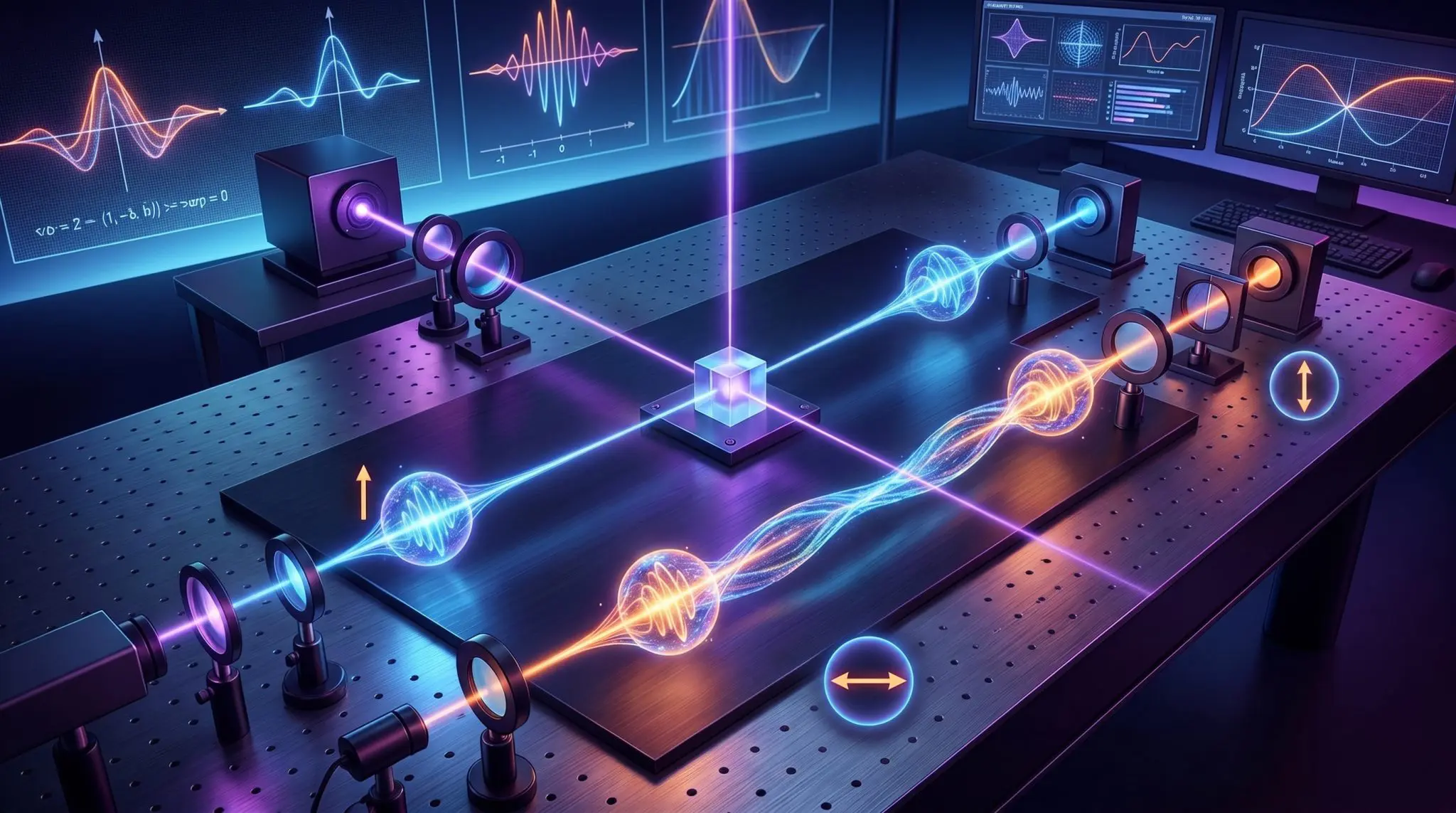
The potential to rapidly analyze materials at the molecular level has taken a significant step forward with the development of scanless quantum Fourier-transform infrared spectroscopy, or sQFTIR. This technique bypasses longstanding limitations in traditional infrared spectroscopy by leveraging the principles of quantum optics and entangled photons, offering a pathway to faster, more sensitive chemical analysis. Central to sQFTIR is the exploitation of spontaneous parametric down-conversion (SPDC), a process where a pump laser generates pairs of signal and idler photons within a nonlinear crystal. These entangled photons are then used to encode mid-infrared spectral information into the near-infrared range, circumventing the need for direct mid-IR detection. This innovative approach fundamentally alters how spectral data is collected; instead of relying on scanning an optical delay to build up an interferogram, sQFTIR employs a static, low-gain nonlinear interferometer.
This static configuration, combined with a sophisticated reconstruction algorithm, allows for the retrieval of time-domain signals and the reconstruction of mid-infrared spectra from near-IR measurements spanning 3000 to 2380 wavenumbers. The benefits are substantial. The team demonstrated a remarkable sensitivity improvement of 26.8 dB (a factor of 21.8), over conventional scan-based methods, a result stemming from the inherent multiplexing capabilities of frequency-domain acquisition. This coherent averaging, similar to principles used in optical coherence tomography, allows for the simultaneous acquisition of spectral and spatial information. Kaufmann et al.
Researchers have demonstrated a sQFTIR technique that fundamentally alters how infrared spectra are acquired, moving away from time-domain measurements to a static, frequency-domain system. This shift isn’t merely a technical refinement; it represents a departure from established practice, eliminating the mechanical components traditionally required to build up an infrared signal. This is made possible by a low-gain nonlinear interferometer operating in a static configuration, a significant contrast to the dynamic systems of conventional FTIR. The implications of this scanless methodology extend beyond simply speeding up data acquisition; the team demonstrated a substantial leap in sensitivity. Analysis reveals an intrinsic signal-to-noise advantage, quantified as a difference of 26.8 dB (a factor of 21.8) over traditional scan-based methods. This enhancement stems from a “multiplex advantage associated with multipixel detection and coherent averaging,” effectively harnessing the power of simultaneous data collection. Therefore, the sQFTIR technique isn’t just about eliminating a mechanical step, but about fundamentally improving the quality and speed of infrared spectral analysis.
The pursuit of increasingly detailed chemical analysis has driven continuous refinement of hyperspectral imaging techniques, yet conventional Fourier-transform infrared (FTIR) spectroscopy remains constrained by the need for mechanical scanning to collect data. Recent advances, however, demonstrate a departure from this established practice with the development of scanless quantum FTIR (sQFTIR), a method that promises significantly enhanced performance. This technique bypasses traditional time-domain measurements by leveraging frequency-domain analysis and entangled photons, achieving a signal-to-noise ratio improvement of 26.8 dB (a factor of 21.8) over classical FTIR systems. The sQFTIR system achieves a spatial resolution of 12.3 µm alongside a spectral resolution reaching 8 cm-1, facilitating rapid hyperspectral mapping. This innovative methodology represents a significant step towards faster, more sensitive, and robust hyperspectral imaging capabilities for a wide range of applications.
These theorems aren’t merely theoretical underpinnings; they directly enable the reconstruction of mid-infrared spectra from measurements taken in the near-infrared range, a surprising departure from conventional FTIR methods. This allows for the creation of a static, low-gain nonlinear interferometer, eliminating the need for the traditionally cumbersome optical delay scanning. Parseval’s theorem further ensures the conservation of energy and noise power as data transitions between these domains, maximizing signal clarity and minimizing data loss. This theoretical framework translates into a substantial practical advantage. The researchers report a quantified signal-to-noise ratio improvement of 26.8 dB (a factor of 21.8), demonstrating a significant leap in sensitivity compared to classical FTIR systems. This isn’t simply a marginal gain; it represents a fundamental shift in the limits of detection achievable with infrared spectroscopy, facilitated by the elegant interplay of these mathematical principles and a carefully designed quantum optical setup.
Source: https://arxiv.org/abs/2607.17964



See today’s quantum computing news on Quantum Zeitgeist for the latest breakthroughs in qubits, hardware, algorithms, and industry deals.