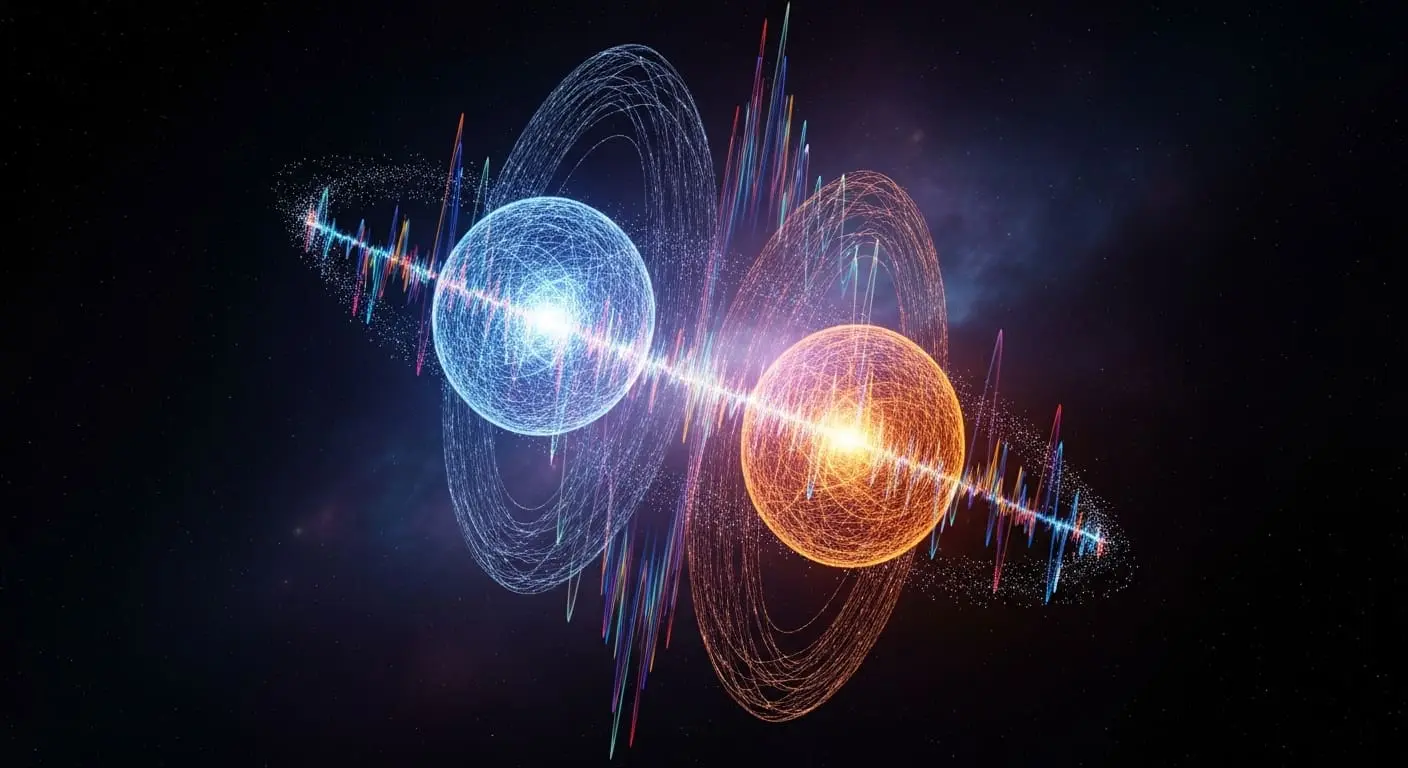
Andreas Blommaert and colleagues at Princeton University present a new calculation using a sum over SL(2,Z) Kerr-lens spacetimes and a holographic duality to complex Liouville string theory. The calculation yields an exact quantum computation of spectral density, matching predictions from semi-classical gravity and revealing a connection to the double scaled SYK model. This work provides a key microscopic understanding of de Sitter space through a worldline holographic approach.
Exact Quantum Computation of de Sitter Density of States via Holographic Duality and Kerr-lens
Previously, calculating the density of states for an observer within de Sitter space relied on approximations and semi-classical methods; the new method delivers an exact quantum computation, a first for this cosmological environment. This breakthrough originates from a novel approach summing over SL(2,Z) Kerr-lens spacetimes, theoretical geometries representing possible spacetimes around an observer, and employing a holographic duality to complex Liouville string theory, a sophisticated mathematical framework rooted in conformal field theory. The resulting spectral density calculation precisely matches predictions from semi-classical gravity, validating the methodology and offering insights into the double scaled SYK model, a theoretical tool used to understand complex quantum systems. The significance lies in providing a well-defined, computable quantity, the density of states, for a space where quantum effects are expected to be prominent, offering a pathway towards a complete theory of quantum gravity in a cosmological setting.
A new quantum computation technique has determined the density of states within de Sitter space, a measure of available quantum states, crucial for understanding the universe’s evolution and its ultimate fate. This calculation depends on summing over SL(2,Z) Kerr-lens spacetimes, theoretical representations of space around an observer, and utilizes a holographic duality linking de Sitter gravity to complex Liouville string theory, a sophisticated mathematical tool that allows for the translation of gravitational problems into more tractable quantum mechanical ones. The spectral density calculation confirms the accuracy of the approach and provides new insights into the double scaled SYK model, a theoretical framework for understanding complex quantum systems, aligning with predictions derived from semi-classical gravity. Furthermore, the methodology reveals a precise embedding of the double scaled SYK model within 3d quantum cosmology; torus universes, essential for radial quantization, are holographically related to two copies of the SYK collective field theory. This connection suggests that the dynamics of de Sitter space may be understood as a consequence of the collective behaviour of many quantum mechanical degrees of freedom, mirroring the behaviour observed in the SYK model.
Mapping Kerr-lens spacetimes via holographic duality and Liouville string theory
Holographic duality proved central to the calculations, functioning as a mathematical equivalence between a theory of gravity in a higher-dimensional space and a simpler quantum theory on its boundary, much like a realistic 3D movie projected from a 2D surface. This principle, originating from string theory and the AdS/CFT correspondence, allows physicists to study strongly coupled quantum systems by mapping them to weakly coupled gravitational theories, and vice versa. Utilising this duality, the team mapped SL(2,Z) Kerr-lens spacetimes, visualised as a set of slightly distorted lenses each representing a possible geometry of spacetime, onto a family of generalised crosscap geometries. These crosscap geometries are particularly relevant as they encode information about the topology of spacetime and are essential for defining the boundary conditions for the holographic calculation. This transformation allowed for the computation of amplitudes using a complex Liouville string theory, a sophisticated mathematical framework for describing string interactions, and ultimately defined the density of states within the de Sitter static patch. The Liouville string theory provides a natural framework for incorporating the quantum fluctuations of the spacetime geometry, which are crucial for calculating the density of states accurately.
Quantifying quantum states in de Sitter space advances cosmological understanding
Researchers at Princeton University and the Institute for Advanced Study have devised a method for calculating the density of states within de Sitter space, an important step towards resolving fundamental questions about the universe’s expansion and the nature of quantum gravity. Current calculations, however, are demonstrated only for the simplest Kerr-lens spacetime, a theoretical representation of space around an observer, and it remains an open question whether this approach extends to more complex, realistic cosmological scenarios. Despite applying currently only to a simplified model of spacetime, this work represents a major advance in understanding de Sitter space. The static patch considered in this study represents the observable universe for a comoving observer, providing a localized perspective on the global de Sitter geometry.
De Sitter space describes an expanding universe, and calculating its density of states, in effect, counting the possible quantum states within it, is vital for tackling questions about quantum gravity, a theory unifying quantum mechanics and general relativity. The calculation delivers an exact quantum computation of the density of states within three-dimensional de Sitter space, achieved by summing over a series of theoretical spacetime geometries known as Kerr-lens spacetimes. Each Kerr-lens spacetime represents a possible history or worldline of an observer within de Sitter space, and the sum over these geometries effectively accounts for all possible quantum fluctuations of the spacetime. This calculation, underpinned by holographic duality, a mathematical link between gravity and quantum theory, establishes a microscopic description of de Sitter space previously inaccessible to direct computation. Quantifying quantum states in de Sitter space advances cosmological understanding. Current calculations, however, are demonstrated only for the simplest Kerr-lens spacetime, a theoretical representation of space around an observer, and it remains an open question whether this approach extends to more complex, realistic cosmological scenarios. Above all, the resulting framework reveals a connection between this cosmology and the double scaled SYK model, a theoretical tool used to study complex quantum systems, suggesting a deeper relationship between gravity and quantum chaos. The SYK model, originally developed to understand the behaviour of strongly interacting electrons, provides a surprisingly accurate analogue for the quantum dynamics of de Sitter space, hinting at a universal underlying principle governing both systems. The precise correspondence allows for the application of techniques developed in the context of the SYK model to gain insights into the quantum properties of de Sitter space, and vice versa.
The researchers calculated the density of states within three-dimensional de Sitter space using a sum over Kerr-lens spacetimes and a holographic duality. This is important because quantifying quantum states in de Sitter space is a key step towards resolving fundamental questions in quantum gravity and cosmology. The computation provides a microscopic description of this space, previously difficult to achieve through direct calculation, and establishes a link between de Sitter space and the double scaled SYK model. The authors suggest this framework may allow for the development of a microscopic worldline hologram of 3d de Sitter.
👉 More information
🗞 An observer’s quantization of 3d de Sitter
🧠 ArXiv: https://arxiv.org/abs/2606.26241


See today’s quantum computing news on Quantum Zeitgeist for the latest breakthroughs in qubits, hardware, algorithms, and industry deals.