

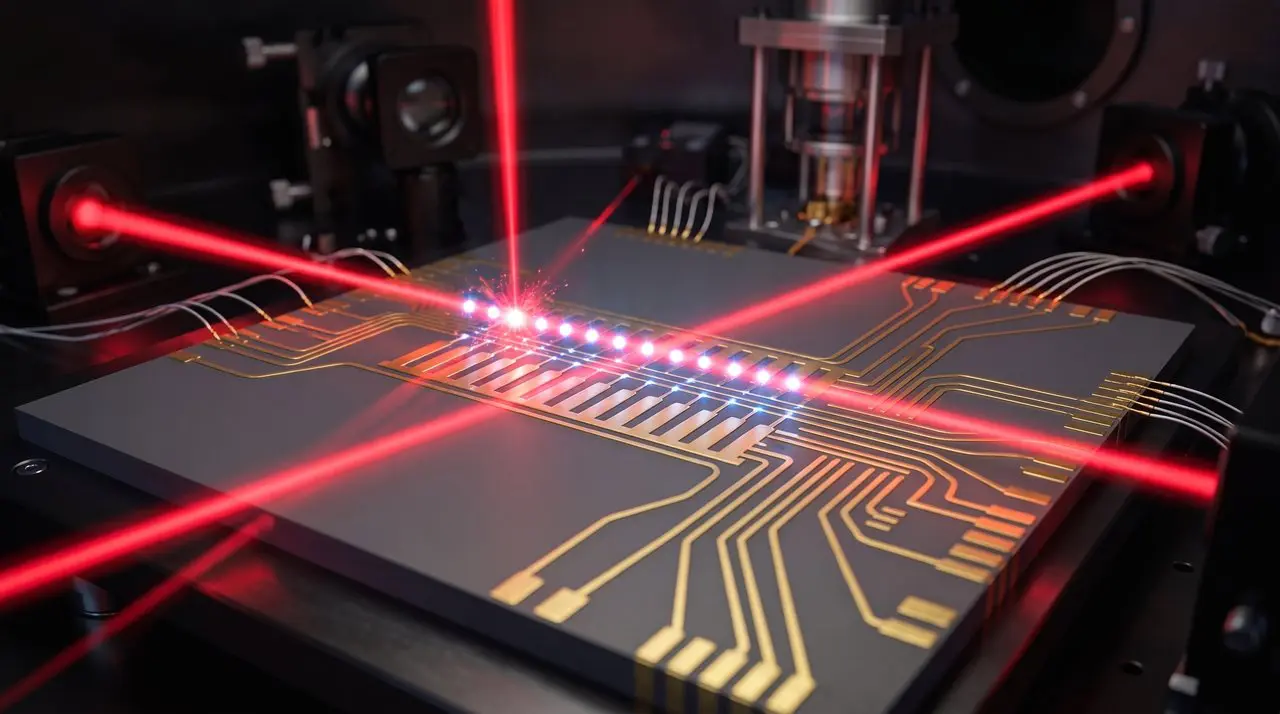
Intense laser light shapes to precisely control complex quantum states known as Schrödinger cats. Manipulation of the polarisation and spatial structure of high-harmonic generation (HHG) beams engineers these delicate quantum systems. Geometrical manipulation of cat state parameters is now possible; structured illumination provides flexible means for controlling their dynamics across a broad range of conditions. Researchers have achieved greater command over specially created quantum states of light called Schrödinger cats using shaped laser beams.
This builds upon existing techniques involving high-harmonic generation, where lasers interacting with matter create new frequencies of light by fully considering quantum effects within the driving laser itself. Techniques to command delicate quantum states known as Schrödinger cats are being refined; imagining a coin spinning in the air perfectly illustrates this concept, before it lands, it exists simultaneously as both heads and tails. These ‘cat’ states represent superpositions where multiple possibilities exist concurrently, offering potential for advanced technologies like improved sensors and secure communication networks.
The work builds upon high-harmonic generation (HHG), which can be likened to shining a bright torch through a prism but creating entirely new wavelengths of light at extremely intense levels. By carefully shaping laser beams during HHG, controlling their polarisation and spatial structure, researchers manipulate cat state parameters with unprecedented precision.
Geometric shaping of intense laser fields enables controlled manipulation of optical Schrödinger
Intensities exceeding 10 13, 10 15W/cm 2 have been attained during high-harmonic generation (HHG), reaching levels comparable to atomic Coulomb fields and enabling previously impossible quantum state manipulation. Before this advancement, controlling the delicate superposition inherent in Schrödinger cat states remained elusive at such scales. Manipulating both polarisation and spatial structure demonstrated geometrical control over these complex quantum systems; structured illumination influences their evolution within phase space across varying parameters.
A range between 10 13 and 10 15W/cm 2 enabled geometric control of optical Schrödinger cat states via high-harmonic generation (HHG). The process converts laser light into new frequencies, modifying the initial quantum state of the driving field through photon redistribution amongst modes.
Geometric phases arising from interaction with matter were characterised by analysing displacements of coherent states induced by this structured illumination. Exploration of manipulating polarisation using rotating ellipses and spatial structure via Full Poincaré beams influenced these complex systems; such control is vital for creating genuinely topological cat states suitable for enhanced precision measurements.
Harmonic correlation analysis unlocks pathways towards topologically protected Schrödinger cat state realisation
Advances in diverse fields, including precision sensing and secure communication networks, are promised by control over Schrödinger cat states. Demonstrating complex winding properties within “genuinely topological” configurations, however, remains largely theoretical due to significant hurdles in measurement protocols. Refinement of conditional measurements requires detailed analysis correlating emitted harmonics with characteristics of initial laser illumination during high-harmonic generation. Structured laser beams facilitated precise control over these delicate Schrödinger cat configurations, manipulating their geometric properties within phase space with considerable finesse. This ability represents an advance beyond previous approaches that treated electromagnetic fields classically when modelling HHG. Manipulating both the polarisation, the orientation of the electric field within each wave, and spatial structure across varying conditions resulted in flexible command over these systems.
The research demonstrated controlled manipulation of optical Schrödinger cat states using high-harmonic generation driven by structured light between 10 13 and 10 15 W/cm 2. By analysing how different laser beam shapes influence quantum state evolution in phase space, researchers showed geometric control is possible during harmonic generation, a process which redistributes photons to create new frequencies.
This represents a move beyond classical modelling of electromagnetic fields in HHG as it establishes correlations between the driving field and generated harmonics. The authors suggest further exploration with more complex illumination could lead to genuinely topological cat states suitable for precision measurements.
👉 More information
🗞 Geometric Control of Cat States in High Harmonic Generation
✍️ Arti Gaharwar, Rocío Borrego-Varillas, Marcelo F. Ciappina, Anna G. Ciriolo, Javier Rivera-Dean, Philipp Stammer, Paraskevas Tzallas, Emilio Pisanty and Maciej Lewenstein
🧠 ArXiv: https://arxiv.org/abs/2608.20119


See today’s quantum computing news on Quantum Zeitgeist for the latest breakthroughs in qubits, hardware, algorithms, and industry deals.



