

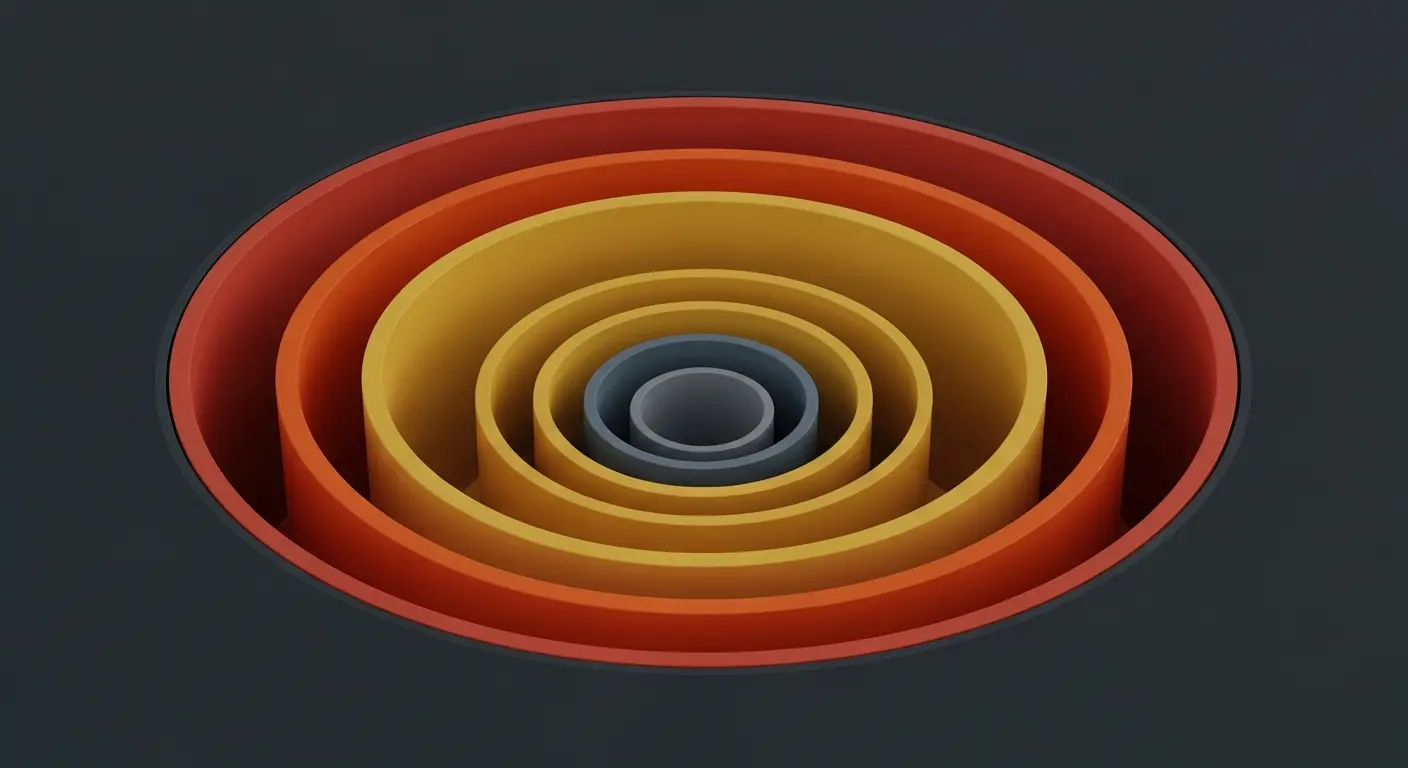
A low-dimensional holographic correspondence linking quantum chaos and gravity is now reviewed by Alexander Altland and Julian Sonner at the Institute for theoretical physics and University of Geneva. The review details how quantum chaos functions as both a universal element and a guiding principle in matching the properties of gravity in the ‘bulk’ with those of quantum mechanical boundary theories. Examination of early and late-time chaotic behaviours reveals the key role of incorporating elements of string theory to fully understand quantum gravity at its most fundamental scales, enabling potential higher-dimensional generalisations of this holographic approach.
Quantising black hole microstates via holographic duality and string theory extensions
The order of gravitational quantum level spacing is currently under investigation. Resolving these fine-grained quantum scales requires extending semiclassical gravity with elements of string theory. Higher dimensional generalizations of the chaotic holographic correspondence are considered as a future outlook. Solving gravity from its foundations in Einstein’s theory to the deep microstate quantization of black holes remains one of the biggest open problems in physics.
The discovery of the holographic correspondence represents a significant advance in this direction. It revealed a link between the geometric foundations of gravity and quantum field theory, providing a duality principle and the possibility to validate results obtained in one framework by comparison to the other. Maldacena’s duality between N = 4 super Yang-Mills theory and gravity in five-dimensional Anti-de Sitter space exemplifies this connection.
This work primarily reviews a simpler holographic correspondence, that between strongly interacting one-dimensional boundary theories (quantum mechanics) and two-dimensional gravity. This progress arose from the confluence of several ideas, notably the theory of strongly interacting fermion systems, random matrix theory, two-dimensional gravity, and topological string field theory. Quantum chaos links these different fields of physics through a single organizing concept.
The appearance of chaos in this context is unsurprising, reflecting the maximally entropic, or chaotic, nature of black holes. A distinctive aspect of the two-dimensional holographic correspondence, central to this article, is how quantum chaos acts as a source of universality, revealing connections that might otherwise have remained opaque. The correspondence revolves around three theories: the SYK model of N randomly interacting Majorana fermions as a boundary theory, the Jackiw-Teitelboim (JT) gravitational path integral, and Kodaira-Spencer (KS) field theory as its string-theoretical completion.
Two independent “bridges” establish the connection between the SYK boundary and the JT/KS bulk. The first describes early-time chaotic instabilities at scales ∼N, manifesting as operator scrambling or quantum butterfly effects. Late time scales, ∼exp(N), are addressed by the second bridge, where chaotic correlations of spectra or even structures with single level resolution take centre stage. Anchorage of the correspondence in two well-understood theories gives it a high level of concreteness and makes it the most fine-grained formulation of a holographic principle known to date.
Realising two distinguishing features of the low-dimensional setting is important for contextualizing this development within holography at large. Two-dimensional gravity is conceptually simpler than its higher dimensional counterparts, bearing similarity with two-dimensional electrodynamics. It lacks propagating degrees of freedom, Einstein equations being of second order, their solutions are essentially fixed by boundary data, bringing topology to the forefront of principles determining its solutions.
Furthermore, the concrete framework discussed here departs from the orthodox mindset of holography in that it is statistical in nature, relating ensemble averages of strongly fluctuating boundary observables to smooth bulk structures. By contrast, the original holographic principle calls for an exact equivalence between a microscopically defined boundary Hamiltonian and a bulk dual. The conceptual status of ensemble averaging remains under active investigation.
One interpretation rationalizes the ensemble by considering low-dimensional holography as an effective theory, obtained by integration over the many degrees of freedom (‘ensemble’) of higher-dimensional parent theories. Irrespective of its origin, the presence of a statistical principle has its own merits. Ensemble averaging isolates universal signatures of quantum chaos after sample-to-sample information has been averaged out, while retaining access to fine-grained system information through higher statistical moments.
Spectral correlation functions probe the two-dimensional gravitational spectrum down to individual black hole microstates, i.e. the highest possible level of resolution in this context. Attempts to lift these insights to higher dimensions are underway, but these developments are only beginning. This work reviews the 2D holographic correspondence in a manner hopefully accessible to both high- and low-energy physicists. Addressing an interdisciplinary readership requires some compromise.
Background material on the two-dimensional AdS black hole or basics of the statistical theory of quantum chaos is included, which may be skipped by readers of the respective camps. In formulas, X ∼(. is often written, omitting numerical factors, prioritizing parametric connections over numerical accuracy. Several directions cannot be adequately covered in this short review. Specifically, the periodic-orbit/trace-formula approach to JT/matrix-theory physics and the growing literature on coupling matter to JT gravity would each require a substantial separate discussion.
Readers interested in a review focused on JT gravity are referred to relevant publications. Before examining the details, let us briefly outline two-dimensional holography for those unfamiliar with it. Two-dimensional gravity is concerned with the geometry of surfaces, which can have holes (like a torus), or boundaries (like a cylinder), or both. While this setting leaves room for geometric complexity, the restriction to AdS geometries imposes constant negative curvature.
Two-dimensional geometries constrained in this way are rich, but simple enough to be quantitatively describable. In 2D holography, surface boundaries (with the topology of circles) are loaded with quantum systems, the boundary coordinates playing the role of time. These spatially zero-dimensional systems are quantum chaotic, and the prevalent reading is that the surface structures connecting them describe quantum chaotic correlations between different replicas of boundary systems in an ensemble averaged sense.
In other words, the surface geometries encode information otherwise contained in the statistical correlations of a random matrix ensemble. Topology is the common ground on which these perspectives meet. Both random matrix correlations and the surface structures connecting boundaries can be organized in hierarchies of ascending topological complexity, and a breakthrough result of the field is the demonstration that the two approaches quantitatively agree.
In this way, chaotic complexity has been geometrized to infinite order in perturbation theory. The first five sections of this review cover these developments. The final chapter of the story is the non-perturbative completion of the theory towards a level of precision where statistical correlations between individual gravitational quantum states are resolved. Understanding the bulk surface structures in terms of the worldsheets of topological strings can achieve this.
This extension naturally connects to non-perturbative approaches to quantum chaos via nonlinear σ-models, completing the description of gravitational quantum chaotic correlations. The detailed narrative begins with reviews of its main protagonists, the SYK model (section 2) and JT gravity (section 3). Section 4 discusses matrix theory from the two perspectives required in the context of the holographic correspondence: matrices as proxies of topological geometric structures, and as models for chaotic correlations. This will form the basis for a comparison between the expansion of the JT path integral in gravitational geometries of ascending complexity and the perturbative 1/N-expansion of a matrix ensemble in section 5. Finally, section 6 will demonstrate how a non-perturbative completion of the JT path integral is achieved by the inclusion of elements of string theory.
This extension addresses two problems at once: the statistical ensemble nature of the theory, and the description of the gravitational spectrum down to the level of individual microstates. An outlook on the extension of the theory to higher dimensions is presented in section 7. The SYK model was proposed in 2015 as a holographic boundary dual of two-dimensional gravity, and had to fulfil a number of expectations: 1) quantum chaotic behaviour leading to maximal entropy across all relevant time scales, 2) absence of spatial extension, making it a 0 + 1-dimensional system in zero space and one time-dimension, and 3) conformal symmetry in this time direction to stay close to the ‘AdS/CFT’ paradigm, which posits conformal boundary theories as partners of AdS spaces. Since its introduction, the model has become a paradigm in the field of many-body physics at large, with applications in condensed matter physics, chaos, and gravity.
Extensive reviews can be found in the cited references. Kitaev satisfied all three conditions in terms of a deceptively simple model definition involving N ≫ Majorana fermions ηa, i.e. real fermions with commutation relations [ηa, ηb]+ = 2δab, governed by the Hamiltonian H = 1 4. N X a,b,c,d Jabcd ηaηbηcηd with Gaussian distributed all-to-all exchange constants ⟨|Jabcd|2⟩= 6 J2 N3. The absence of a quadratic term makes this a model of ‘infinitely strong’ particle interactions. Quantum chaos and the holographic principle are central to the SYK models, which stand in the tradition of an older family of model systems introduced in the early 1970s to describe the statistical properties of heavy nuclei.
As an alternative to the then popular, modelling of the nuclear Hamiltonian as a random matrix, this more refined approach started from the two-body interaction H = PN α,.,δ=1 Jα,.,δc† αc† βcγcδ of N ‘hadrons’, with O(N4) randomly distributed coupling constants {Jα,.,δ}. In this way, these models defined ensembles ’embedded’ into a ∼2N-dimensional Hilbert space by a comparatively small number of statistically independent parameters. At the time, the statistical correlations present in the embedded ensembles were considered too complex for analytical solutions. Apart from the numerical observation of an approximately Gaussian distributed many-body density of states, their physics remained poorly understood.
Recent years have witnessed progress in developing a low-dimensional holographic correspondence, specifically constructing quantum mechanical boundary theories as holographic duals of two-dimensional gravity. Quantum chaos played a role in these developments, acting as a source of universality and guiding the matching of bulk and boundary signatures of gravity. This correspondence revolves around the SYK model, two-dimensional Jackiw-Teitelboim gravity, and Kodaira-Spencer field theory.
Enhanced spectral resolution reveals black hole microstates through holographic duality
Spectral resolution of two-dimensional gravity has improved from scales of ∼N to ∼exp(N), enabling the probing of individual black hole microstates for the first time. This advancement surpasses previous holographic principles, which lacked the granularity to resolve quantum gravity at such fine scales, and anchors the correspondence to established theories like the SYK model and Jackiw-Teitelboim gravity. The resulting low-dimensional holographic correspondence links quantum mechanical boundary theories to two-dimensional gravity via quantum chaos, acting as both a universal element and a guiding principle for matching bulk and boundary signatures.
This framework requires incorporating elements of string theory to accurately describe gravitational quantum level spacing; previously, semiclassical gravity was insufficient at these resolutions. A fine-grained low-dimensional holographic correspondence has been developed, constructing quantum mechanical boundary theories as holographic duals of two-dimensional gravity, where quantum chaos plays a role as a source of universality. This development allows examination of late time scales, up to the order of gravitational quantum level spacing, and establishes connections with models such as the SYK model and Jackiw-Teitelboim gravity. Extending semiclassical gravity with string theory elements, specifically Kodaira-Spencer field theory, is now needed to resolve these fine-grained quantum scales.
String theory necessity and quantum chaos in holographic gravity
The pursuit of a holographic correspondence, a mapping between gravity and quantum mechanics, promises a deeper understanding of black holes and the very fabric of spacetime. However, this latest work, while demonstrating the necessity of string theory to resolve gravitational quantum scales, stops short of fully integrating these elements into the existing two-dimensional framework. This limitation highlights a persistent tension within holography: the desire for precise, microscopic descriptions and the challenges of maintaining a consistent macroscopic picture.
The researchers successfully established a low-dimensional holographic correspondence, linking quantum mechanical theories to two-dimensional gravity through the principles of quantum chaos. This means they created a framework for understanding how gravity can emerge from quantum systems, utilising models such as the SYK model and Jackiw-Teitelboim gravity. The study demonstrates that accurately resolving gravity at extremely small scales requires incorporating elements of string theory, extending beyond traditional semiclassical approaches. The authors suggest future work will focus on generalising this chaotic holographic correspondence to higher dimensions.
👉 More information
🗞 Quantum chaos and the holographic principle
🧠 ArXiv: https://arxiv.org/abs/2604.12784



See today’s quantum computing news on Quantum Zeitgeist for the latest breakthroughs in qubits, hardware, algorithms, and industry deals.



