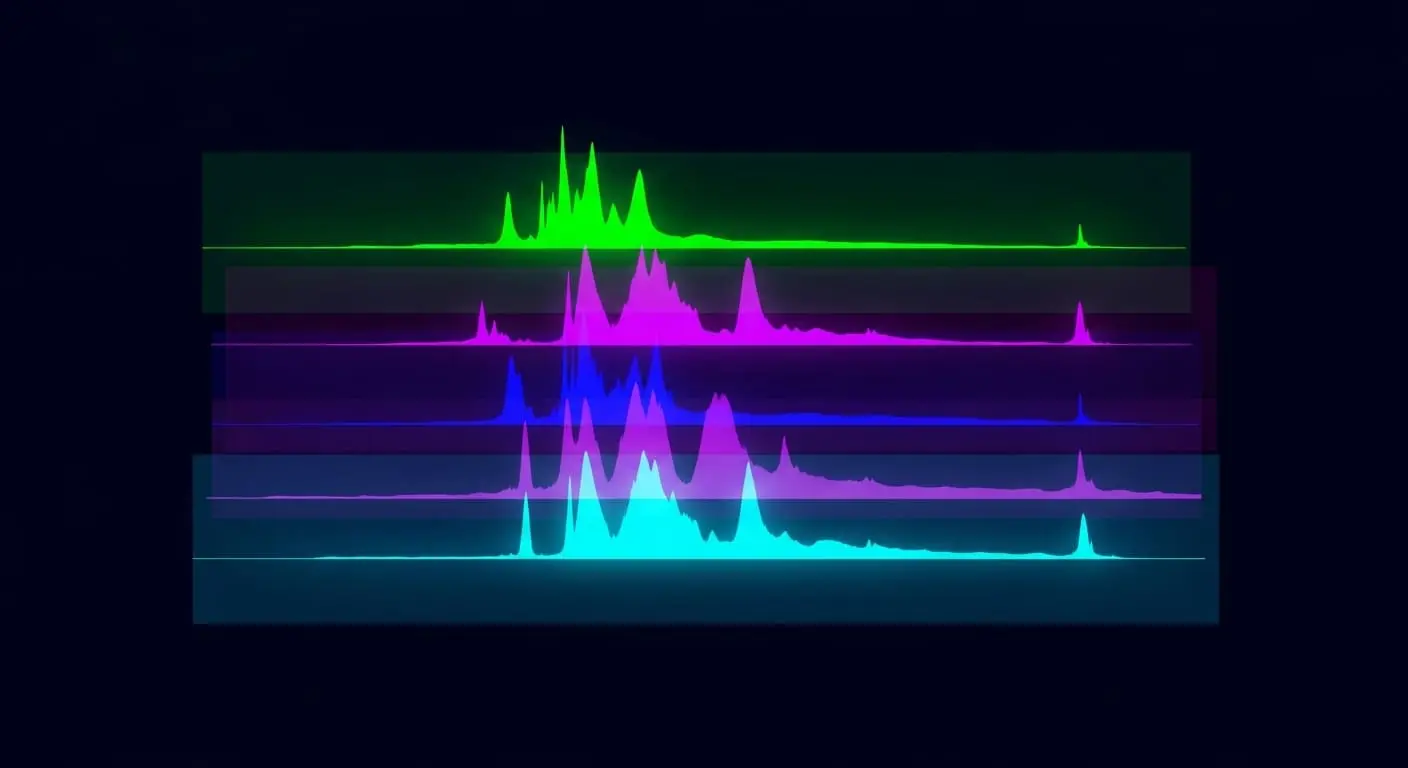
Yongxu Fu, Zhejiang Normal University, has analytically described dynamically separated Z2 skin channels in non-Hermitian systems, revealing how these channels circulate around one-dimensional chains, tracing semiclassical worldlines. A rigorous analytical description of these Z2 skin channels was previously largely unexplored, hindering full understanding of their behaviour. By combining semiclassical and skin-effect theories, the team shows that these circulations induce quantum revivals and dynamical quantum phase transitions exhibiting scale-dependent behaviour, quantified by a spectral winding number of one.
Yongxu Fu, Zhejiang Normal University, has analytically described how unusual energy channels, termed Z2 skin channels, behave within materials exhibiting anomalous time-reversal symmetry. These channels circulate within the material’s structure, a process linked to a well-established ‘skin effect’ where energy concentrates at material edges. This clarifies the connection between these channels and the skin effect, deepening understanding of non-Hermitian physics, a branch of physics exploring systems that do not follow conventional energy conservation rules.
Yongxu Fu, Zhejiang Normal University, has detailed the behaviour of unusual energy pathways, known as Z2 skin channels, within materials that don’t adhere to standard energy conservation rules; these systems can be conceptualised as a simplified model of a slightly leaky bucket. These channels concentrate energy flow at the edges of a material, behaving similarly to how water accelerates around the edges of a riverbed. The team found these channels circulate within the material’s structure, tracing a path, a ‘semiclassical worldline’, analogous to tracking a parcel’s delivery route. This circulation leads to predictable energy revivals and shifts in the material’s quantum state, with the nature of these shifts dependent on the material’s scale. The analytical description clarifies the connection between these channels and the ‘skin effect’, but questions remain about how these findings might be applied to engineer materials with tailored quantum properties.
Dynamical channel separation reveals non-trivial topological properties and scale-dependent quantum
Analytical descriptions of Z2 skin channels, previously unexplored, are now possible, moving beyond reliance on the winding-control mechanism established in earlier work. This represents a key advance because prior methods were limited to systems exhibiting the ordinary skin effect. Dynamically separated channels arise in non-Hermitian systems with anomalous time-reversal symmetry, circulating around one-dimensional chains and tracing semiclassical worldlines, which enables the observation of quantum revivals.
This circulation induces dynamical quantum phase transitions exhibiting scale-dependent behaviour, distinguishing them from conventional transitions; the spectral winding number is identically zero for the Z2 skin effect but individually non-zero for each band. The analysis rigorously connects symmetry to dynamic evolution, although demonstration in systems beyond simple one-dimensional chains currently remains elusive, and a pathway to practical device applications is yet to be determined. Unlike standard transitions displaying consistent characteristics regardless of scale, these circulations also induce dynamical quantum phase transitions exhibiting scale-dependent behaviour. Validating previous work, the spectral winding number is confirmed to be zero overall for the Z2 skin effect, yet individually non-zero within each energy band. The channels evolve exponentially in momentum space, with amplitude maxima converging on dominant momenta, offering insight into their behaviour.
Semiclassical worldlines reveal dynamic energy transport in non-Hermitian systems
A mapping of complex quantum behaviour onto more intuitive, classical concepts was achieved by combining semiclassical and skin-effect theories, proving key to unlocking this analytical description of Z2 skin channels. The technique centres on tracking ‘semiclassical worldlines’, the path an energy packet takes as it moves through a material, analogous to tracing the route of a parcel delivery. Applying this perspective to non-Hermitian systems, a simplified model of a material where energy isn’t always conserved, like a slightly leaky bucket, allowed the team to visualise how energy flows along these unusual channels.
This visualisation revealed that the channels aren’t static pathways, but circulate within the material, a behaviour previously difficult to characterise analytically. Energy packet movement within non-Hermitian systems was analysed using ‘semiclassical worldlines’, offering a simplified alternative to fully quantum mechanical modelling. The analysis focused on one-dimensional chains exhibiting anomalous time-reversal symmetry, investigating the behaviour of dynamically separated Z2 skin channels. Demonstrating exponential time evolution in momentum space, these channels circulate within the material under periodic boundary conditions and reveal quantum revivals.
Winding control of energy transport in one-dimensional Z2 skin channels
A detailed analytical account of Z2 skin channels, unusual pathways for energy within materials that defy standard energy conservation, has finally been provided. This breakthrough builds on previous work establishing a ‘winding-control mechanism’ for these channels, yet the current analysis remains constrained to one-dimensional systems; extending these findings to more realistic, three-dimensional materials presents a considerable challenge. Understanding energy flow within these unusual pathways provides a fundamental building block for modelling more complex systems.
These findings rigorously confirm a previously proposed mechanism, offering a strong validation of the underlying physics. Scientists have now mapped how these dynamically separated Z2 skin channels, unusual pathways for energy within materials that do not follow typical energy conservation rules, evolve by combining semiclassical theory, tracking energy as if it followed a classical path, with established understanding of the skin effect, where energy concentrates at material edges. These channels circulate around one-dimensional chains, tracing a path termed a ‘semiclassical worldline’, and predictably lead to quantum revivals, where energy returns to its original state. Further investigations will begin to explore these effects in three-dimensional systems soon.
The research demonstrated that dynamically separated Z2 skin channels within one-dimensional materials exhibit predictable, exponential time evolution and circulate as semiclassical worldlines. This analytical description of these unusual energy pathways confirms a previously proposed winding-control mechanism and validates the underlying physics of the skin effect. These findings are important because they provide a fundamental understanding of energy transport in non-Hermitian systems with anomalous time-reversal symmetry. The authors intend to extend this work to explore these effects in three-dimensional systems.
👉 More information
🗞 Z2 Skin Channels and Scale-Dependent Dynamical Quantum Phase Transitions
🧠 ArXiv: https://arxiv.org/abs/2604.12450


See today’s quantum computing news on Quantum Zeitgeist for the latest breakthroughs in qubits, hardware, algorithms, and industry deals.