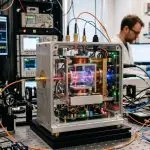
Quantum Source reports demonstrating a single-atom memory that increases entanglement rates between quantum processors by eliminating the need for simultaneous photon arrivals. This advancement addresses key barriers to fault tolerance and connectivity, previously insurmountable for single quantum hardware platforms. Former Israeli Prime Minister Naftali Bennett believes this approach, combining photons and atoms, offers “the most scalable path to fault-tolerant quantum computers.” The company also achieved a first: the demonstration of single-atom trapping and coupling near a planar photonic chip, an important step toward scalable atom-photon interfaces.
Atom-Photon Hybrid Architecture for Fault Tolerance
This achievement overcomes a significant engineering hurdle in integrating disparate quantum systems, allowing for strong interactions between individual atoms and photons on a single platform. Researchers successfully confined a single atom within the evanescent field of an integrated photonic resonator, enabling efficient coupling for quantum operations. This atom-photon coupling directly addresses the challenges of entanglement distribution, a key requirement for fault-tolerant quantum computation. This innovation simplifies the synchronization demands of quantum communication, a major obstacle for scaling quantum networks and distributed quantum computing.
The team’s work details how this memory enhances the reliability and speed of entanglement generation, which is important for error correction protocols. Bennett, also a Quantum Source Board Member, highlighted the potential of combining the strengths of photonic and atomic qubits to overcome limitations inherent in single-platform approaches.
The company’s blueprint aims to use photons for long-distance communication and atom-based quantum memory for robust data storage and processing. Quantum Source, recently voted by “Globes” readers as their favorite startup, is developing a quantum computer based on this combination of photons and cold atoms, founded by alumni of the Weizmann Institute and experienced chip entrepreneurs.
Source: https://www.qs-labs.com/post/v-the-path-to-scalable-quantum-computing-quantum-source-series-intro


See today’s quantum computing news on Quantum Zeitgeist for the latest breakthroughs in qubits, hardware, algorithms, and industry deals.