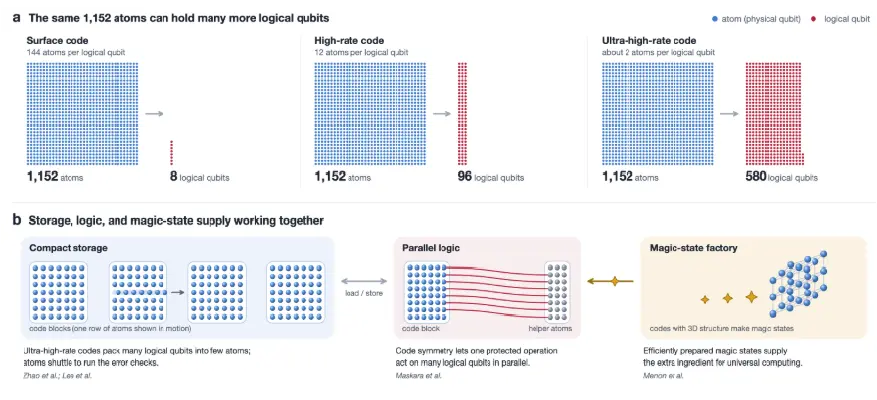
Researchers led by Hengyun Zhou at MIT and collaborators have designed quantum error correction codes encoding more than one logical qubit for every two physical data qubits, a remarkably efficient use of redundancy. The team bridged ultra-high-rate error-correcting codes with physical implementation using reconfigurable neutral-atom arrays, achieving extremely low error rates even accounting for faults in the protection circuits themselves.
By developing principles to balance quantum information storage, protection strength and error check complexity, the researchers introduced new code families requiring blocks of only hundreds of physical qubits. This work, conducted within the Center for Ultracold Atoms, illustrates how compact storage, parallel processing and efficient preparation of special quantum states can work together to advance quantum computing.
Ultra-High-Rate Codes & Reconfigurable Neutral-Atom Arrays
Researchers achieved this by co-designing the codes and their implementation for reconfigurable neutral-atom arrays, a platform initially pioneered by scientists within the Center for Ultracold Atoms. This shared protection extends across hundreds of logical qubits, minimizing the resources needed for reliable quantum computation. Computer simulations demonstrated extremely low error rates, even when accounting for errors within the protective circuits themselves. Efficient storage of quantum information is not the sole challenge; manipulating that information while maintaining its integrity is equally vital.
A collaborative study led by Nishad Maskara saw Zhou’s group partner with Mikhail Lukin’s group at Harvard to develop fast, parallel operations tailored for these ultra-high-rate codes. By using patterns and symmetries inherent in the codes, the team showed that multiple operations can effectively share the resources needed to shield them from errors.
They also devised methods for transferring specialized states into the computational process, a necessary step for universal quantum computation. The codes developed all have a distance of 12, a metric indicating the number of errors they can withstand before information is lost; for the ultra-high-rate code, 12 represents an upper limit. These principles allow researchers to systematically design more compact error-correcting codes, as detailed in their September 2026 publication.
“Every scheme also needs additional atoms for error checks,” the researchers note, clarifying that a distance of 12 does not automatically equate to identical error rates across all implementations. Varun Menon and colleagues, in work published this month, demonstrated single-shot magic state factories for quantum LDPC codes, further enhancing the toolkit for robust quantum computation.
Compact Code Design Principles Balance Protection and Storage
Researchers established principles to systematically balance quantum information storage capacity with the strength of its protection and the complexity of error checks, enabling the design of more compact error-correcting codes. This approach also provides designers with a clearer method for selecting codes tailored to their specific hardware. Jong Yeon Lee and colleagues further refined this approach, detailing how to systematically design codes that prioritize compactness while maintaining robust error protection.


See today’s quantum computing news on Quantum Zeitgeist for the latest breakthroughs in qubits, hardware, algorithms, and industry deals.