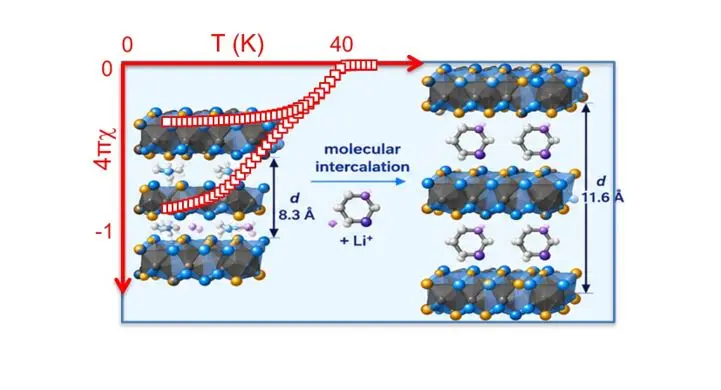
Synchrotron X-rays at the European Synchrotron Radiation Facility in France were instrumental in revealing how electron transfer, not layer spacing, controls superconductivity in iron-based materials. Research led by Dr. PhD candidate Myrsini Kaitatzi, first author of the resulting publication in Solids 220, 114128 (2027), details findings that provide important experimental evidence that microscopic electronic structure, not structural expansion alone, is central to understanding unconventional superconductivity.
Electron Transfer, Not Layer Spacing, Governs Superconductivity
Molecular insertion alters electron transfer within iron-based materials, a new study reveals, rather than simply increasing the distance between conducting layers. Researchers demonstrated this by modifying electron distribution, offering a potential pathway to tune superconductivity, the ability of a material to conduct electricity with zero resistance. This finding challenges the long-held assumption that expanding the space between layers was the primary control mechanism for achieving superconductivity at higher temperatures.
Synchrotron Mössbauer spectroscopy, combined with high-resolution X-ray diffraction, provided critical insight into these microscopic changes, probing both the atomic structure and the local electronic environment of iron. These results suggest that manipulating electron behavior, rather than physical spacing, is key to unlocking more effective superconducting materials.




See today’s quantum computing news on Quantum Zeitgeist for the latest breakthroughs in qubits, hardware, algorithms, and industry deals.