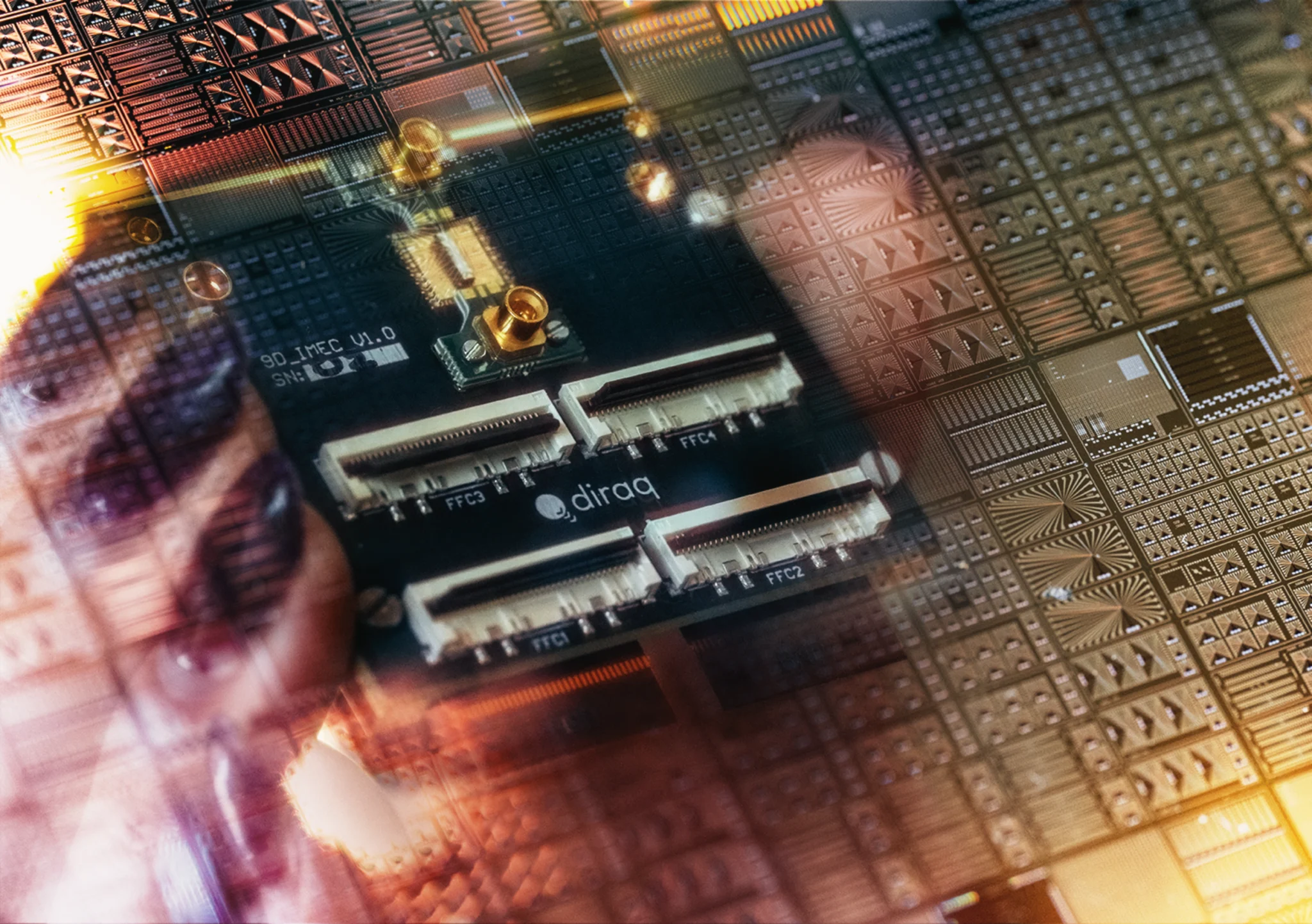
Diraq will receive up to US$300 million in funding from the U.S. Defense Advanced Research Projects Agency as it enters the final stage of the Quantum Benchmarking Initiative. This advancement allows Diraq to undergo independent verification and validation of its approach to building a utility-scale, fault-tolerant quantum computer by 2033, the company says.
“Advancing to Stage C of the QBI program represents a crucial independent validation that our path to utility-scale quantum computing holds up under rigorous technical scrutiny,” said Andrew Dzurak, Diraq Founder and CEO. Diraq’s silicon spin qubits use existing manufacturing processes, which is a key advantage as the company aims to scale to over 2 million qubits by 2031.
DARPA QBI Stage C Validates Diraq’s Utility-Scale Quantum Computing Path
Diraq will subject its designs to independent scrutiny as it enters Stage C of the Quantum Benchmarking Initiative, a program designed to assess the viability of reaching utility-scale quantum computing by 2033. This final stage focuses on validating not just performance, but also the cost and manufacturability of Diraq’s silicon-based systems, a critical step beyond theoretical demonstrations, according to the company. An initial tranche of US$51 million will fund the next year of development, supporting technical demonstrations and system updates aimed at validating capabilities for a future quantum computing platform.
The company’s approach is distinct because it uses existing semiconductor manufacturing infrastructure, a strategy that addresses a key bottleneck in scaling quantum processors. “That gives Diraq a decisive advantage: we are scaling on a manufacturing base that already exists, while others are still working out how to build one.” This compatibility has enabled Diraq to demonstrate high-fidelity qubits manufactured on a standard 300mm CMOS process, and the coherent operation of an eight-qubit array using the same process, the firm reports.
Diraq’s roadmap anticipates a significant acceleration in qubit count, aiming for 150,000 qubits by 2029. This aggressive timeline is enabled by the foundry compatibility of silicon spin qubits, a factor that positions the company to potentially achieve utility scale, defined as the point where a quantum computer delivers more value than its cost, by 2031, two years ahead of the QBI schedule.
The company plans to achieve this with more than 2 million physical qubits integrated onto a single chip, a density that would represent a leap forward in quantum computing hardware. The validation process under Stage C is a rigorous examination of economic viability. “DARPA is examining whether the cost and manufacturability hold up, which is exactly the test the industry should be applying.” McGregor drew a direct parallel to the evolution of the semiconductor industry, asserting that manufacturing economics will ultimately determine the winners in the quantum computing race.
Diraq’s recent expansion across the United States, with headquarters in Palo Alto, laboratories in Chicago and Albuquerque and a technology hub in Los Angeles, reflects its commitment to scaling both its technology and its operations. This expansion is further supported by a Letter of Intent for $38 million from the U.S. Department of Commerce under the CHIPS and Science Act, intended to bolster domestic production of fault-tolerant silicon quantum computers.
Before the end of 2026, Diraq intends to deploy the world’s first silicon spin quantum computer to operate in a shared commercial data centre, hosted by Equinix in Sydney, Australia. The company’s progress through Stage B involved detailing its research and development plan for reaching utility scale, including identifying technical risks, mitigation strategies and prototypes, Diraq reports. Now, with Stage C underway, the focus shifts to demonstrating that these plans translate into a cost-effective and scalable reality, a challenge that will determine whether Diraq’s approach can deliver on the promise of fault-tolerant, utility-scale quantum computing.
Advancing to Stage C of the QBI program represents a crucial independent validation that our path to utility-scale quantum computing holds up under rigorous technical scrutiny.
Andrew Dzurak, Diraq Founder and CEO



See today’s quantum computing news on Quantum Zeitgeist for the latest breakthroughs in qubits, hardware, algorithms, and industry deals.