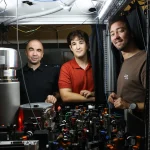
A team led by UCF Professor of Physics Madhab Neupane has experimentally identified signatures of altermagnetism in a layered material, potentially solving the problem of disruptive magnetic fields in future devices. Published in Nature Communications, the findings detail how this emerging form of magnetism combines the benefits of ferromagnetism and antiferromagnetism, offering a path toward faster, smaller, and more energy-efficient electronics.
“These materials are distinguished from more conventional antiferromagnets by their ability to generate and detect spin currents without the negative effect of producing stray fields,” Neupane says, highlighting the versatility of this discovery for applications like spintronics and ultrafast memory. The research focuses on using electron spin, rather than charge, to potentially reinvent how information travels through a circuit.
Co₁/₄TaSe₂: Layered Material Exhibiting Altermagnetic Signatures
The layered material Co₁/₄TaSe₂ exhibits a unique electronic behavior originating within the material itself, according to a recent study detailing signatures of altermagnetic order. Researchers determined the source of this behavior through careful measurements designed to differentiate surface effects from those occurring deeper within the structure, resolving a key question in altermagnetic theory.
“Our approach was to use higher-resolution methods that were insensitive to the electron’s spin to measure the splitting in the energy levels,” explained the team, indicating a focus on precision measurement techniques. The material’s tunable layered structure further enhances its appeal for technological development; weakly bound layers allow for the creation of extremely thin structures suitable for thin-film devices.
This characteristic places Co₁/₄TaSe₂ within the family of transition-metal dichalcogenides, or TMDs, materials increasingly investigated for their unique electronic properties. Magnetic cobalt atoms inserted between these layers are responsible for the unusual magnetic characteristics observed, offering a pathway to control and manipulate the material’s behavior. There is currently a lot of debate in altermagnetic theory about how the spin-polarized electronic states interact with other magnetic phenomena.
These include spintronics, ultrafast memory devices, terahertz networks and energy-efficient electronics, all areas demanding materials with tailored magnetic properties. As electronic devices continue to shrink, the need for materials that operate faster while consuming less energy becomes increasingly urgent, and altermagnetic materials like Co₁/₄TaSe₂ offer a promising solution. “This new property makes them very well positioned for use in many different applications,” Neupane says.
The team’s success in identifying multiple platforms for further investigation suggests that more advanced studies into these materials are already underway, building on the confidence gained from converging experimental and theoretical evidence. “Seeing those independent pieces of evidence converge gave us confidence that we had identified a genuine layered altermagnet,” Neupane concluded, emphasising the significance of the findings for the field.
Evidence for altermagnetism in a versatile materials platform opens a lot of new possibilities.
Milo Sprague, the study’s lead graduate student researcher
ARPES Technique Reveals Altermagnetic Electronic Structure
The precision of angle-resolved photoemission spectroscopy, or ARPES, proved critical in identifying altermagnetic characteristics within the layered material Co₁/₄TaSe₂; the technique allowed researchers to map the material’s electronic structure. Researchers moved beyond simply detecting a split in electronic bands, a preliminary indicator, and employed spin-resolved ARPES to confirm the origin of that splitting as a signature of altermagnetism. This secondary measurement definitively revealed that the split states carried opposite spin polarizations, a key characteristic distinguishing altermagnets from conventional magnets.
Prior to this study, it remained unclear whether the telltale signs of altermagnetism in layered materials would originate from the surface or from deeper within the bulk material. The team’s measurements demonstrated the relevant electronic state arose primarily from within the material, exhibiting clear altermagnetic order. “The significance became clear once the experimental measurements consistently matched our theoretical predictions,” stated UCF Professor Madhab Neupane, emphasizing the convergence of theory and experiment that validated the findings.
The material’s layered structure is a structural detail and a functional asset, providing a means to tune its properties and study the resulting effects on both electronic and magnetic behavior. This tunability allows for systematic investigation of how modifications to the material impact its altermagnetic characteristics, opening avenues for exploring previously unanswered questions in the field.
Milo Sprague, the study’s lead graduate student researcher, highlighted the potential for further exploration, stating, “Evidence for altermagnetism in a versatile materials platform opens a lot of new possibilities.” The ability to manipulate the material’s composition and observe the corresponding changes in its behavior positions Co₁/₄TaSe₂ as a valuable platform for future research. Further theoretical work remains to fully understand the intricacies of altermagnetism, but identifying this material provides a strong experimental foundation.
“There are many details to the theory of how altermagnets work that haven’t been explored or verified yet,” Neupane said, noting that the team has already begun more advanced studies using this newly identified platform.
If this approach proves viable, then layered altermagnets will be at the forefront of electronics development.
Madhab Neupane, Professor of Physics at UCF
Spin Currents and Stray Field Avoidance in Altermagnets
The layered material Co₁/₄TaSe₂ exhibits a key advantage over traditional antiferromagnets; it generates and detects spin currents without producing disruptive stray magnetic fields, according to UCF’s research. This capability addresses a critical limitation in miniaturizing electronic components, where unwanted magnetic interference becomes increasingly problematic as devices shrink. The team’s experimental work focused on confirming this behavior, using techniques sensitive to electron spin to verify the presence of altermagnetism within the material itself.
“Then, we complemented this measurement with spin-resolved ARPES to conclusively tell if this looks like altermagnetism,” explained Madhab Neupane. The ability to manipulate spin, rather than charge, offers a pathway to faster, more energy-efficient electronics, a field known as spintronics. Altermagnets are particularly promising for spintronics applications because they circumvent the issues associated with stray fields, allowing for denser integration of components.
The researchers’ findings suggest that Co₁/₄TaSe₂ could be a versatile platform for further investigation into altermagnetism and its potential to advance technologies like ultrafast memory devices and terahertz networks. Beyond simply identifying the altermagnetic state, the UCF team’s work opens avenues for deeper exploration of the underlying physics. The material’s adaptability allows researchers to alter its composition and observe the resulting changes in its magnetic and electronic properties.
This tunability is important for addressing unanswered questions about how altermagnetism interacts with other phenomena, and for refining theoretical models. If successful, layered altermagnets could become central to future electronics development, enabling smaller, faster and more energy-efficient technologies.
These materials are distinguished from more conventional antiferromagnets by their ability to generate and detect spin currents without the negative effect of producing stray fields.
Madhab Neupane, Professor of Physics at UCF
Tunable TMD Layers Advance Spintronic Device Potential
Researchers were able to separate and combine these layers into extremely thin structures, a capability important for developing thin-film devices and other emerging technologies. The layered material’s unique characteristics offer a pathway toward circumventing the issues associated with conventional antiferromagnets.
As electronic devices continue to shrink, researchers need new materials that can operate faster while consuming less energy.
Madhab Neupane, Professor of Physics at UCF
Source: https://www.ucf.edu/news/ucf-researcher-discovers-experimental-evidence-of-new-type-of-magnetism/




See today’s quantum computing news on Quantum Zeitgeist for the latest breakthroughs in qubits, hardware, algorithms, and industry deals.