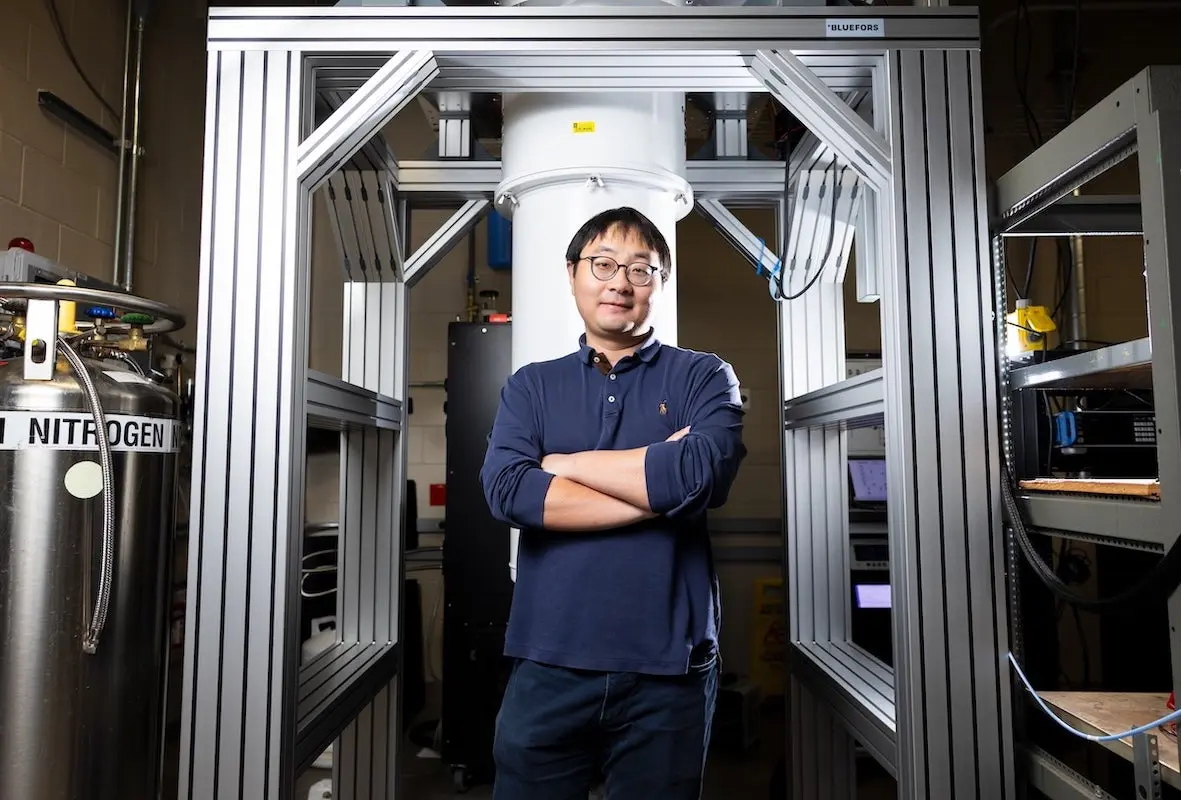
Assistant Professor Han Zhao is using a visual approach to stabilizing quantum states, utilizing a topological “braiding” method similar to tying a knot to combat the fragility of quantum computing. Supported by the Oak Ridge Associated Universities Ralph E. Powe Junior Faculty Enhancement Award, Zhao’s research combines tiny mechanical vibrations with superconducting systems to shield quantum operations from disruptive environmental factors like stray radio waves and temperature fluctuations. “The future of quantum computing will be its real-world applications in science and the economy,” Zhao says, emphasizing the need to address the instability of quantum states for practical applications. By focusing on overall patterns in quantum evolution, imagining “the strands as the evolution of the quantum excitations and the knots as the entangled quantum states”, Zhao and his team at UCF aim to improve the reliability of these powerful, yet delicate, systems.
Assistant Professor Han Zhao’s research demonstrates a convergence of disciplines; he is employing tiny mechanical vibrations within superconducting systems to fortify the fragile states essential for quantum computation. Unlike traditional methods focused on isolating quantum systems, Zhao’s team is investigating how controlled interactions with the environment can enhance stability. The core of this work lies in a topological “braiding” approach, conceptually similar to tying a knot, to stabilize quantum states by concentrating on overarching patterns of interaction. This differs from conventional quantum error correction, which demands significant hardware resources to protect quantum information; Zhao’s technique aims for inherent resilience in the quantum operations themselves. Microscopic vibrating structures, or nanomechanical resonators, are key to this process, interacting with microwave signals within superconducting quantum circuits operating at temperatures near absolute zero. Zhao emphasizes the practical implications of this research, believing this method offers a path toward fault-tolerant quantum computing capable of tackling problems currently beyond the reach of even the most powerful supercomputers, with potential applications spanning drug discovery, materials science, and energy technologies.
This means our lab is on the right track to accomplish research of high importance. We are also grateful for the support of getting students involved in advanced experimental quantum research.
Han Zhao, assistant professor of physics
Mechanical Vibrations Stabilize Fragile Quantum States
Assistant Professor Han Zhao’s research demonstrates a surprising convergence of disciplines, actively employing tiny mechanical vibrations within superconducting systems to fortify the fragile states essential for quantum computation. This work lies in a topological “braiding” approach, conceptually similar to tying a knot, to stabilize quantum states by concentrating on overarching patterns of interaction. This differs from conventional quantum error correction, which demands significant hardware resources to protect quantum information; Zhao’s technique aims for inherent resilience in the quantum operations themselves. Microscopic vibrating structures, or nanomechanical resonators, are key to this process, interacting with microwave signals within superconducting quantum circuits operating at temperatures near absolute zero.
The future of quantum computing will be its real-world breakthrough applications in science and the economy.
Topological “Braiding” Approach to Quantum Entanglement
The Powe Junior Faculty Enhancement Award centers on leveraging mechanical vibrations within superconducting systems. This intersection of traditionally separate fields represents a novel direction in addressing quantum decoherence, a major impediment to building practical quantum computers. This method aims to reduce the impact of noise and imperfections inherent in quantum hardware; the process, he elaborates, is akin to tying a shoelace, where the final knot doesn’t require absolute precision in every strand’s movement. These experiments require an ultra-stable environment achieved through specialized dilution refrigerators, cooling systems capable of reaching temperatures just a fraction of a degree above absolute zero. Within this environment, Zhao’s team investigates how controlled interactions between microwave signals and these vibrating resonators can exchange quantum information.
And this certain pattern is dictated by the intrinsic topology of the engineered interaction between superconducting quantum circuits and the mechanical resonators in an open quantum system.
The Powe Junior Faculty Enhancement Award supports this research, which diverges from traditional error correction methods by focusing on inherent resilience within quantum operations themselves. The funding not only supports graduate student research but also facilitates access to specialized superconducting quantum hardware and UCF’s advanced nanofabrication facilities. “The most inspiring aspect of receiving the award for me is to know that the scientific merit of the proposed research received extremely positive recognition in the community,” Zhao explains, highlighting the validation of this unconventional direction. This intersection of traditionally separate fields, mechanical engineering and quantum physics, represents a step toward building more robust quantum systems. The core principle, as Zhao describes it, involves visualizing quantum excitations as strands and entangled states as knots. “The process of achieving a certain quantum state, i.e., the knot, can have various wiggles due to noise and control imperfection, but as long as it follows a certain pattern, it will result in a high-fidelity quantum operation.” This emphasis on pattern recognition, rather than precise control, offers a potentially scalable pathway to fault-tolerant quantum computing.
Now, imagine the strands as the evolution of the quantum excitations and the knots as the entangled quantum states.
Han Zhao, assistant professor of physics

See today’s quantum computing news on Quantum Zeitgeist for the latest breakthroughs in qubits, hardware, algorithms, and industry deals.