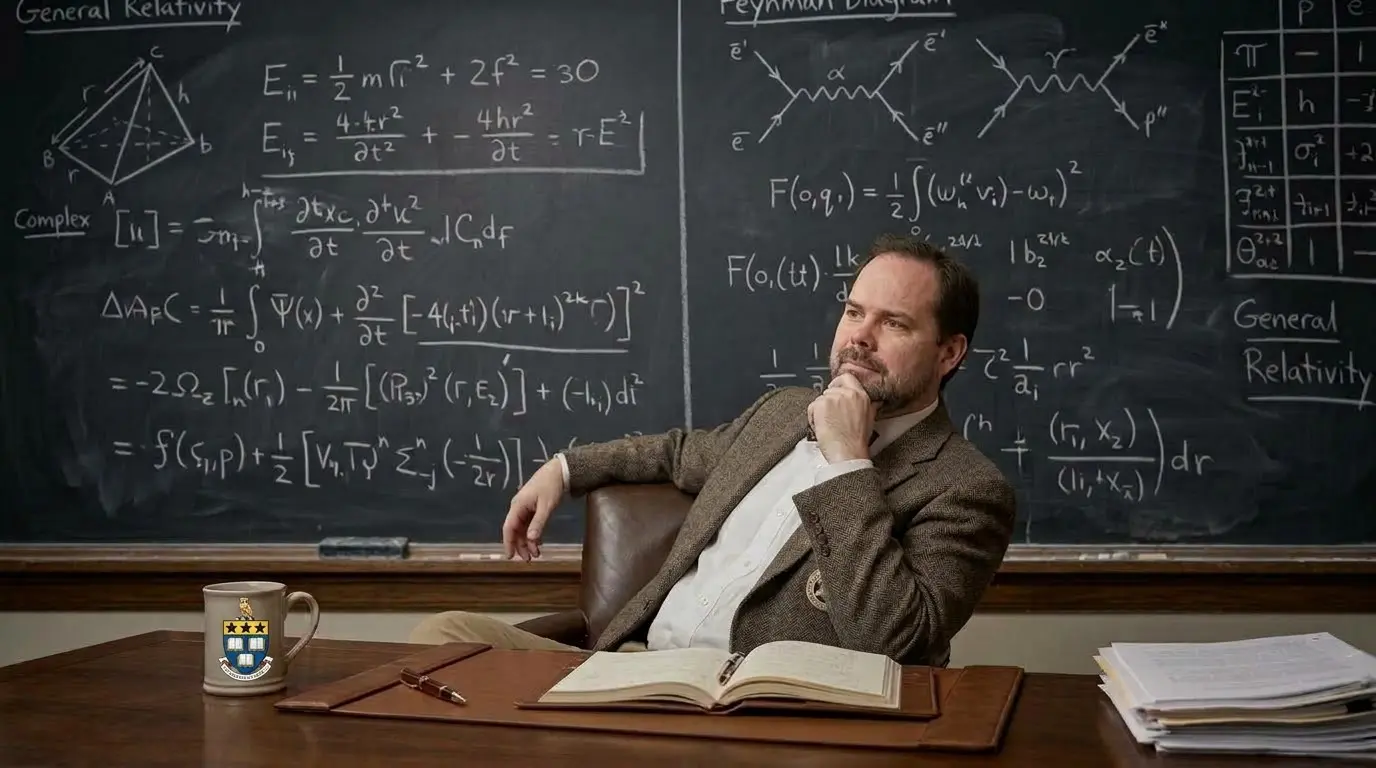
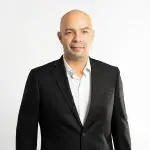
Ben Varcoe is Professor of Quantum Information Science at the University of Leeds, and a physicist who builds companies as well as experiments. He first made his name in 2000 with a paper in Nature that showed how to make light containing an exact number of photons, something physicists had found very hard to do. Since then he has turned his physics into a heart scanner and a new kind of encryption.
His first company, Creavo Medical Technologies, took a portable heart scanner from a Leeds lab bench to hospitals in Britain and the United States, raising more than £20 million along the way. His second, Cavero Secure, makes encryption keys small enough to fit on a SIM card. Both grew out of his Leeds lab.
One simple idea ties it all together. As he explains on Ben Varcoe’s Leeds staff page, information is always stored and moved by something physical, so it has to follow the laws of physics like everything else. Understand those laws well and you find new ways to handle information. That thought has taken him a long way.
- An Australian physicist who found his way to Munich
- Catching light one photon at a time
- A counter for the faintest microwave signals
- A heart scanner that began with a swivel chair
- Creavo took the scanner to hospitals in Britain and America
- Acoro Medical looks for hidden danger in the heartbeat
- Keeping secrets with noise and everyday light
- Cavero Secure puts his key exchange on a SIM card
- His students call him the king of story time
- Still curious, from anyons to black holes
- Frequently asked questions
An Australian physicist who found his way to Munich
Ben Varcoe trained as a physicist in Australia. His ORCID record lists an honours degree from Flinders University in Adelaide and a doctorate from Griffith University in Brisbane, where his first research papers came out of the laser physics lab. Even then he was working with light and atoms.
By 1999 he had moved to Germany. He joined the Max Planck Institute for Quantum Optics near Munich, in the team of Herbert Walther, whose one-atom maser was a famous experiment on how single atoms and photons behave together. He stayed for several years, and the work he did there is still the most cited of his career.
Catching light one photon at a time
Here is the puzzle he helped solve. Light comes in tiny packets called photons, and even the steadiest laser never holds a fixed number of them, because the count jiggles from one moment to the next. Imagine a bucket that holds exactly two marbles every time you look, never one and never three. With light, that is very hard to arrange.
Physicists call such light a Fock state. The 2000 Nature paper calls it the most basic quantum state of light. To make it, the Garching team sent rubidium atoms one at a time through a tiny superconducting box, colder than outer space, where a photon could survive for a few tenths of a second.
The team found two ways in. In 1999 Varcoe and his colleagues found a way to hold the photon count steady. The Nature paper then built the light up one atom at a time and used another atom to check the count, producing light with exactly one or exactly two photons, “measured unambiguously”. Hundreds of later papers have cited it.
The team kept improving. A 2001 paper described a source that gave out a set number of photons whenever it was asked, and a 2004 review reported the best cavity ever built for this kind of work. This matters because quantum computers and quantum links both carry information on single photons. Varcoe helped show those building blocks could be made to order.
A counter for the faintest microwave signals
Next came the University of Sussex and a fresh challenge. Counting photons of visible light one by one is routine, but microwave photons carry far less energy, so catching a single one is much harder. It would help everywhere from cold-atom labs to the hunt for new particles.
His answer was a chain reaction. In the design he and two colleagues published, one incoming photon sets off a cascade of excited atoms, and each of those is easy to spot. On paper it could catch more than nine in ten photons. They even aimed it at the axion, a proposed particle that may make up the universe’s dark matter.
The same ideas led him to some of the biggest questions in physics. With colleagues he worked out how a group of linked atoms could sense tiny jitters in spacetime itself, and he also studied how atoms in a cavity would respond to gravitational waves. In 2006 he moved to Leeds, and by 2014 he was leading its Quantum Information Group.
A heart scanner that began with a swivel chair
At Leeds, Varcoe found a problem worth solving. Chest pain is one of the most common reasons people go to A&E, yet Leeds noted that up to three in four of those patients do not have blocked-artery heart disease. Yet many still go through long and costly tests.
Every heartbeat gives off a faint magnetic field. Reading it can reveal a heart short of oxygen, but the usual sensors need liquid helium, a shielded room and expert staff, at a cost his Leeds page puts above a million. That keeps them out of most hospitals.
His idea was a cheap, portable version built from simple coils of wire. The project began in 2011 in his Leeds lab with an oscilloscope, some shop-bought coils and a handful of students, as his student John Mooney later described in his thesis. The first home-wound coils were not sensitive enough. For a while the team was even fooled by signals from the swivel chair they sat on.
Varcoe cracked it with pencil and paper. He worked out the ideal shape for the coils, and the 7-centimetre coils he designed were made by Mundorf, a German maker of audio parts. The team then borrowed a trick from quantum optics to strip out background noise, and his staff page adds a delightful twist. Adding the right kind of noise, it says, “actually enhances the ability to detect the signal”.
It worked. A 2017 paper showed the device picking up the heart’s main electrical wave in an ordinary hospital ward with no shielded room, and its first version was tested at Leeds General Infirmary.
Creavo took the scanner to hospitals in Britain and America
To get the scanner to patients, Ben Varcoe set up a company. It began in 2014 as Quantum Imaging, backed that April by £1.6 million led by IP Group, and in 2016 it became Creavo Medical Technologies, with Varcoe as chief scientific officer. It also gathered an advisory board of leading heart specialists.
Medical magnetometry has been used in imaging for some years, but has been restricted in the past, because of the need to use liquid helium cooling systems, highly controlled environments and specialist staff. With this investment, we can develop a fully portable device capable of using this technology in a routine clinical environment.
Ben Varcoe, University of Leeds announcement, 8 April 2014
Creavo grew fast. Its timeline shows a first study at Leeds in 2015, European approval for its research device in 2016, and a 750-patient study across five UK A&E departments from January 2017. In the United States the device gained FDA clearance that October. A 720-patient study followed at five American centres.
Investors believed in it. The company raised more than £20 million in all, including £13.4 million in a single round in 2017, and that November it won two IET Innovation Awards. “For the first time, we have harnessed the technology into a battery-powered portable device that can be deployed directly to the patient’s bedside,” Varcoe said.
Early results were encouraging. In a 2018 study the scanner picked up more than 95 in every 100 patients who had heart disease caused by narrowed arteries. When a scan came back clear, it was right about 98 times in 100, which is exactly what a busy A&E needs to reassure the many people whose hearts are fine.
Acoro Medical looks for hidden danger in the heartbeat
Varcoe has since taken heart scanning a step further. He is a director of Acoro Medical, a Leeds spin-out first registered in 2023, whose AcoroScan reads the heart’s magnetic field in five minutes. It looks for hidden electrical faults that can trigger a sudden, fatal heart rhythm.
The aim is to help doctors decide who really needs an implanted defibrillator. It is the small device that shocks a failing heart back into rhythm. Acoro says 80 per cent of people given one never need it, while 80 per cent of the people who would really benefit from one go without. Its work builds on the Magneto-SCD trial, whose plan was published in 2020.
The trial was led by the cardiologist Faizel Osman, who is now Acoro’s chief clinical adviser. He also sat on Creavo’s medical advisory board, so the physicist and the heart doctor have been chasing the same goal for years.
Keeping secrets with noise and everyday light
Alongside the heart work, Varcoe has spent years on a very different question, one that matters to every bank, hospital and government that needs to keep its data safe. How can two people share a secret key that no eavesdropper can steal? Most quantum key distribution does it with single photons, which need delicate equipment.
He tried something bolder and started from noise. In a 2012 paper he showed that two people can add their own noise to a line and still end up sharing a key that no listener can read. The same year he founded Cryptographiq, and Leeds worked with it, with Airbus Defence and Space and with L3-TRL on keys built to stay safe for years to come.
His group then showed that ordinary thermal light, the kind a simple LED gives off, can carry a secret key. With his student Adam Walton, he built a working version from off-the-shelf broadcast equipment, which points to secure keys made from cheap, everyday parts rather than costly lab kit. That is good news for anyone on a budget.
He tests existing systems too. Finding the weak spots is how encryption gets stronger, and his group has shown how joining the stages of a quantum protocol can leak information. In 2026 it probed the famous BB84 protocol, devised by Charles Bennett and Gilles Brassard.
Cavero Secure puts his key exchange on a SIM card
His second security company is the one making headlines now. Varcoe and Frey Wilson founded Cavero Quantum in 2020. Four years later Leeds announced that the start-up had raised £2.2 million from two backers, Foresight Group and Northern Gritstone, a fund set up by three universities in the north of England.
The university was proud of it. “It is inspiring to see how the experimental quantum science team at Leeds has developed solutions for such a critical issue in online security,” said Nick Plant, one of its senior leaders. Varcoe kept his job as a professor, and Wilson became the company’s chief technology officer, leading the engineering that turns the science into working products.
The clever part is that the key is never sent at all. As Cavero explains, both sides swap closely linked data and trim away the differences until they share the same secret, using maths related to ML-KEM, the new US post-quantum standard.
That matters because a large enough quantum computer could break the maths that protects most internet traffic today. Cavero reports that its method needs about half the computing work of the US standard, and it can run in as little as 2.1 kilobytes of memory. That brings strong protection to SIM cards.
The company now trades as Cavero Secure. In 2026 it joined the GSMA, the body for the world’s mobile networks, raised a further $2.5 million and began taking its CaveroCore engine to the defence world. Its website sums up the founders neatly. “Two scientists founded Cavero Secure, believing physics, not patches, would solve the hardest problems in security.”
His students call him the king of story time
Much of this work was done with his doctoral students, and their theses show how wide his interests run. Since 2009 he has supervised or co-supervised at least nine PhDs at Leeds, on subjects from cavity physics and laser measurements to spotting stress in steel and sensing ripples in spacetime. Some fed straight into his inventions.
John Mooney helped build the heart scanner, while Elizabeth Newton found new ways to test quantum cryptography and Adam Walton learned to share keys using thermal light. Joseph Wilson went further afield. He worked with engineers from BAE Systems on new ways to shield army vehicles from blasts.
His students speak warmly of him, and their thanks say a good deal about the kind of teacher he is. Mooney thanked him for “fascinating insights and countless stimulating discussions”. Newton wrote that her project would not have been possible without “my supervisor, Ben Varcoe, the king of story time”.
His influence reaches well beyond his own lab. From 2014 to 2019 he was one of the investigators behind the national hub for quantum communications, a £24 million centre set up to turn British research into working technology.
Still curious, from anyons to black holes
His curiosity has not slowed down. In 2026 he joined a team that used Quantinuum’s quantum computers to copy the rules followed by anyons, strange particle-like patterns that could one day make quantum computers far more reliable. The results came within about one part in a thousand of the ideal.
Some of his work is wonderfully practical. He has kept atomic clocks in step using microwave broadcasts, and his magnetometers have been used to find buried pipes and to test steel. At the other extreme, he has written about the entropy of black holes and how information escapes them.
It all comes back to that simple idea on his staff page. Information is physical. Understand the physics and you find new ways to store it, move it and keep it safe, which is exactly what Ben Varcoe has done in hospitals, in phone networks and in the lab.
Frequently asked questions
Who is Ben Varcoe
Ben Varcoe is Professor of Quantum Information Science at the University of Leeds. He trained in Australia, worked at the Max Planck Institute for Quantum Optics and the University of Sussex, and joined Leeds in 2006. He is also a technology entrepreneur who has founded companies in heart imaging and cyber security.
What did Ben Varcoe show in his 2000 Nature paper
Working in Herbert Walther’s group near Munich, he and three colleagues made light holding an exact number of photons, exactly one or exactly two. Light like this, called a Fock state, is a basic building block for quantum computing and quantum communication.
Which companies has Ben Varcoe founded
He founded Cryptographiq in 2012 to work on secure communication. He set up Quantum Imaging in 2014, which became Creavo Medical Technologies. He co-founded Cavero Quantum with Frey Wilson in 2020, now called Cavero Secure. He is also a director of Acoro Medical, a Leeds heart-scanning spin-out.
What did Creavo, the company Ben Varcoe set up, achieve
Creavo built a portable, battery-powered scanner that reads the heart’s magnetic field at the bedside. It won European approval in 2016 and FDA clearance in 2017, ran studies in UK and US hospitals, raised more than 20 million pounds and won two IET Innovation Awards.
What does Cavero Secure, co-founded by Ben Varcoe, do
Cavero Secure makes a key exchange that protects data against future quantum computers. Both sides arrive at the same key without ever sending it, and the company says it runs in as little as 2.1 kilobytes of memory, small enough for a SIM card. Varcoe leads its cryptography.
What is Acoro Medical, where Ben Varcoe is a director
Acoro Medical is a Leeds spin-out. Its AcoroScan uses a five-minute magnetic scan of the heart to help doctors judge who is at risk of sudden cardiac death and would benefit from an implanted defibrillator.
What has Ben Varcoe written
His work appears mainly as research papers, from his 2000 Nature paper on photons to recent work on quantum cryptography, anyons and black holes. He has also written chapters in books on photon number states, published in 2001 and 2003.

See today’s quantum computing news on Quantum Zeitgeist for the latest breakthroughs in qubits, hardware, algorithms, and industry deals.