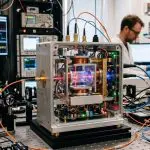
As reliance on satellite signals grows, so does the vulnerability of military navigation systems to jamming, spoofing, and outages. Recognizing this threat, ZenaTech has advanced its defense-focused quantum navigation system to the testing phase, designed to enable secure drone operations even when GPS is unavailable, the company says. Fortune Business Insights estimates the global quantum navigation systems market will expand from approximately $1.3 billion in 2026 to $7.4 billion by 2034, representing a projected 24.27% annual growth rate as demand accelerates for resilient positioning, navigation, and timing technology.
Quantum Navigation Addresses GPS Vulnerabilities in Modern Warfare
Quantum navigation systems are projected to expand from a $1.3 billion market in 2026 to $7.4 billion by 2034, reflecting a rapidly increasing demand for alternatives to satellite-dependent positioning in contested environments. This substantial growth, forecast by Fortune Business Insights, is driven by the escalating threat of GPS jamming, spoofing, and outages, scenarios increasingly likely on modern battlefields where reliance on unencrypted signals presents a critical vulnerability.
Grand View Research corroborates this trend, estimating the broader quantum navigation market at $1.64 billion in 2026 with a projection of approximately $8.0 billion by 2033. ZenaTech, Inc. is currently validating its defense-focused quantum navigation system through drone testing in Sharjah, UAE, a key milestone in delivering redundancy and mission assurance to future defense customers.
The company’s engineering team is evaluating the system’s accuracy and reliability under real-world flight conditions, beginning with indoor platforms and progressing to larger, AI-powered cargo drones like the ZenaDrone 1000, according to ZenaTech. “Operating reliably when GPS and satellite navigation are degraded, denied, or spoofed is a mission-critical requirement for modern defense operations,” said Shaun Passley, Ph. This system utilizes principles derived from quantum physics to enable accurate navigation independent of external signals, combining quantum inertial sensing with AI-based path correction for continuous, high-precision positioning.
The development of quantum navigation isn’t solely focused on military applications; the technology also promises benefits for commercial drone operators facing GPS-challenged environments. Dense urban areas, indoor facilities, underground spaces, and extended beyond visual line-of-sight missions all present scenarios where reliable GPS signals are unavailable or unreliable.
ZenaTech anticipates incorporating its validated quantum navigation system across select drone platforms, expanding capabilities in areas like surveillance, infrastructure inspection, and defense missions. This partnership aims to drive breakthroughs in scaling quantum processors into accelerated quantum supercomputers capable of solving complex problems. The company’s CUDA Quantum platform and DGX Quantum systems provide the infrastructure necessary for developing and deploying quantum algorithms, while NVQLink, launched in early 2026, offers low-latency integration of quantum processors with GPU supercomputers.
A recent NVIDIA calibration model, reported on September 23, 2026, functions across six qubit modalities, further showcasing the company’s progress in quantum computing. This integration is important because quantum navigation systems require significant computational power for data processing and error correction. The NVIDIA Advanced Quantum Computing research center in Boston, announced in September 2025, focuses on hybrid quantum-classical algorithms and drug discovery, highlighting the potential for cross-disciplinary applications of this technology.
Quantum Computing Inc. This partnership will focus on developing practical quantum solutions and building the next generation of quantum talent. Rigetti Computing, meanwhile, has secured $100 million in funding from the U.S. Department of Commerce to accelerate superconducting quantum computing research and development, aiming to address key technical bottlenecks in scaling quantum processors.
Red Cat Holdings, through its Blue Ops division, is integrating Havoc’s collaborative autonomy software with uncrewed surface vessels, expanding autonomous functions for defense customers. These combined efforts demonstrate a growing investment in quantum navigation and related technologies, driven by the increasing need for resilient and secure positioning, navigation, and timing capabilities in a world where GPS signals can no longer be guaranteed.



See today’s quantum computing news on Quantum Zeitgeist for the latest breakthroughs in qubits, hardware, algorithms, and industry deals.