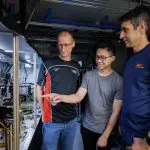
Researchers led by Christopher Monroe at Duke have, for one of the first times in quantum physics, observed string-breaking dynamics, a process where connected building blocks of matter stretch and create particles, on a quantum simulator. The Duke Quantum Center team used a chain of 13 trapped ions to emulate conditions similar to the Big Bang, offering a new way to study high-energy physics without recreating the event itself.
“Quantum computer simulations provide the best platform to investigate complex questions like matter formation, short of having witnessed the big bang itself,” said Monroe, the Gilhuly Family Presidential Distinguished Professor of Electrical and Computer Engineering and Physics. This study joins two similar published findings from other research teams, validating the use of quantum computers to simulate this phenomenon on different platforms.
Trapped-Ion Quantum Simulation Models Quark-Antiquark String Breaking
The Duke Quantum Center team used a chain of 13 trapped ions to perform the simulation, recreating conditions mirroring the extreme energies present immediately after the Big Bang. Researchers used precisely controlled laser beams to tune interactions between these ions, effectively manipulating the energy within the system and mimicking the stretching and eventual breaking of a string of fundamental particles. By preparing the system in an out-of-equilibrium state, they tracked the evolution of the simulated string and observed the emergence of effective charges, reconstructing the resulting dynamics with high fidelity.
This experimental approach offers a novel way to investigate phenomena inaccessible through traditional means, such as direct observation of particle creation. Confirmation of the quantum simulation’s accuracy came through comparison with a classical computer model, validating the results obtained from the trapped-ion system.
As the complexity of these simulations increases, the computational demands quickly exceed the capabilities of even the most powerful conventional computers; future experiments will rely exclusively on quantum processing power. Arinjoy De, first author on the paper and now at QuEra Computing, emphasized the significance of this controlled environment, stating, “By simulating quark confinement and string-breaking phenomena in a controlled lab environment, we’re opening up new pathways for experimental investigations into the behavior of matter at its most fundamental level.” Studying these processes in isolation is important for deepening our understanding of the universe’s earliest moments. This Duke Quantum Center study is not isolated; teams led by Google and QuEra Computing achieved similar results using superconducting circuits and neutral atoms, respectively.
Christopher Monroe noted the convergence of these efforts, explaining that the successful replication of string-breaking dynamics on these distinct quantum platforms strengthens the validity of this approach to simulating high-energy physics. “As a physicist, it is incredibly exciting to investigate the conditions of the early universe in an atomic-level computing machine,” said Zohreh Davoudi, associate professor of physics at UMD, who was part of the research team.
Quantum computer simulations provide the best platform to investigate complex questions like matter formation, short of having witnessed the big bang itself.
Christopher Monroe, the Gilhuly Family Presidential Distinguished Professor of Electrical and Computer Engineering and Physics at Duke
Laser Control Recreates High-Energy Physics Dynamics on 13 Ions
The simulation of string-breaking dynamics, a process where connections between fundamental particles stretch and yield new particles, has been replicated on platforms led by Google and QuEra Computing, each with its own advantages and challenges, bolstering confidence in the technique’s validity. This observation provides insight into the complex dynamics of particle creation, a process that occurred in the earliest moments of the universe and remains difficult to study directly.
The ability to simulate these dynamics without relying on traditional, high-energy particle colliders represents an advancement in the field. “These are the three platforms leading the charge in quantum computing, so it’s a nice benchmark and comparison for the quantum community,” noted Christopher Monroe, Gilhuly Family Presidential Distinguished Professor of ECE and Physics.
The successful replication of string-breaking dynamics across these platforms demonstrates the growing maturity of quantum simulation technology and its potential to address previously intractable problems in physics. The research, supported by funding from the Department of Energy (DE-SC0020312, DE-SC0025341, DESC0019040, DE-SC0024220, DE-SC0020271), National Science Foundation (OMA-2120757), Air Force Office of Scientific Research, Defense Advanced Research Projects Agency and Amazon Web Services, underscores the collaborative nature of this emerging field and the promise of quantum computing to reveal new understanding of the universe’s fundamental laws.
As a physicist, it is incredibly exciting to investigate the conditions of the early universe in an atomic-level computing machine.
Zohreh Davoudi, associate professor of physics at UMD, who was part of the research team


See today’s quantum computing news on Quantum Zeitgeist for the latest breakthroughs in qubits, hardware, algorithms, and industry deals.