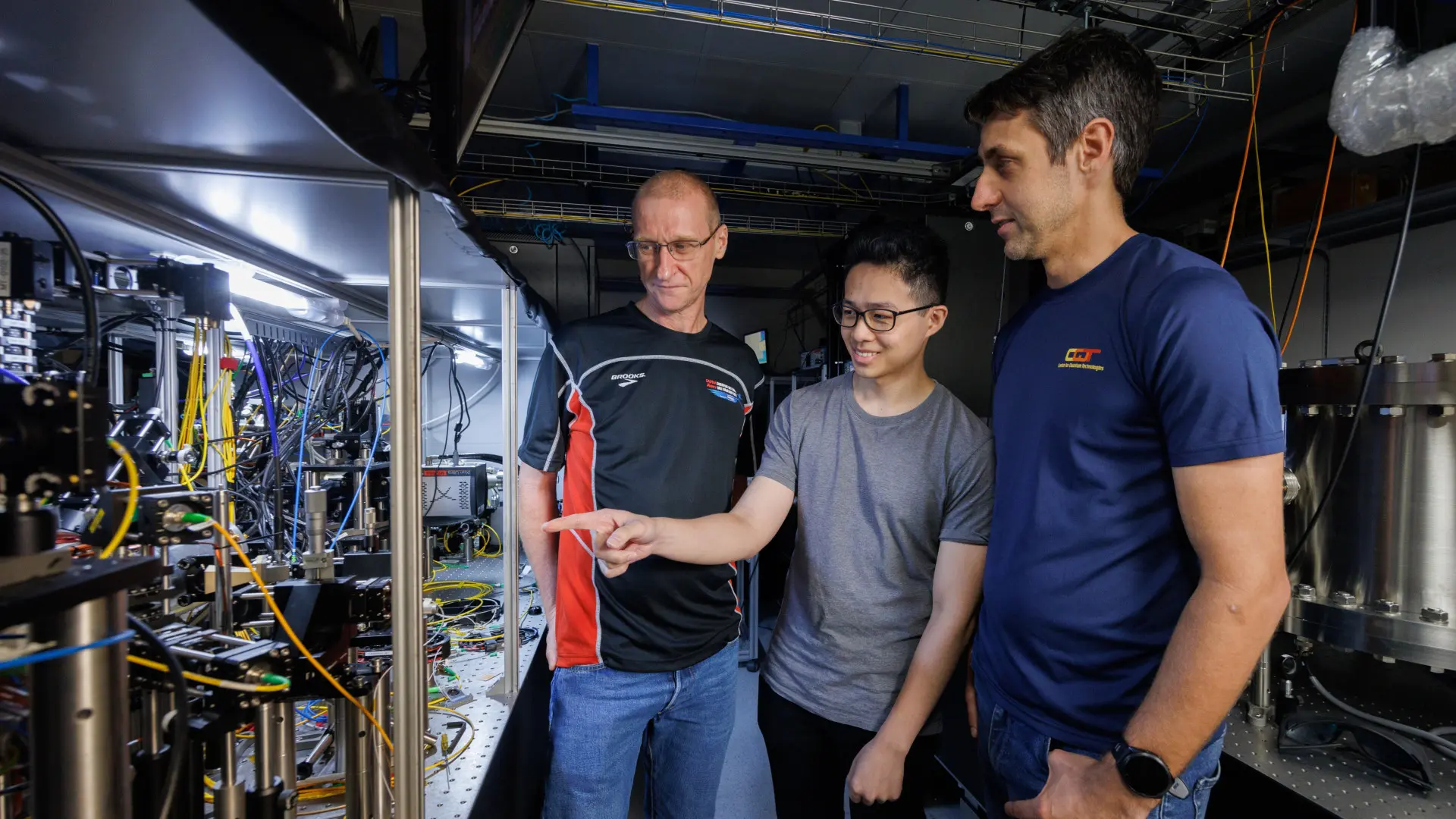
Singapore’s Centre for Quantum Technologies has constructed an atomic clock using lutetium, challenging the caesium standard that has defined global timekeeping since the 1960s. The clock’s accuracy is so precise it measures time in terms of trillions of moments, and the team reports it outperforms previous record holders built from different elements. “I am confident that what we have now is the most accurate clock in the world,” says team leader Murray Barrett, a CQT Principal Investigator and Associate Professor at the National University of Singapore.
This advance promises to refine our understanding of fundamental physics and improve gravitational monitoring. They also built two clocks and compared their ticking to each other, finding an uncertainty of 5.7 x 10⁻¹⁹, which is the most precise clock comparison ever made.
Lutetium Atomic Clock Achieves Record Uncertainty of 1 x 10-19
The lutetium atomic clock constructed by researchers at Quantum Technologies achieved a record uncertainty of 1 x 10-19, surpassing all previously reported figures for optical atomic clocks. This level of precision means the clock loses or gains approximately one second every 300 billion years, a feat enabled by the unique properties of the element lutetium itself. Unlike caesium, the element underpinning the global time standard since the 1960s, lutetium exhibits minimal sensitivity to environmental factors like temperature and magnetic fields, contributing to its exceptional stability.
“The good properties mean that high accuracy can be achieved even in a wide range of environments,” explains Associate Professor Murray Barrett of the National University of Singapore. To validate this accuracy, the team constructed two independent lutetium clocks and directly compared their performance.
This comparison yielded an uncertainty of 5.7 x 10⁻¹⁹, marking the most precise clock comparison ever documented. According to Dr. Kyle Arnold, a Senior Research Scientist from CQT at NUS and joint first author on the paper, “It basically tells you that comparing clocks and demonstrating reproducibility is the only way to test a standard.” The ability to verify accuracy through direct comparison is crucial, as it establishes confidence in the clock’s reliability and provides a benchmark against which future timekeeping technologies can be measured.
Each clock utilizes a single, charged lutetium-176 ion, excited by a laser with a wavelength of 848 nanometers to define its timekeeping transition. The team’s decade-long effort involved meticulous precision engineering to optimize the clock’s setup and fully exploit the potential of lutetium.
Barrett expresses strong confidence in the clock’s performance. The next phase of development focuses on miniaturizing the current lab-scale prototype into a portable system, expanding its potential applications beyond fundamental physics research. While comparisons to other leading atomic clocks worldwide are desired, logistical challenges currently impede such direct verification.
The next step is to take the lab-scale clock and miniaturise it into a transportable system.
Mr Michael Lee, joint first author on the paper and a PhD student on the NUS team
Correlation Spectroscopy Validates CQT’s Dual-Clock Comparison
5.7 x 10⁻¹⁹ is the measurement carried out over 200 hours, which validated the clock’s performance by comparing the ticking of two independently constructed devices, a critical step in establishing a new time standard. They independently measured the height difference between the lutetium ions to below the millimetre level, resolving a potential 5mm discrepancy on the measurement table. This level of precision highlights the challenges in comparing optical atomic clocks at this scale, as even slight variations in gravity can measurably affect timekeeping.
The good properties mean that high accuracy can be achieved even in a wide range of environments.
Murray Barrett, Associate Professor


See today’s quantum computing news on Quantum Zeitgeist for the latest breakthroughs in qubits, hardware, algorithms, and industry deals.