Researchers have discovered that upconversion nanoparticles (UCNPs) function not only as light emitters but also as active mixers of light frequencies, generating what are known as beat frequencies (BFs). This finding underpins a new photophysical lock-in detection (PP-LID) approach that completely eliminates residual excitation light, a long-standing problem in UCNP imaging, even under demanding experimental conditions.
The technique extracts these beat frequency signals using only frame-rate-limited cameras, offering a potentially accessible path to enhanced signal-to-background ratios in bioimaging and biosensing. The work demonstrates how excitation modulation at two different frequencies allows lock-in detection at their difference frequency.
Lanthanide Upconversion Nanoparticles for Background-Free Bioimaging
Beat frequencies generated by lanthanide upconversion nanoparticles (UCNPs) now provide a means of capturing images free from residual excitation light, a longstanding challenge in bioimaging. This photophysical lock-in detection (PP-LID) approach completely eliminates interference from sources that typically obscure faint signals, offering a substantial improvement over existing lock-in techniques.
UCNPs are gaining traction in biomedical applications because their anti-Stokes shifted emission offers a pathway to background-free signal detection, surpassing the sensitivity of traditional fluorophores. The resulting BF signals are described as “devoid of ambient and residual excitation light,” indicating a significant reduction in noise and improved clarity.
Fabrication of these core-shell nanoparticles involves a specific process: stoichiometric lanthanide chloride shell precursors, oleic acid, and octadec-1-ene are combined and heated under argon flow to create a homogeneous solution. This mixture is then cooled before adding pre-synthesized core nanoparticles and a methanolic solution of NaOH and NH₄F.
The paper suggests potential for further research and development in this area. The ability to achieve background-free imaging with standard camera equipment represents a practical advancement for researchers seeking higher sensitivity and clearer results in biological studies, as highlighted by references to transient state microscopy and diffuse optical tomography techniques.
UCNP Nonlinearity Generates Additional Emission Frequencies
UCNPs generate additional spectral components when excited with modulated intensity, creating what researchers call beat frequencies (BFs) between the base modulation frequencies; this nonlinearity, inherent even under non-saturation excitation conditions (below 1 W cm −2), is fundamental to their multi-step excitation process before emission. This behavior allows for a novel approach to signal extraction, moving beyond traditional lock-in detection methods that struggle with residual excitation light.
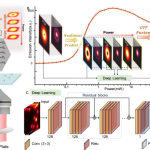
The team hypothesized that modulated excitation would yield emission signals with these additional frequency components, effectively creating a new pathway for background-free imaging. Analysis of emission data in the frequency domain revealed a clear BF signal at 2 Hz when researchers performed Fast Fourier Transform (FFT) analysis on summed intensity time-traces. This signal was then isolated through frequency filtering and used to reconstruct an image, demonstrating the feasibility of extracting information solely from the BFs.
The reconstructed BF image exhibited a marked suppression of prominent residual excitation light present in standard averaged images, while preserving the original UCNP signal pattern as seen in emission profiles. The strength of these generated BFs is notably higher in multi-photonic upconversion luminescence (UCL) bands, compared to the two-photonic 800 nm emission. This disparity indicates a strong capacity for UCNPs to generate BF signals in response to superimposed modulated excitation.
To further validate the technique, the researchers subjected the system to overwhelming ambient light, remaining below detector saturation, and observed continued suppression of background noise through BF filtering; “The prominent residual excitation light present in the averaged image…is almost entirely suppressed in this BF image,” while the UCNP signal remained clear. A simple memoryless nonlinearity model, alongside a rate-equation UCNP model, provided further physical intuition for the observed phenomenon, solidifying the understanding of how UCNPs function as frequency mixers.
Photophysical Lock-in Detection Resolves Beat Frequencies
The discovery allows for a photophysical lock-in detection (PP-LID) approach that exploits the inherent nonlinearity of upconversion luminescence (UCL), offering a pathway to background-free imaging. Specifically, modulating excitation at two different frequencies yields emission signals containing these BFs, distinguishable from both ambient light and residual excitation. This PP-LID technique addresses a limitation of conventional lock-in detection, which fails to eliminate concurrently modulated residual excitation light, a persistent issue even with existing methods.
While standard lock-in detection discriminates between periodic signals and random noise, it cannot resolve light modulated at the same frequency as the desired optical signal; the new approach circumvents this by generating BFs at frequencies independent of the initial excitation. The team successfully imaged BF signals from UCNPs using a frame-rate-limited sCMOS camera, a relatively accessible imaging technology, and validated the technique through tissue imaging experiments.
A capillary tube containing a suspension was positioned behind a 5 mm-thick slab of chicken breast tissue to simulate light scattering and attenuation within biological samples. “Suppression of laser residuals and ambient light in surface imaging via photophysical lock-in detection,” the researchers noted, highlighting the potential for practical applications. This approach offers significant potential, as the BF signal can be generated at a sufficiently low, arbitrary frequency, making it detectable with low-speed detectors.
Simulations Demonstrate UCNP Frequency Mixing
Simulations revealed that upconversion nanoparticles (UCNPs) generate additional frequency components in their emitted light, distinct from residual excitation light, and exploitable for enhanced signal-to-background ratio. These newly discovered spectral characteristics arise not simply from light emission, but from the UCNPs actively mixing the frequencies present in the excitation source, a behavior previously unobserved in these materials. The simulations established that lock-in detection (LID) applied at these newly generated frequencies can substantially reduce background noise, offering a pathway to clearer imaging.
The relative strength of these beat frequency signals, the simulations showed, can be optimized through careful control of UCNP composition and design, opening avenues for tailored nanoparticle engineering. Researchers set the maximum excitation intensity for UCNP simulations at 1 W cm−2, mirroring conditions relevant to biological applications and ensuring realistic modeling of the nonlinear optical response.
This nonlinearity was hypothesized to generate emission signals with frequency components absent in the original excitation light, and the simulations confirmed this prediction. When exposed to two superimposed sinusoidal or square waves modulated at different base frequencies, the UCNPs functioned as modulation frequency mixers, generating beat frequencies.
“We realized that the inherent nonlinearity of UCNPs could enable them to function as modulation frequency mixers, generating difference, or beat frequency signals when multiple base modulation frequencies are simultaneously applied to the excitation light,” the researchers wrote. The team extended their simulations to explore this phenomenon, confirming the generation of these beat frequencies under varying excitation conditions, and paving the way for a new approach to background suppression in bioimaging.
Excitation Modulation Reveals Second-Harmonic Signals
Simulations demonstrated that lanthanide upconversion nanoparticles (UCNPs) produce second-harmonic (SH) signals when excited by either sinusoidal or square-wave modulation, establishing a new channel for lock-in detection (LID). This capability arises from the inherent nonlinearity within the UCNPs themselves, allowing them to function not simply as emitters of light, but as active components in frequency mixing processes. While the higher frequency of the SH signal initially presented a challenge for detection with standard cameras, further investigation revealed an unexpected benefit of the UCNPs’ nonlinear behavior.
Researchers discovered that UCNPs exposed to two superimposed base modulation frequencies generate beat frequencies (BFs), lower frequency components not present in the original excitation light. Analysis of summed intensity time-traces, followed by FFT analysis, further isolated beat frequencies (BFs) demonstrating their consistent generation. Frequency-filtering the signal from the image sequence, pixel by pixel, then allowed for image reconstruction, effectively isolating the UCNP signal from background interference.
The generation of these BFs stems from the nonlinear response of UCNPs to excitation intensity, and can be significantly enhanced through careful engineering of the nanoparticle core and shell structure to manipulate upconversion pathways. This technique offers a distinct advantage, as it does not require specialized detection equipment beyond frame-rate-limited cameras.
Beat Frequency Signal Strength Optimizes UCNP Design
This capability extends beyond simple light emission; UCNPs function as active frequency mixers, creating new signals through excitation modulation. Researchers verified this through numerical modeling of a two-photon energy-transfer upconversion system, observing a second harmonic signal when the UCNPs were excited with a sinusoidal frequency. Square-wave excitation further produced even-order harmonics, demonstrating the UCNPs’ ability to multiply input frequencies. Analysis of the fast Fourier transform (FFT) spectra confirmed the generation of beat frequencies (BFs) when UCNPs were excited by two superimposed square waves.
Specifically, a 2 Hz beat frequency signal was detected alongside expected base frequencies and their second harmonics, even when analyzing the upconverted luminescence (UCL). These findings suggest a pathway to optimize UCNP composition and design to maximize BF signal strength, providing a predictive framework for materials development. The beat frequency signal measured approximately 3% for the two-photonic 800 nm emission and exceeded 20% in multi-photonic UCL bands. “We see significant potential in exploiting the BF signal for practical applications,” the researchers state, highlighting the technique’s ability to circumvent limitations of existing methods.
PP-LID Enhances Signal-to-Background Ratio in Imaging
Frame-rate-limited cameras are sufficient to resolve beat frequencies generated by upconversion nanoparticles, a finding that bypasses the need for specialized, high-speed imaging equipment. The technique actively manipulates light frequencies within the nanoparticles themselves, transforming them into mixers that generate these resolvable beat frequencies. The PP-LID method demonstrably enhances signal-to-background ratio in imaging, even under challenging conditions like those found deep within tissues. Simulations comparing UCNP emission to that of conventional fluorophores revealed a linear response from the latter under modulated excitation, while UCNPs exhibited the frequency mixing crucial to PP-LID.
This performance was achieved while simultaneously eliminating the interference of leaked laser light. The researchers emphasize that PP-LID primarily improves signal clarity and contrast, without altering the inherent spatial resolution limited by light diffusion within the tissue.
While the technique does not address the fundamental limits of light scattering, it provides a substantial advantage in extracting weak signals from noisy backgrounds. For deep tissue imaging, the approach could be particularly valuable, enabling clearer visualization despite significant light attenuation and scattering, and offering a means to optimize both UCNP composition and design for maximized beat frequency signal strength.
Frame-Rate-Limited Cameras Detect Beat Frequencies
UCNPs generate beat frequencies when excited by multiple light sources, creating resolvable spectral components beyond their typical upconverted emission, a surprising function for these nanoparticles that transforms them into active light frequency mixers. This capability forms the basis of a new imaging technique where signals appear at the difference between the excitation frequencies, known as beat frequencies. These beat frequencies are not present in the residual excitation light, offering a pathway to clearer images.
Simulations and experiments demonstrated the generation of these additional frequency components within the upconverted luminescence signal, components absent from the background excitation light. In experiments using UCNPs, the intensity trace of the generated upconverted luminescence, averaged over time, revealed a strong beat frequency signal. “Extracting BF signals by PP-LID thus provides a strategy to significantly enhance signal-to-background conditions in UCNP-based bioimaging and biosensing,” the researchers write, highlighting the potential for improved clarity in complex biological samples.


See today’s quantum computing news on Quantum Zeitgeist for the latest breakthroughs in qubits, hardware, algorithms, and industry deals.