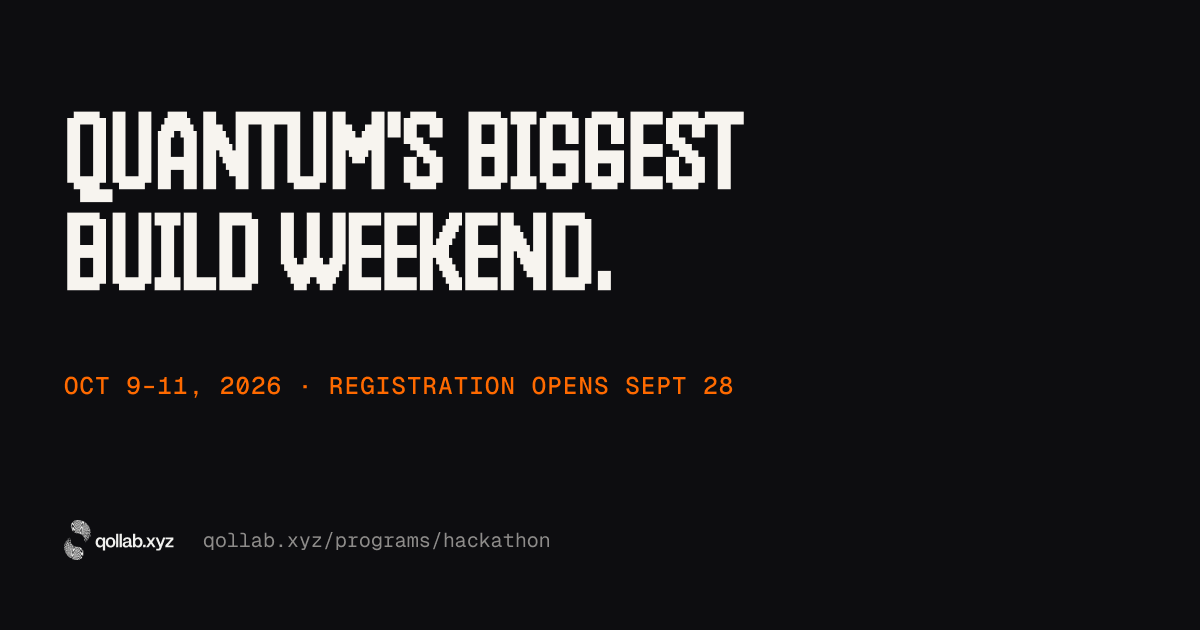
IonQ and Qollab will run a 48-hour quantum hackathon the weekend of October 9, and registration opens on September 28. The rules, the themes and the prize table are public now.
Registration opens September 28 and the build runs October 9 to 11
The hackathon starts at 19:00 ET on October 9, and the submission deadline is 19:00 ET on October 11, which gives every team the same 48 hours. Registration closes at 11:00 ET on October 6, ahead of the Friday start. The round carries the name SESSION 2026.10.09, taken from the day it starts.
Anyone 18 or older, based in one of the 45 countries Qollab lists, can enter from wherever they are, alone or in a team of up to four. The weekend is remote. Beginners can enter, and a little Python helps.
Students at a campus in the hackathon enter on the student track. Professionals, and students from any other school, name one of those campuses so a local panel can score their work, and that is the second track. The campus is only a judging home. It does not have to be their own school.
Teams write Qiskit in the browser and run it on an IonQ simulator
Teams write the whole project in the browser on Qollab. The language is Python and the toolkit is Qiskit, the library a programmer uses to write a quantum circuit and send it to an IonQ simulator. Qollab’s primer walks a newcomer to a running circuit in six short lessons. The code runs on IonQ’s simulator, a program that imitates the quantum computer, and the work has to be done during the weekend. The finished project goes up on Qollab under an MIT license, which lets anyone reuse it, with a page that explains the work.
Twenty-one university nodes score the work before it goes global
Qollab lists 21 nodes in 10 countries, among them UCLA, Georgia Tech, Toronto and Aalto, and a node is the campus group that scores its own entries before anything goes global. The score sheet is the same everywhere. Local panels finish in the week of October 12. Global winners are named in the week of October 19. Judges look at how new the work is, how well it runs, what it changes, and how clearly it is written.
Three themes, and a project can place without matching one
The rules set out three themes, and a project that fits none of them can still take a placement prize. Theme prizes go to a project that matches a theme.
Quantum Impact is the brief for a real data set and a result you can measure. A team takes public data from shipping, factories, energy, finance or some other field, builds the best result a normal computer can manage, and then shows where a quantum step changes that result. That mix, a quantum step inside an otherwise normal program, is what hybrid means here.
Quantum Playground is the open brief. A team can build a game, a piece of music, a work of art or something a visitor can play with, and superposition, interference, entanglement or measurement has to be essential to it. Random output on its own does not qualify.
Quantum Unlocked is the teaching brief. A team picks a hard subject, such as error correction, fault tolerance or quantum networking, and builds a demo, an animation or a visual tool that makes the idea click. The aim is that a newcomer can explain the idea afterward.
First place is $10,000 in cash plus $20,000 in hardware time
First place is $10,000 in cash plus $20,000 in compute, second place is $5,000 plus $15,000, and third place is $2,500 plus $10,000 on the global table. The compute figure is hardware time. Qollab says winners spend it on IonQ’s machines through the platform, and there is no cash equivalent to withdraw.
Specialty prizes sit beside the top three. Each one is $500 in cash and $5,000 in compute. They go to the most novel or creative project, the best documentation, the entry with the most impact, and the best project in each theme. A team can win a placement prize and a specialty prize in the same weekend.
Ten projects bring a node its own prizes. First at the node is $500 in cash and $5,000 in compute, second is $300 and $3,000, and third is $200 and $2,000. When a node has fewer than 10 projects, it still sends its top three up to the global panel.
A mentor gives two hours on October 10 or 11
Qollab is recruiting mentors for the build, and the application is open now, before team registration starts. A mentor gives at least two hours on October 10 or October 11, in one-hour windows chosen in their own time zone, and can also take questions on the event Slack. Researchers, engineers and graduate students can apply from anywhere, and a mentor is allowed to compete as well.
The full rules, the country list and the prize table are on the hackathon site. Qollab has also scheduled an optional question session with the committee in the week of October 5.


See today’s quantum computing news on Quantum Zeitgeist for the latest breakthroughs in qubits, hardware, algorithms, and industry deals.