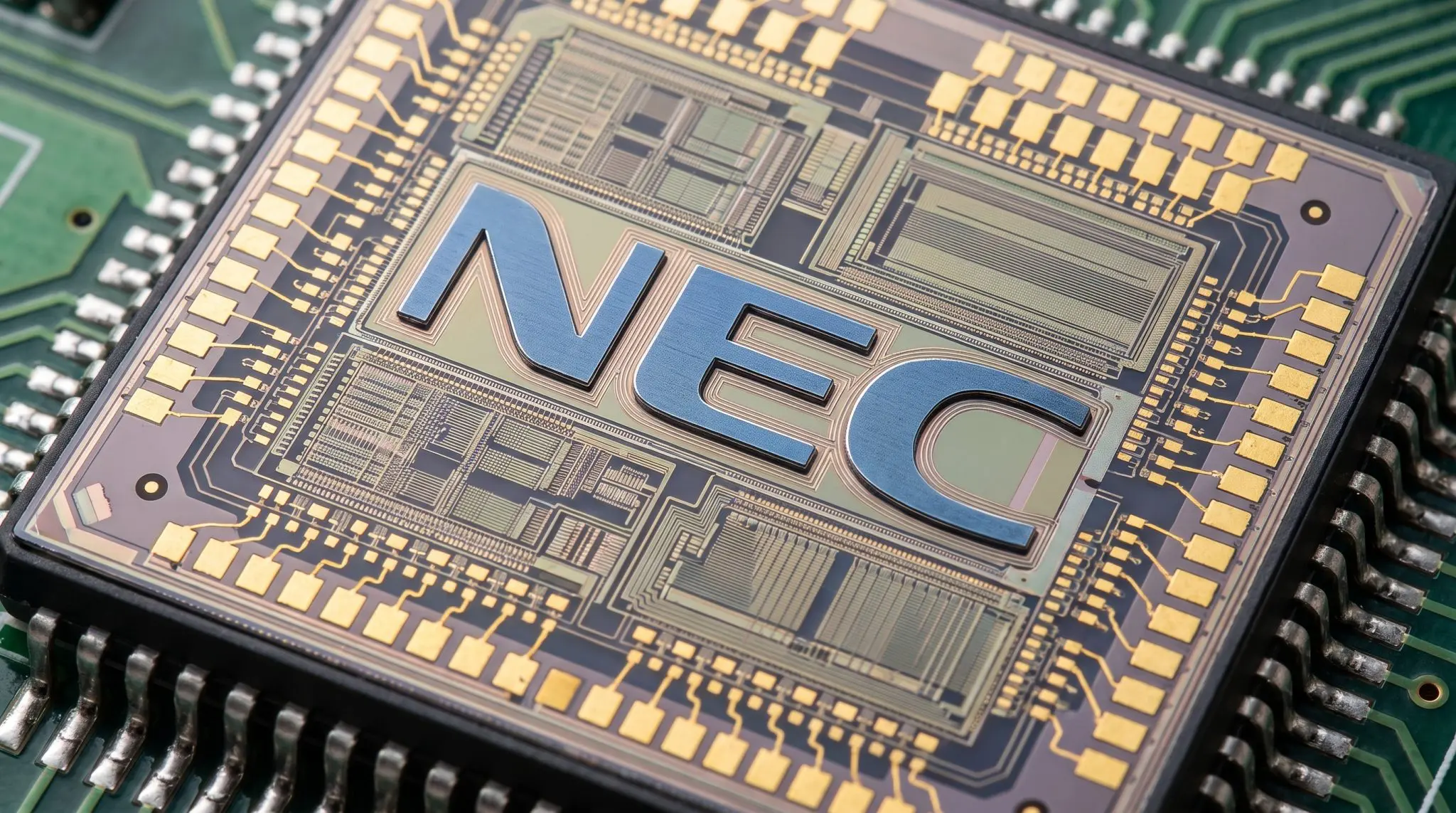
NEC has stopped development of a working quantum computer, the technology group revealed on September 5, 2026, after concluding that a return on investment would take too long, the company says. This decision marks a change for NEC, which has conducted quantum computing research since the 1990s. Meanwhile, Japan announced plans to send 30,000 young scientists abroad to study AI and quantum research, a move that highlights a national ambition that contrasts with this private-sector decision. According to the company, development would likely take too long to generate a return on investment.
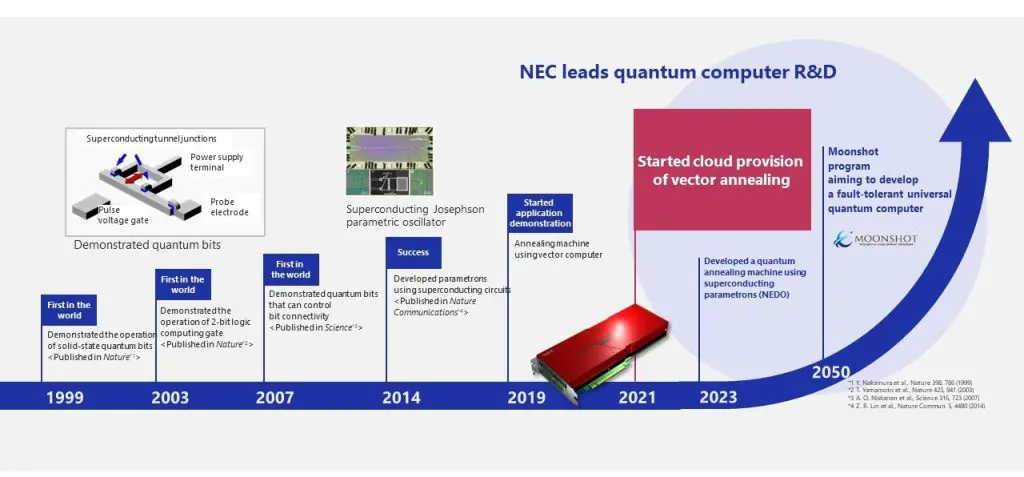
NEC has long been a pioneer in quantum computing, becoming the first company in the world to demonstrate qubit operation with a superconducting solid-state device in 1999 and later achieving a highly sensitive qubit readout using a superconducting parametron circuit in 2014. Today it pursues both major approaches—gate-based quantum computers and quantum annealing—through the NEC-AIST Quantum Technology Cooperative Research Laboratory. On the gate-based side, NEC serves as project manager for a superconducting-circuit effort under Japan’s Moonshot program, which aims to realize a fault-tolerant quantum computer by 2050.
For combinatorial optimisation, NEC was developing a distinctive quantum-annealing architecture based on superconducting parametron and Josephson Parametric Oscillator (JPO) circuits. This design yields longer coherence times than conventional annealers, requires fewer qubits to represent the same Ising-model problems, and is structured for easier scaling. In June 2023 the company began joint cloud-access research with Tohoku University on an 8-qubit annealing machine, with the explicit goal of hybrid operation alongside classical simulated annealing running on NEC’s SX-Aurora TSUBASA vector processors.
The immediate technical target was thought to be to grow the qubit count (annealing) system from 8 qubits to 100 or more so that practical services become feasible. The principal obstacles are the wiring and measurement hardware that scale with qubit count and the limited cooling capacity of dilution refrigerators that must keep devices near 10 mK. NEC is therefore also investigating compact control electronics that can operate inside the cryostat, seeking architectural efficiencies rather than simply larger refrigerators. The company positions its combination of quantum hardware and existing high-performance classical systems as a distinctive advantage for delivering usable hybrid solutions.
NEC Ends Quantum Computer Development Due to ROI Concerns
The decision reflects a pragmatic assessment of the lengthy timeline required to commercialize the complex technology, a factor increasingly affecting private sector quantum initiatives. This shift arrives as Japan intends to dispatch 30,000 young scientists abroad to bolster expertise in both artificial intelligence and quantum research. The company’s decades-long commitment to quantum computing research now concludes with a focus on financial outcomes, signaling a recalibration of priorities within the technology group.
This assessment contrasts with ongoing, substantial investment in quantum computing by both the United States and China. Fujitsu recently articulated ambitions to become an artificial intelligence competitor to companies in those two nations, highlighting a broader national strategy. NEC’s move underscores the challenges of translating fundamental quantum research into viable commercial products, even for established technology leaders. The world has moved away from pure annealing machines, and the timelines for FTQC appear to be getting closer; if the tech was largely focused on annealing, it was competing with a well-established competitor, D-Wave, with a good installed base and a company like D-Wave that is also building gate-based machines aiming at logical qubits and fault tolerance.
Not financial advice of course, but we don’t think this will come as much as surprise, as the news teams hardly see any product releases or much news from NEC. It’s likely the nearest competitor (Fujitsu) also have been in a similar space. Fujitsu’s superconducting processors sit in the line that started at NEC. Yasunobu Nakamura demonstrated the first superconducting charge qubit at NEC in 1999; he later became director of RIKEN’s Center for Quantum Computing. Fujitsu’s machines are built at the RIKEN RQC–Fujitsu Collaboration Center with that group.
NEC tried to do both gate-model integration (Moonshot, cryoelectronics, packaging) and a unique JPO annealer that used long coherence and ParityQC-style coupling. The annealer never left the 4- then 8-qubit lab stage
Source: https://asia.nikkei.com/business/technology/japan-s-nec-scraps-effort-to-build-a-quantum-computer



See today’s quantum computing news on Quantum Zeitgeist for the latest breakthroughs in qubits, hardware, algorithms, and industry deals.