Researchers at ITMO University have created a silicon film capable of switching light up to a billion times per second. The device, an adjustable metasurface operating in the middle infrared range, offers a new approach to controlling radiation by eliminating traditional glass or sapphire substrates that weaken optical signals.
Instead, the team fabricated a one-micrometer-thin, levitating silicon membrane; Mihail Petrov, a senior researcher at ITMO’s Faculty of Physics, explains that the Swiss team of physicists designed the metasurface and conducted calculations of its linear optical properties. This innovation promises advancements in optical computing, biosensors, and data transfer systems.
Silicon Metasurface Enables Gigahertz-Scale Light Modulation
This adjustable metasurface operates within the middle infrared range, a spectrum where existing metasurfaces often lack dynamic control capabilities. Traditional designs typically serve a single wavelength or purpose after fabrication. The team detailed their findings in a recent publication in Nature Communications, outlining a method for dynamically controlling light signals for potential use in optical computing and data transmission. Conventional metasurface fabrication often relies on glass or sapphire substrates, but these materials impede signal strength by absorbing radiation.
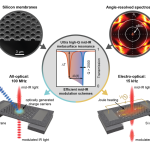
This approach maximizes transparency and allows for precise control of infrared beams, achieving a quality factor, a measure of resonance, reaching 3,000. The membrane’s responsiveness stems from its ability to alter transparency with external stimuli; applying a five-volt electrical charge heats the silicon, reducing transmission, while a short laser pulse generates free electrons, instantaneously changing optical properties.
Sergey Makarov, a chief research associate at ITMO’s Faculty of Physics, explains that in the electric mode, the speed of switching is limited by the membrane’s heating and cooling time. The optical mode is different, as the laser pulse changes silicon properties nearly instantaneously, resulting in switching times of mere nanoseconds and a modulation frequency reaching the order of a gigahertz, a billion switches per second.
This gigahertz-scale modulation frequency rivals the clock speeds of contemporary processors, but performs signal processing directly with light. Such a device could underpin compact spectrometers for chemical analysis, enhance thermal imaging sensitivity, and secure optical communication systems through light-based data encryption. The research received support from the federal program Priority 2030, and the team is now investigating light polarization control to further increase data transmission capacity.
First, the Swiss team of physicists designed the metasurface and conducted calculations of its linear optical properties, for instance, how it will transmit and reflect light depending on the nanohole geometry. Next, we calculated how fast such structures will be able to change their optical properties, for example, switch from transparent to non-transparent state in a fraction of a nanosecond.
Even minor external stimuli cause a noticeable change in transparency, enabling both attenuation and transmission of light.
In the electric mode, the speed of switching is limited by the membrane’s heating and cooling time. The optical mode is different: the laser pulse changes silicon properties nearly instantaneously, which is why the switching time is mere nanoseconds and the modulation frequency reaches the order of a gigahertz, that’s a billion switches in a second.
Sergey Makarov, a chief research associate at ITMO’s Faculty of Physics and the head of the research team specializing in nanophotonics

See today’s quantum computing news on Quantum Zeitgeist for the latest breakthroughs in qubits, hardware, algorithms, and industry deals.