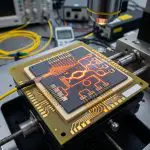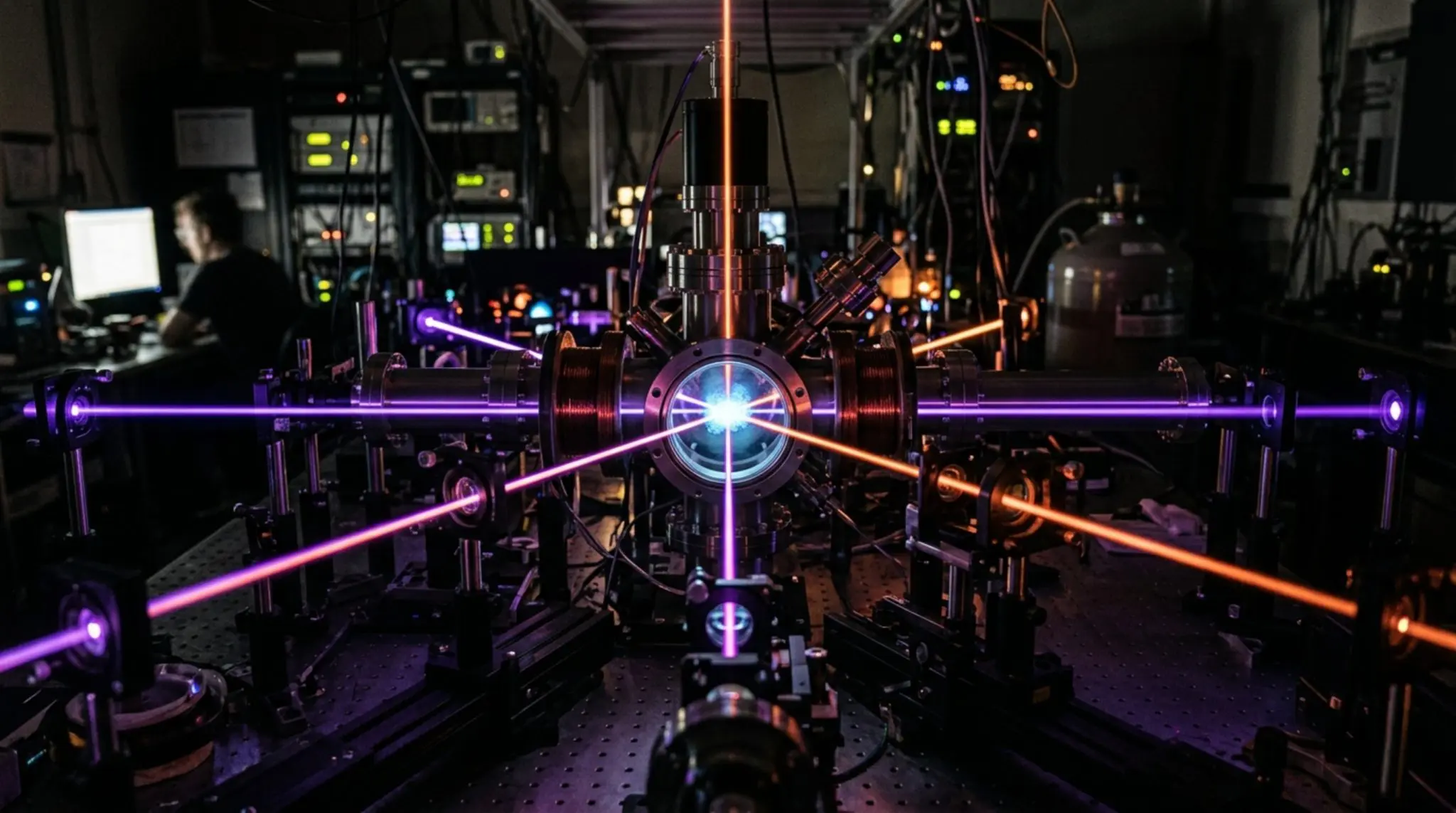
Princeton scientists have created a superconducting quantum computing chip featuring qubits that maintain coherence for over 1 millisecond, a duration nearly fifteen times longer than that of current industry standard processors. This achievement builds on foundational research begun in 1985 at the University of California, Berkeley, ultimately recognized with the Nobel Prize for John Clarke, Michel Devoret, and John Martinis.
Irfan Siddiqi, a professor at the University of California, Berkeley, noted that “Quantum mechanics was created to explain phenomena that seem to defy classical physics,” as researchers continue to translate this complex science into viable quantum computing technologies.
1985 Berkeley Experiment Demonstrated Scalable Quantum Behavior
Superconducting qubits maintained coherence for over one millisecond in a recent demonstration by Princeton scientists, a duration nearly fifteen times longer than that of typical industry standard processors. The 1985 experiment addressed a fundamental challenge in quantum physics: observing quantum effects in systems large enough to be directly measured.
Prior to this, quantum phenomena were largely confined to the microscopic realm of individual particles. As Alicia Kollár, an assistant professor at the University of Maryland, explained, “There’s a general rule in physics that the fundamental building blocks of physics are quantum mechanical, but that by the time you can see it with your eye or touch it, that is all lost.” The Berkeley team circumvented this limitation by utilizing superconducting circuits exhibiting both quantization and quantum tunneling, effectively scaling up quantum behavior to a visible level.
They achieved this using Josephson junctions, which allow Cooper pairs, pairs of electrons that move without resistance in superconducting materials, to tunnel through insulating barriers. The significance of this achievement extends beyond simply observing quantum effects in larger systems; it provided physical evidence of previously theoretical states. The team’s meticulous experiments, supported by the DOE’s Basic Energy Sciences program, involved creating a superconducting circuit and injecting microwaves to control and measure its parameters.
By demonstrating quantum tunneling, the ability of particles to pass through energy barriers they classically shouldn’t, they confirmed key predictions of quantum mechanics and established a platform for future quantum technologies. The choice of materials in these early experiments was deliberate.
As Devoret noted, “Clarke, Devoret and Martinis were using aluminum and niobium because those are the archetypal superconductors.” The initial goal was to understand the fundamental physics, with the potential for technological applications emerging later. This foundational research, spanning decades, has now culminated in the development of qubits with significantly improved coherence times.
While the 1985 experiment proved the possibility of quantum behavior in a system large enough to be manipulated, the recent Princeton achievement demonstrates a substantial advancement in its practicality. The field has not reached a moment of rapid change similar to the early days of classical computing, but the progress is undeniable.
The biggest advances in superconducting qubits through those years came from physics groups. And I say that with fondness, because I’m a physicist.
Chuck Black, Deputy Associate Laboratory Director at DOE’s Brookhaven National Laboratory
DOE Funding Enabled Superconducting Qubit Technology
The recent achievement of over one millisecond coherence in superconducting qubits developed at Princeton University builds directly on foundational research initiated in 1985 with support from the Department of Energy. The longevity of qubit states is paramount; longer coherence allows for more complex calculations before quantum information is lost to environmental noise. This initial success, funded by the DOE’s Office of Basic Energy Research, established the groundwork for manipulating quantum states in a controllable manner.
Aluminum and niobium were selected for their superconducting properties, providing an ideal environment for observing quantum phenomena. The initial goal, however, wasn’t necessarily quantum computing, which highlights the importance of sustained investment in basic science; discoveries often find unexpected applications decades after their initial conception.
The long-term impact of this foundational research is now evident in the advancements being made in superconducting qubit technology. One researcher explained that “It’s been this marriage of really good superconducting device people with really good materials scientists and premier facilities for doing materials science.” The ability to leverage expertise from various engineering disciplines has been instrumental in achieving record-setting results. The progress is undeniable, though the field has not yet reached the point of widespread application.
Siddiqi said, “We haven’t reached that moment that happened in regular computing when people started thinking of all of the new things you could use a computer for.” However, with continued support and innovation, the future of quantum computing, built on decades of DOE-funded research, appears increasingly promising. The team reports demonstrating a significant increase in qubit coherence, lasting nearly fifteen times longer than industry standard processors.
What allowed us to do it was advances in how stable the qubits could be.
Robert Schoelkopf
Quantum Mechanics Explains Subatomic Particle Duality
These quantum phenomena, while counterintuitive to classical physics, are fundamental to the behavior of subatomic particles. Unlike classical objects with definite properties, quantum particles exist in a state of probability until measured. This means a quantum bit, or qubit, can represent 0, 1, or a combination of both simultaneously, vastly increasing computational possibilities.
The team’s work demonstrated that Cooper pairs, paired electrons in a superconductor, could exhibit quantum tunneling, passing through energy barriers they classically shouldn’t be able to overcome. The progression from demonstrating these fundamental quantum effects to building functional qubits required a convergence of expertise, as noted by a researcher involved in the current Princeton project.
The ability to maintain coherence for over 1 millisecond represents a step towards realizing the potential of quantum computing, allowing for more complex algorithms and error correction. Yao Lu, an associate scientist at DOE’s Fermi National Accelerator Laboratory and the Superconducting Quantum Materials and Systems Center, highlights the broader implications, stating, “Quantum computing is such a different paradigm for how to think about information and how to simulate the natural world or compute problems.” The fact that this level of control over quantum states has been achieved, as one scientist put it, “is unbelievable. I’m so proud of us as human beings, that we’ve been able to make so much progress.”
There’s a general rule in physics that the fundamental building blocks of physics are quantum mechanical [but] that by the time you can see it with your eye or touch it, that is all lost.
Alicia Kollár, an assistant professor at the University of Maryland
Quantization Defines Discrete Energy Levels in Qubits
The extended coherence allows for more intricate algorithms and reduces the error rates that plague current quantum systems. The foundation for this recent progress, however, extends back to 1985. Their initial work focused on observing quantization, the principle that quantum particles possess discrete, specific energy levels, rather than a continuous range. The 1985 experiment utilized aluminum and niobium, archetypal superconductors, because Clarke, Devoret, and Martinis explained that these materials exhibit predictable quantum tunneling.
To illustrate, consider a basketball and a brick wall; classically, the basketball would never pass through. However, quantum particles have a probability of tunneling through such barriers, a phenomenon observed in unstable nuclei and crucial for solar fusion. “We would never be where we were these days with electronics if we had stuck with germanium,” highlighting the importance of materials science in advancing quantum technology, as the selection and refinement of superconducting materials are critical for achieving long coherence times and minimizing errors.
It’s been this marriage of really good superconducting device people with really good materials scientists and premier facilities for doing materials science.
C2QA, Black
Quantum Tunneling Allows Particle Passage Through Barriers
This extended coherence is not merely a technical refinement; it directly addresses a fundamental challenge in building practical quantum computers, where maintaining the delicate quantum states of qubits is paramount. The ability of these qubits to sustain information for such a prolonged period signifies a substantial leap toward complex calculations previously unattainable. The principle underpinning this achievement traces back to 1985, when researchers at the University of California, Berkeley, first demonstrated quantum behavior in a system large enough to be manipulated.
This isn’t merely a theoretical curiosity; it’s a fundamental aspect of how these circuits operate. Unstable nuclei exhibit quantum tunneling during decay, and even the sun’s fusion relies on it, despite conditions seemingly insufficient for such a reaction according to classical physics.
The team at Princeton leveraged this principle to design circuits where electrons can “tunnel” through insulating layers, creating the quantum states necessary for computation. The fragility of quantum effects presents a significant hurdle. The Princeton team’s success isn’t solely about materials science or quantum physics; it’s about the convergence of both.
The long-term investment in basic research, beginning in 1985, has culminated in this demonstrable progress, proving that a foundational understanding of quantum mechanics can translate into tangible technological advancements. The team’s achievement, building on decades of work, demonstrates that the boundary between the classical and quantum worlds is becoming increasingly blurred.
Quantum computing is such a different paradigm for how to think about information and how to simulate the natural world or compute problems.
Robert Schoelkopf
Josephson Junctions Facilitate Superconducting Quantum Circuits
This leap in stability stems from a refined understanding and application of Josephson junctions, components crucial to building and controlling superconducting quantum circuits. The ability to maintain qubit coherence, the quantum state necessary for computation, for such an extended period addresses a central challenge in quantum computing.
A researcher involved in the project explained, “Once we leveraged a lot of this established expertise that we can borrow from engineers in other fields, we’re able to achieve record-setting results.” This interdisciplinary approach built upon decades of foundational work, initially supported by the Department of Energy’s Office of Science. The core of these superconducting circuits relies on the unique properties of Josephson junctions. These junctions, first proposed in 1962 by physicist Brian Josephson, consist of two superconducting materials separated by a thin insulating barrier.
While classical physics would predict no current flow across an insulator, quantum mechanics allows for Cooper pairs, pairs of electrons, to “tunnel” through the barrier, creating a supercurrent. Building on this foundation, researchers have continued to refine the design and materials used in Josephson junctions. The ability to fabricate increasingly complex and stable superconducting circuits, facilitated by advancements in Josephson junction technology, is bringing practical quantum computing closer to reality.
What is the boundary between our classical world and quantum degrees of freedom?
Yao Lu, an associate scientist at DOE’s Fermi National Accelerator Laboratory and the Superconducting Quantum Materials and Systems Center
Source: https://www.energy.gov/science/articles/quantum-palm-your-hand-evolution-superconducting-qubits


See today’s quantum computing news on Quantum Zeitgeist for the latest breakthroughs in qubits, hardware, algorithms, and industry deals.