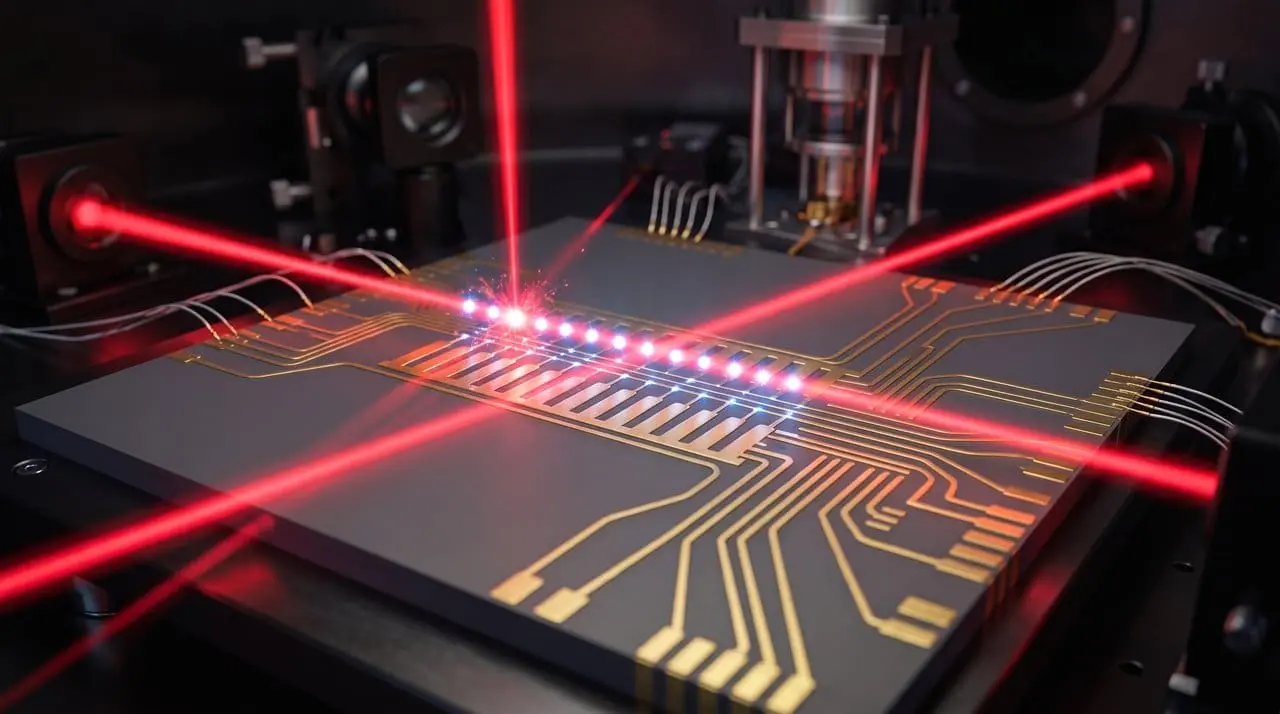
Yann Valibouse of the University of Vienna and colleagues have experimentally implemented a BB84-like protocol using a photonic quantum SWITCH, embedding Alice and Bob’s operations within it. This enables eavesdropper detection via measurements of a control qubit, achieving an average detection probability of 0.15 ±0.02 per shared qubit. The technique avoids discarding encrypted data during eavesdropping detection. Current methods typically require revealing and discarding portions of the key to check for interference, but this new approach allows all data to potentially remain secure during communication.
The team embedded operations for sending and receiving information within a photonic quantum SWITCH, a device exploiting a quantum phenomenon called indefinite causal order. Existing quantum key distribution protocols, like the BB84 method of encrypting messages using the properties of light, typically require revealing and discarding portions of the key to verify security, but this new technique preserves all potentially secure data. The team embedded the operations for sending and receiving information within a photonic quantum SWITCH, a device that manipulates single photons like a railway switch directing them along different paths.
This SWITCH exploits a quantum phenomenon called indefinite causal order, where the sequence of quantum operations isn’t fixed but determined by quantum chance, similar to a coin flip deciding an action. This is a departure from classical physics where events occur in a definite sequence, and opens up possibilities for novel quantum information processing tasks.
Indefinite causal order enhances photonic quantum key distribution security
Eavesdropper detection now reaches 0.15 ±0.02 per shared qubit, representing a substantial improvement over previous quantum key distribution methods. These earlier methods necessitated discarding portions of encrypted data to verify security, reducing the effective key rate and potentially limiting the length of secure communications. The researchers University of Glasgow, Fakultät für Mathematik, and Academy of Sciences developed a new protocol that embeds standard BB84-like cryptographic operations within a photonic quantum SWITCH.
This enables monitoring of a control qubit for interference, allowing potentially secure data to remain usable for key generation and overcoming a fundamental limitation of earlier systems. The BB84 protocol itself relies on encoding information in the polarization of single photons, and any attempt to intercept and measure these photons inevitably introduces disturbances that can be detected, but traditionally at the cost of discarding some of the transmitted data.
The system exploited indefinite causal order, a quantum phenomenon where the sequence of operations isn’t fixed. This is achieved through a carefully designed interferometer that allows photons to traverse multiple paths simultaneously, creating a superposition of different causal orders. Utilising a device manipulating single photons, this achieved a significant breakthrough in security protocols. Uniquely, it detects interference on a control qubit, rather than discarding encrypted data for verification, as is typical in BB84-like cryptography.
The experiment demonstrated that the quantum SWITCH can function with a coherent superposition of alternative orders, a feature previously shown to benefit communication through noisy channels and enhance metrology. The ability to maintain coherence, the preservation of quantum properties, is crucial for the security of the protocol, as any loss of coherence would allow an eavesdropper to gain information without being detected. Furthermore, the new measurement technique allows photon polarization to be measured within the device without disrupting the coherence of the light, which is vital for maintaining security.
Detecting eavesdropping within quantum key distribution using a photonic switch and control qubit
Quantum key distribution, a method for creating unhackable communications, is being refined by scientists who are tackling a persistent challenge. This challenge involves verifying security without compromising the encryption itself. The inherent security of quantum key distribution stems from the laws of quantum mechanics, which prevent perfect copying of unknown quantum states.
However, verifying that no eavesdropping has occurred requires careful analysis, and traditional methods often involve sacrificing some of the security to achieve this verification. This control qubit acts as a ‘witness’ to any interference caused by an eavesdropper attempting to intercept the quantum signal.
Accepting only specific measurement results, the reliance on post-selection currently prevents this from being a fully secure system as it could introduce hidden biases. Post-selection involves discarding measurement outcomes that do not meet certain criteria, which can potentially skew the results and create vulnerabilities. While this initial demonstration is a significant step forward, further research is needed to eliminate the need for post-selection and achieve a truly secure system. This demonstration is important because it proves a principle: it shows that detecting an eavesdropper is possible without revealing any of the encryption key itself. This contrasts with existing methods where some key data must be sacrificed to verify security. The team’s experimental work utilises indefinite causal order, allowing for embedding cryptographic operations within the device itself. In particular, this approach achieves eavesdropper detection by examining a control qubit, circumventing the need to publicly reveal and discard portions of the encryption key, a limitation of existing BB84-based systems. Although the current implementation requires post-selection of measurement outcomes, this proof-of-principle establishes indefinite causal order as a viable resource for enhancing quantum communication security. Future work will focus on removing the post-selection requirement and exploring the potential of this technique for long-distance quantum communication and integration with existing quantum networks.
The research demonstrated a method for quantum cryptography where eavesdropper detection occurred with a probability of 0.15 ±0.02 per shared qubit. This is important because it allows for verification of security without publicly revealing or discarding any of the encryption key, unlike standard BB84 protocols. The experiment embedded cryptographic operations within a photonic quantum SWITCH, utilising a control qubit to witness potential interference from an eavesdropper. Although the current implementation relies on post-selection of measurement results, the authors intend to address this limitation in future work to improve the system.
👉 More information
🗞 Experimental Quantum Key Distribution in an Indefinite Causal Order
✍️ Yann Valibouse, Martí Cladera-Rosselló, Michael Antesberger, Hector Spencer-Wood, Kyrylo Simonov, Patrik Sund, Mathieu Bozzio, Philip Walther and Lee A. Rozema
🧠 ArXiv: https://arxiv.org/abs/2608.13561




See today’s quantum computing news on Quantum Zeitgeist for the latest breakthroughs in qubits, hardware, algorithms, and industry deals.