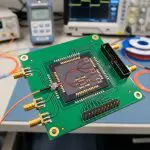
A hybrid quantum-classical computing approach streamlines complex calculations by reformulating a key challenge in drug discovery: identifying how molecules bind to target proteins. This new method tackles molecular docking by transforming it into a graph-based problem solvable with advanced encoding techniques; this allows for more efficient use of computational resources while maintaining key optimisation structures. A new computational method has been devised for molecular docking, integrating both classical and quantum computing techniques to identify how molecules bind to target proteins.
The team reformulated complex calculations as a graph-based problem, simplifying the search for optimal molecule arrangements within a protein’s binding site. The approach uses advanced encoding which efficiently represents information using qubits, the basic units of quantum information, reducing demand on processing power whilst preserving essential optimisation features. A new computational approach identifies how molecules bind to proteins, vital in designing effective drugs.
Molecular docking requires immense computing power due to the sheer number of potential arrangements between drug candidates and their target proteins; it is like trying every possible key in a lock with billions of keys to test. The team reformulated this complex task as a graph-based problem, focusing on finding the most connected group within that network, akin to highlighting the biggest circle of friends where everyone knows each other.
one hundred qubits
molecular docking is a vital computational task in drug discoveryThe advancement provides a versatile platform to address increasingly intricate drug discovery challenges previously impossible due to substantial computing needs. Reformulating molecular docking as a graph-based combinatorial problem enabled efficient encoding with fewer resource demands while maintaining key optimisation structures vital for precise results.
Employing a variational full-basis encoding strategy, representing data via Bloch sphere vectors, compressed information onto fewer qubits than conventional methods allowing execution on a superconducting quantum computer. Successful completion of docking calculations validated the approach; convergence was attained within an acceptable number of optimisation steps utilising randomised imaginary time evolution inspired warm starting techniques alongside gradient based methods.
Accurate recovery of maximum vertex weighted cliques, which represent optimal molecular binding poses, occurred for two biologically relevant instances possessing complex structures and analysis revealed minimal impact from circuit depth or penalty strength parameters indicating robust design implementation. The full-basis encoding strategy reduced qubit requirements to just ⌈N/3⌉ for an N-sized problem, significantly lessening resource demands compared with standard approaches needing one qubit per variable.
Bloch sphere vector manipulation enables feasible quantum computation for drug discovery modelling
Identifying how molecules bind to proteins, a process known as molecular docking, remains a major obstacle in contemporary drug discovery because of the vast number of potential arrangements requiring assessment. This work builds on existing knowledge by simplifying this process into a maximum vertex-weighted clique problem solvable using conventional computers and explored methods to accelerate calculations via quantum processing. Recognising that consistently superior fully fault-tolerant quantum computers are still some way off, crucial groundwork has been laid demonstrating feasibility through transforming the challenge into one involving manipulating Bloch sphere vectors, visual representations of qubit states.
A hybrid quantum-classical approach successfully demonstrated molecular docking by reformulating it as a maximum vertex-weighted clique allowing efficient encoding utilising Bloch sphere vectors representing qubit states. Beyond proof of concept, these results establish feasibility with currently available hardware paving the path for optimising complex computational biology calculations; this work could significantly speed up drug discovery in future and marks a step towards harnessing near-term devices. This achievement represents progress toward addressing limitations imposed by molecule size which impacts broader applicability to truly large protein targets routinely encountered within pharmaceutical research.
The researchers developed a new method for simulating how molecules bind to proteins using both quantum and classical computing techniques. By reformulating molecular docking as a maximum vertex-weighted clique problem and employing full-basis encoding, they reduced the number of qubits needed to represent variables to approximately one third of those required by standard methods.
This approach demonstrates that complex computational biology calculations can be performed with existing quantum hardware, offering potential benefits for optimising drug discovery processes. The study provides evidence supporting the use of advanced encoding strategies in quantum optimisation tasks relevant to structure-based drug design.
👉 More information
🗞 Resource-Efficient Bio-Molecular Docking on a NISQ-era Digital Quantum Computer
✍️ Tianqi Chen, Adrian M. Mak, Jianguo Li, Jian Feng Kong, Chandra Verma and Sebastian Maurer-Stroh
🧠 ArXiv: https://arxiv.org/abs/2608.19868


See today’s quantum computing news on Quantum Zeitgeist for the latest breakthroughs in qubits, hardware, algorithms, and industry deals.