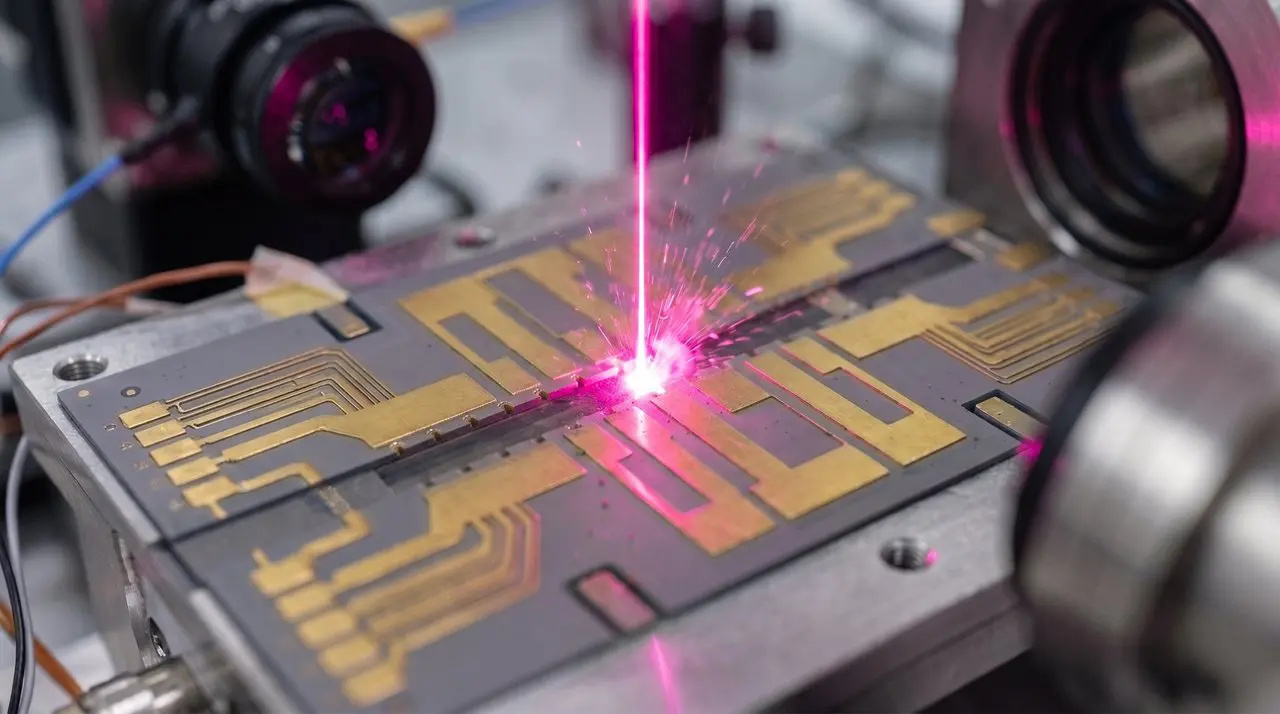
Researchers have created a terahertz metasensor on a 4 mm x 8 mm chip capable of identifying and quantifying mixtures of biomolecules with a maximum error below 3.6%. The device integrates terahertz generation, molecular interaction, and signal detection onto a single, self-supporting 20 μm-thick lithium niobate wafer.
This design achieves a five-order-of-magnitude reduction in the size of the terahertz functional module relative to conventional terahertz time-domain spectroscopy systems, offering a robust and scalable platform for portable quantitative multi-component biomolecular analysis. The work advances terahertz fingerprint sensing by enabling both identification and quantification of multiple biomolecules simultaneously.
Lithium Niobate Chip Enables Compact Terahertz Metasensor Design
The design achieves 6% precision, a level previously unattainable in devices of this size. Fabrication of the chip relies on a 20 μm-thick lithium niobate wafer, chosen for its unique properties that enable both the generation and detection of terahertz waves without external components. The exceptional nonlinearity of the lithium niobate crystal eliminates the need for separate terahertz sources and detectors, contributing significantly to the device’s miniaturization.
Researchers patterned a periodic metasurface array directly onto the lithium niobate substrate, creating a platform for broadband surface-localized terahertz waves that amplify interactions with biomolecules. This configuration enhances the effective path length for terahertz-molecule interaction strength.
The metasensor’s ability to accurately quantify biomolecular mixtures, specifically L-histidine, L-tyrosine, α-lactose, and maltose, demonstrates a significant advancement beyond earlier devices focused solely on identifying the presence of single molecules. Experimental results confirm the chip can distinguish the fingerprint absorptance of these four biomolecules across a continuous spectrum and measure their concentrations with an error below 3.6%. This level of accuracy is achieved through a combination of the broadband SSPP modes supported by the metasurface and a normalization processing technique used to obtain absorption spectra for biomolecular fingerprint analysis, as reported in the paper.
The system utilizes a femtosecond laser pulse focused onto the lithium niobate wafer to generate broadband terahertz waves via impulsive stimulated Raman scattering. The resulting terahertz wave propagates as a subwavelength waveguide mode before being converted to the SSPP mode by the metasurface array.
Researchers employed a drop-casting and drying method to deposit the biomolecules onto the metasurface, allowing for analysis of individual compounds. The design’s potential extends to clinical, pharmaceutical, and point-of-care applications, offering a fully integrated, portable, and high-performance solution for biomolecular mixture analysis.
Broadband Metasurface Excites Surface Polaritons for Biomolecule Interaction
The lithium niobate wafer’s unique properties allow for the creation of a self-supporting structure, integrating all necessary functions onto a single substrate. These waves effectively enhance the interaction between terahertz radiation and biomolecules, increasing terahertz-molecule interaction strength and effective path length. The resulting terahertz wave, carrying fingerprint absorption information, is then detected by a probe pulse, completing the integrated process. The study reports that “the metasurface array supports broadband SSPP modes that confine and guide terahertz waves propagating along the surface, significantly enhancing terahertz-molecule interaction strength and effective path length.”
The ability to analyze multiple biomolecular components simultaneously, with high accuracy, positions this on-chip metasensor as a promising tool for a range of applications, including clinical diagnostics, pharmaceutical research, and point-of-care analysis. The researchers envision a future where this technology facilitates rapid and accurate identification of complex biological samples, potentially revolutionizing fields reliant on precise molecular characterization.
On-Chip Integration Reduces Terahertz System Footprint Five Orders of Magnitude
This on-chip device not only identifies biomolecules but also quantifies their concentrations with an error below 3.6%, a level of precision exceeding that of earlier terahertz sensors focused primarily on molecular identification. The design overcomes limitations inherent in conventional terahertz spectroscopy, where weak interactions between terahertz radiation and biomolecules often restrict sensitivity. Four biomolecules, L-histidine, L-tyrosine, α-lactose, and maltose, were used in testing, demonstrating the system’s capability to analyze these biomolecules, which are critical for biomedical research and pharmaceutical applications.
The exceptional nonlinear properties of the lithium niobate crystal are central to the device’s functionality, allowing it to serve as both a generator and detector of terahertz waves. This integrated approach, coupled with the broadband surface-localized terahertz waves, enables continuous broadband detection, overcoming the limitations of narrow bandwidths found in many existing metasensors.
Quantitative Analysis Identifies Four Biomolecules with 3.6% Error
This miniaturization stems from the use of a 20 μm-thick lithium niobate wafer, which serves as both the foundation for the metasensor and the material enabling full system integration. These sensors often focused on simply identifying the presence of a molecule, rather than determining how much is present, limiting their utility in applications requiring precise measurements. This quantitative ability is enabled by broadband surface-localized terahertz waves, generated by patterning a periodic metasurface array directly onto the lithium niobate substrate.
This process converts a subwavelength waveguide mode to the SSPP mode, which are then guided along the surface of the chip via spoof surface plasmon polaritons. The ability to perform accurate, on-chip quantification of biomolecular mixtures has significant implications for point-of-care diagnostics, pharmaceutical quality control, and other applications demanding rapid and reliable analysis.
The team anticipates this technology will facilitate the identification of complex biomolecular compositions, moving beyond single-molecule detection to address real-world samples containing multiple components. The development represents a step toward fully integrated terahertz systems capable of performing complex analyses outside of a laboratory setting.
LN Crystal Functions as Both Terahertz Source and Detector
This integration, achieved through a 20 μm-thick lithium niobate substrate, eliminates the need for external terahertz sources and detectors. The design leverages the unique nonlinear properties of the lithium niobate crystal, allowing it to function as both a source and sensor of terahertz radiation. This on-chip generation method circumvents limitations of previous designs that depended on separate, spatially distinct components. This process converts the terahertz wave from a subwavelength waveguide mode to the SSPP mode, which enhances interaction with the biomolecules being analyzed.
The use of a 5% magnesium oxide-doped lithium niobate wafer further suppresses the photorefractive effect. By confining the terahertz energy and increasing the effective path length for terahertz-molecule interaction, the system amplifies the signal, allowing for precise quantification even with the weak interactions inherent in terahertz spectroscopy. The researchers achieved this by normalizing the obtained absorption spectra, a processing step illustrated in the supporting information.
SSPP Modes Enhance Terahertz-Molecule Interaction & Detection Path Length
This on-chip system, measuring just 4 mm x 8 mm, circumvents limitations of conventional terahertz spectroscopy which often relies on bulky, externally-connected components and is susceptible to environmental interference. Researchers achieved this miniaturization by leveraging the unique properties of lithium niobate, a material capable of both generating and detecting terahertz waves, eliminating the need for separate source and detector elements. The core of the device’s enhanced performance lies in the design of its metasurface array, which supports broadband surface-localized terahertz waves known as spoof surface plasmon polaritons, or SSPPs.
The resulting surface-confined terahertz waves then interact with any biomolecules deposited on the sensor surface. The team utilized a time-resolved phase-contrast imaging system to detect the terahertz wave after interaction, revealing the characteristic fingerprint absorptions of the biomolecules present.




See today’s quantum computing news on Quantum Zeitgeist for the latest breakthroughs in qubits, hardware, algorithms, and industry deals.