

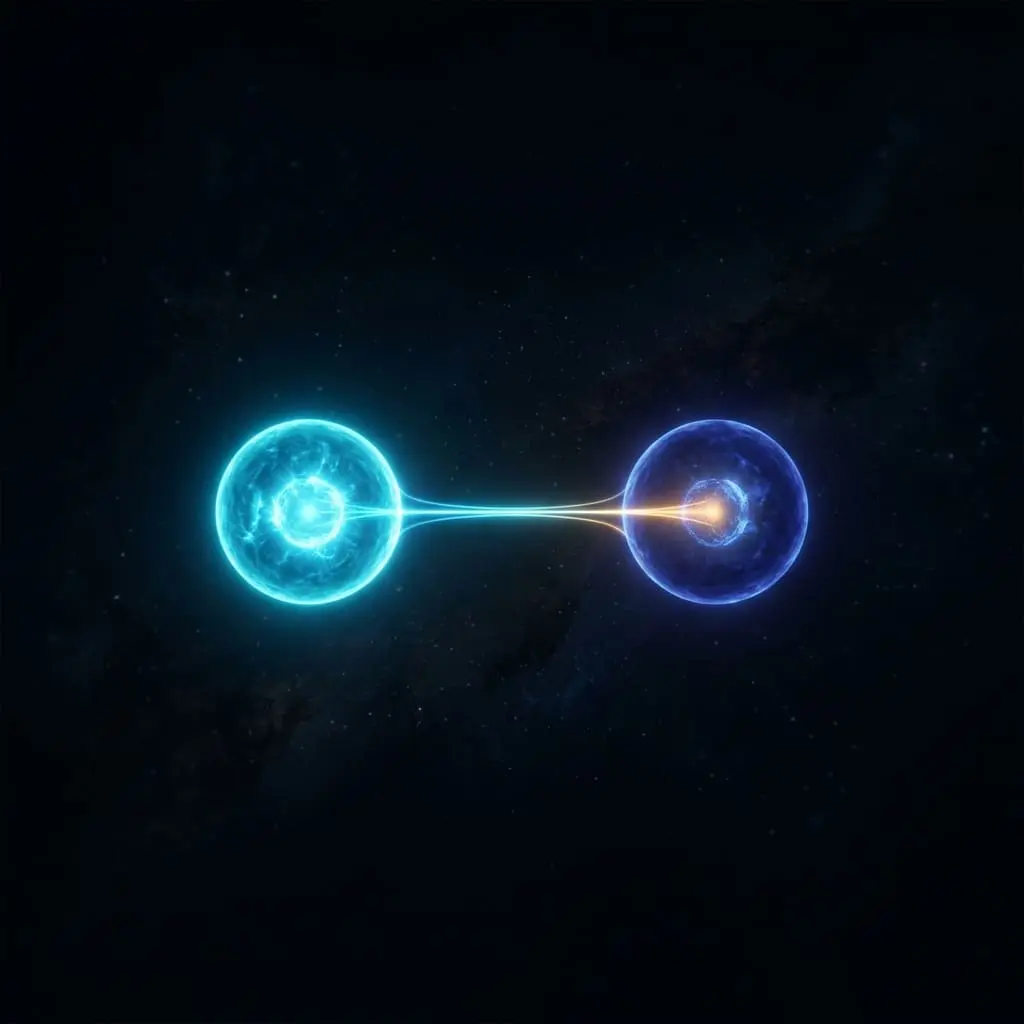
Researchers are drawing a direct line between high-energy physics data and quantum information theory by comparing measurements of hadron multiplicities from the H1 collaboration to entanglement entropy calculated using a QCD dipole cascade model. This work establishes a connection by proposing that entanglement entropy arises in deep inelastic scattering due to a trace over unobserved color degrees of freedom, yielding a quantifiable measure through dipole multiplicities. Unlike previous studies, this research incorporates both transverse-size and azimuthal-angle dependence in the dipole evolution kernel, offering a more complete model of entanglement in these interactions. The team’s analysis of the double leading-logarithmic approximation (DLLA) solution revealed that it generates a larger entanglement entropy for the same initial dipole size, suggesting a sensitivity of entanglement measures to the specific approximation used in QCD calculations.
Entanglement in Deep Inelastic Scattering (DIS) and Collider Physics
A surprising connection between quantum entanglement and the chaotic world of high-energy particle collisions is coming into sharper focus. This work, by Martin Hentschinski of Universidad de las Americas Puebla, Krzysztof Kutak of the Institute of Nuclear Physics, Polish Academy of Sciences, and colleagues, moves beyond theoretical speculation by anchoring entanglement calculations to the specifics of deep inelastic scattering (DIS). The team’s approach centers on the Balitsky, Fadin, Kuraev, Lipatov (BFKL) equation, a cornerstone of high-energy QCD, adapted to model the evolution of gluon multiplicities and, crucially, color dipoles, pairs of quarks representing the proton’s internal structure.
The researchers note that the proton itself is a highly entangled quantum state, and observing it through a virtual photon interaction induces a loss of coherence, resulting in measurable entropy. This suggests that the specific mathematical approximations used in QCD calculations can significantly influence the measured entanglement, demanding careful consideration of their impact. The study compared their calculated entanglement entropy with Shannon entropy measurements of hadron multiplicities obtained by the H1 collaboration, indicating initial support for their approach to quantifying entanglement in these complex interactions.
Following initial explorations linking quantum entanglement to particle collisions, researchers recently refined models to quantify this connection with greater detail. Current investigations focus on deep inelastic scattering (DIS), a process where electrons probe the internal structure of protons, as a means of observing entanglement arising from the interaction. The prevailing approach utilizes quantum chromodynamics (QCD), the theory governing the strong force, to model the proton’s wave function and the subsequent evolution of color dipoles, fundamental constituents arising in high-energy interactions. This work builds upon earlier studies of entanglement in top-quark and Higgs-boson decays, expanding the scope to the realm of proton structure. The researchers achieved these results through the development of Monte Carlo algorithms designed to solve the complex equations governing dipole evolution. A key aspect of the analysis involves comparing the results of the full dipole cascade model with its double leading-logarithmic approximation (DLLA), to determine if hadronic entropy can serve as a proxy for quantifying the underlying quantum entanglement.
This advancement allows for a more nuanced understanding of how the proton’s internal structure influences the observed entanglement. This finding underscores the importance of refining theoretical models to accurately capture the quantum properties of particle interactions and demonstrates that entanglement entropy can be experimentally accessed through hadronic entropy.
The ability to accurately model quantum entanglement within high-energy particle collisions has direct implications for data analysis at facilities like the H1 collaboration, where precise measurements of hadron production are used to probe fundamental properties of matter. Researchers are particularly interested in how well different mathematical techniques capture this entanglement; the DLLA offers computational convenience, but may not perfectly reflect the underlying quantum reality. The study employed Monte Carlo algorithms to solve these complex equations and compared their results to Shannon entropy measurements of hadron multiplicities obtained by the H1 collaboration, allowing for a direct validation of the theoretical framework against experimental observations. Further investigations will focus on refining these models and exploring the limits of their accuracy in describing the intricate quantum dynamics of high-energy interactions, potentially revealing new insights into the structure of matter at its most fundamental level.
The intuitive expectation that quantifying entanglement in high-energy particle collisions would rely solely on theoretical calculations is being challenged by direct comparisons with experimental data; researchers are now demonstrating a link between predicted entanglement entropy and actual particle distributions. This work doesn’t merely confirm existing models, but scrutinizes the approximations inherent in quantum chromodynamics (QCD) calculations, the theory describing the strong force. Martin Hentschinski of Universidad de las Americas Puebla, Krzysztof Kutak of the Institute of Nuclear Physics, Polish Academy of Sciences, and colleagues compared their calculated entanglement entropy with Shannon entropy measurements of hadron multiplicities obtained by the H1 collaboration, a significant step toward experimentally accessing the quantum structure of the proton and the dynamics of strong interactions. The results of this comparison can be experimentally accessed through hadronic entropy, offering a new perspective on the interplay between quantum mechanics and high-energy physics.
Entanglement entropy, a hallmark of quantum mechanics, is now being directly linked to observations from high-energy particle collisions. Researchers are leveraging deep inelastic scattering (DIS) to probe the quantum nature of protons, revealing connections between hadron multiplicities and the subtle signatures of entanglement. This work, detailed in a recent preprint, compared calculated entanglement entropy to data collected by the H1 collaboration. They employ a sophisticated model, a “complete QCD dipole cascade”, to simulate the evolution of color dipoles, the fundamental building blocks of the proton’s wave function in the high-energy limit of quantum chromodynamics. Unlike previous iterations, this model incorporates both the transverse size and azimuthal-angle dependence of these dipoles, offering a more complete picture of entanglement dynamics. Crucially, the researchers investigated the impact of approximations commonly used in QCD calculations. This suggests that refining these approximations is vital for accurately quantifying quantum effects within particle physics. The study’s results not only provide a theoretical framework for understanding entanglement in DIS but also demonstrate that entanglement entropy can be experimentally accessed through hadronic entropy.
Current investigations utilize the Mueller dipole cascade, a framework for describing the evolution of quark-gluon interactions, to calculate entanglement entropy, a measure of quantum connectedness, in deep inelastic scattering (DIS). This approach moved beyond purely theoretical exercises by enabling a direct comparison with hadron multiplicity measurements obtained by the H1 collaboration. The team’s calculations revealed a nuanced relationship between theoretical approximations and measured entanglement. This sensitivity underscores the importance of carefully evaluating the validity of approximations used in quantum chromodynamics (QCD) calculations. The researchers achieved these results through the development of Monte Carlo algorithms designed to solve the complex equations governing dipole evolution. These algorithms allow for numerical determination of dipole multiplicities, essentially counting the number of color dipoles produced in a collision, and subsequently, the calculation of entanglement entropy derived from the von Neumann entropy. By comparing their model predictions to the Shannon entropy of hadron multiplicities measured by H1, they provided initial support for the connection between experimentally accessible particle distributions and fundamental quantum properties of the colliding particles.
This isn’t merely a theoretical exercise; researchers compared the model’s calculations to hadron multiplicity measurements collected by the H1 collaboration. They also compared their calculated entanglement entropy with Shannon entropy measurements of hadron multiplicities obtained by the H1 collaboration, seeking to establish the link between particle production and quantum entanglement. A key aspect of the model is its treatment of dipole evolution, the process by which energetic particles split and recombine within the proton. This partial measurement, they posit, selects preferred configurations that define the observed hadronic final state. This finding highlights the importance of rigorous modeling and careful consideration of approximation errors when quantifying quantum phenomena within the complex environment of high-energy collisions, and underscores that entanglement entropy can be experimentally accessed through hadronic entropy.
👉 More information
🗞 Deep inelastic scattering as a probe of entanglement: the complete QCD dipole cascade
✍️ Martin Hentschinski, Krzysztof Kutak, Wieslaw Placzek and Martin Rohrmoser
🧠 ArXiv: https://arxiv.org/abs/2607.18464



See today’s quantum computing news on Quantum Zeitgeist for the latest breakthroughs in qubits, hardware, algorithms, and industry deals.



