


Scientists at Fudan University, in collaboration with the Shanghai Key Laboratory for Co, have developed a new compilation technique that significantly improves the efficiency of quantum computations performed on two-dimensional neutral-atom arrays. Dekuan Dong and colleagues address the critical challenges of qubit addressing and atom transport, which represent substantial overheads in current neutral-atom quantum computing architectures. Their structure-aware method leverages the inherent algebraic properties of quantum gates and employs graph-theoretic models to minimise these operational costs, offering a pathway towards scalable quantum computation. The approach achieves a reduction in the number of addressing layers required for single-qubit gates by up to a factor of two and decreases atom transport operations for controlled-Z (C-Z) gates by approximately 50 percent. Validation using Quantum Approximate Optimisation Algorithm (QAOA) circuits demonstrates a greater than 30 percent reduction in transport cost, indicating a promising strategy for translating hardware limitations into solvable mathematical problems and unlocking the potential of scalable neutral-atom quantum computing.
Reduced atom movement streamlines controlled-Z gate operations in neutral-atom quantum computing
Researchers at Fudan University and the Shanghai Key Laboratory for Co. have achieved a 50 percent reduction in atom transport operations required for implementing controlled-Z gates on neutral-atom quantum computers. This advancement tackles a key bottleneck hindering the scalability of quantum computations, as previous methods necessitated significant atom movement to enact the two-qubit interactions essential for C-Z gate functionality. The physical rearrangement of atoms, while enabling qubit connectivity, introduces substantial overhead in terms of time and energy consumption, limiting the potential for constructing larger and more complex quantum circuits. Neutral-atom qubits are typically arranged in optical lattices or optical tweezers, and performing a C-Z gate traditionally requires physically moving atoms to be adjacent, a process that is both time-consuming and prone to error. This new technique minimises the need for such physical movement.
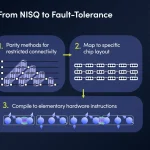
The team’s new compilation framework formulates hardware constraints as solvable algebraic and graph-based problems, enabling a more streamlined approach to qubit manipulation. Specifically, the framework decomposes complex gate sequences into a series of simpler operations that can be executed with minimal atom transport. The compilation method also reduces the number of addressing layers needed for single-qubit gates by up to a factor of two, when compared to standard row or column-based addressing schemes. Traditional addressing methods often require sequentially activating multiple layers of addressing electrodes to target individual qubits, increasing the overall gate time. This improvement stems from exploiting the algebraic structures inherent within different gate families, allowing for efficient rank-one decompositions of operations and thereby reducing the complexity of the addressing scheme. For instance, by recognising symmetries and relationships between gates, the team can combine multiple operations into a single addressing layer, significantly reducing the overhead.
Optimality for self-inverse gates, Pauli gates, phase gates and π/8 gates is detailed in supporting data, demonstrating the effectiveness of the algebraic decomposition approach across a range of commonly used single-qubit operations. These gates form the basis of many quantum algorithms, and optimising their implementation is crucial for achieving high performance. Furthermore, the team’s graph-theoretic model for scheduling controlled-Z gates successfully reduces transport cost by over 30 percent when applied to QAOA circuits designed to solve the MaxCut problem. The MaxCut problem, a classic combinatorial optimisation challenge, serves as a benchmark for evaluating the performance of quantum algorithms. The graph-theoretic model represents the qubit connectivity as a graph, where nodes represent qubits and edges represent the ability to directly interact. The algorithm then seeks to minimise the total distance that atoms need to travel to perform the necessary C-Z gates, effectively reducing the transport cost. While these results represent a substantial reduction in computational overhead, current validation relies on relatively small-scale simulations and further research is needed to demonstrate sustained performance benefits across significantly larger, more complex quantum algorithms.
Addressing physical limitations in neutral-atom quantum compilation through algebraic and
Neutral-atom quantum computers offer a promising path towards scalability due to their reconfigurable qubit layouts, but efficiently compiling instructions for these systems remains a core challenge. Unlike superconducting qubits, which have fixed connectivity, neutral-atom qubits can be moved and rearranged, allowing for greater flexibility in implementing quantum algorithms. However, this flexibility comes at the cost of increased complexity in the compilation process. The framework reduces operational overhead, although current validation relies heavily on circuits tailored to the MaxCut problem. This presents a limitation, as real-world quantum computations will involve far more complex algorithms with differing demands on qubit connectivity and gate arrangements. The performance gains observed on QAOA circuits may not directly translate to other algorithms with different gate sequences and connectivity requirements. However, this work establishes a strong foundation by demonstrating how to translate the physical constraints of neutral-atom arrays, specifically addressing layers and atom transport, into manageable algebraic and graph-theoretic problems. This translation paves the way for broader applicability and more complex quantum computations. The ability to systematically map hardware limitations onto mathematical formulations allows for the development of automated compilation tools that can optimise quantum circuits for specific neutral-atom architectures. Future work will focus on extending this framework to support a wider range of quantum algorithms and exploring the potential for integrating it with existing quantum programming languages and compilers. The ultimate goal is to create a complete software stack that enables researchers and developers to harness the full potential of scalable neutral-atom quantum computing.
The research successfully reduced the number of addressing layers for single-qubit gates by up to a factor of two and decreased atom transport operations for controlled-Z gates by approximately 50 percent. This matters because efficient gate compilation is crucial for scaling up neutral-atom quantum computers and reducing operational overhead. By converting hardware constraints into algebraic and graph-theoretic problems, the authors achieved these improvements on QAOA circuits for MaxCut, reducing transport cost by over 30 percent on average. The authors intend to extend this framework to support a wider range of quantum algorithms and integrate it with existing quantum programming tools.
👉 More information
🗞 Structure-Aware Compilation for Scalable Neutral-Atom Quantum Computing
✍️ Dekuan Dong, Fengyu Zou, Hengzhun Chen, Guorui Zhu and Yingzhou Li
🧠 ArXiv: https://arxiv.org/abs/2607.01787



See today’s quantum computing news on Quantum Zeitgeist for the latest breakthroughs in qubits, hardware, algorithms, and industry deals.



