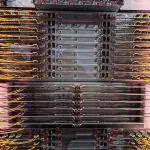
A researcher at Lawrence Berkeley National Laboratory has successfully simulated hadronization, the process where quarks bind together to form particles like protons and neutrons, by remotely accessing IBM quantum hardware through the Oak Ridge Leadership Computing Facility’s (OLCF) Quantum Computer User Program (QCUP). Despite physical experiments at facilities like CERN’s Large Hadron Collider providing indirect measurements, the complete steps of hadronization remain elusive, prompting the need for advanced computer simulations. This project lays the groundwork for leveraging quantum computers to perform calculations beyond the reach of even the most powerful classical supercomputers. “In principle, we know the theory that describes hadronization, but we are unable to make predictions using it because the calculations have been too difficult for a classical computer,” said Anthony Ciavarella, the Berkeley Lab research scientist who led the project; on a quantum computer, direct predictions detailing how hadronization occurs may be possible, aiding searches for new physics.
IBM QCUP Enables Hadronization Simulations
The ability to model the fleeting moments after high-energy particle collisions has improved thanks to a collaboration leveraging IBM quantum hardware. His findings have been published in Physical Review D. The simulation focused on the fundamental mechanism of where “strings” of gluons stretch and ultimately “snap” apart, releasing energy to create new quark-antiquark pairs. Ciavarella utilized 104 of the 156 qubits on IBM’s Heron processor, accessed via QCUP, and employed several techniques to simplify the simulation. These included focusing on heavy quarks, easier to simulate due to their limited spread, and a “scalable circuit concurrent variational quantum solver” co-developed by Ciavarella during his graduate studies.
This solver prepared the quantum computer’s qubits in a stable, low-energy quantum vacuum state. “The idea is to optimize these vacuum preparation circuits on a small system size, then do it with slightly bigger systems, and then even bigger ones. So, by doing this, you can understand how the parameters of your circuit depend on the system size, and you can then extrapolate that out to doing it for a large system,” he said. The simulation’s results aligned with previous classical supercomputer calculations and revealed a “gasifying” effect within the gluon string before separation, potentially indicating a genuine feature of quantum chromodynamics.
One of the original motivations for building quantum computers was that they naturally have this quantum phenomenology built into how they’re constructed. And in these simulations of subatomic systems, we’ve got large amounts of entanglement and quantum correlations that you just can’t efficiently represent on a regular computer.
Heavy Quark Limit & Scalable Quantum Solver
The pursuit of understanding hadronization, the process by which quarks coalesce into particles like protons and neutrons, has long been hampered by computational limitations. Anthony Ciavarella of Lawrence Berkeley National Laboratory successfully modeled key aspects of hadronization using IBM’s quantum hardware, demonstrating a potential path beyond the reach of classical supercomputers. Ciavarella’s approach involved simplifying the complex calculations by focusing on heavier quarks, which are less prone to spreading out during simulation. This created a more manageable starting point. “Heavy quarks (with more mass) are easier to simulate because they don’t spread out as much as light quarks, so they can fit more easily as points on a simulation grid,” he explained. This allowed extrapolation of the results to lighter quarks, offering insights into the behavior of more common particles.
Ciavarella’s work not only validated existing classical simulations but also revealed intriguing details about the hadronization process itself. “One of the findings that we reproduced here is that, in the middle of the gluon string, it starts to look like it’s gasifying at a finite temperature before it separates,” he said, suggesting a fundamental feature of quantum chromodynamics. The success of this initial one-dimensional simulation paves the way for more complex models, with Ciavarella planning to incorporate an additional dimension as quantum computing technology advances.
In principle, we know the theory that describes hadronization, but we are unable to make predictions using it because the calculations have been too difficult for a classical computer. However, on a quantum computer, we should be able to directly make predictions for the details of how hadronization occurs, which will help with the searches for new physics performed at colliders such as the LHC.
This work isn’t simply about replicating existing calculations; it’s about pushing the boundaries of what’s computationally possible, potentially unlocking a deeper understanding of the strong force and the very structure of matter. The simulation was further streamlined by limiting it to one dimension, a stepping stone towards more complex, multi-dimensional models. The results, published in Physical Review D, successfully reproduced findings from classical supercomputer simulations, validating the quantum approach. Notably, the simulation revealed a phenomenon within the gluon string itself. This project demonstrates the potential of quantum computing to tackle previously intractable problems in particle physics, paving the way for more accurate predictions and a deeper understanding of the universe’s building blocks. The pursuit of understanding matter at its most fundamental level has taken a significant step forward, with researchers successfully simulating a key process in particle physics using quantum computing resources.
The idea is to optimize these vacuum preparation circuits on a small system size. Then you do it slightly bigger and slightly bigger and slightly bigger. So, by doing this, you can understand how the parameters of your circuit depend on the system size, and you can then extrapolate that out to doing it for a large system. For example, you can optimize this on up to 10-12 qubits and then extrapolate that out to hundreds if you choose to do so.



See today’s quantum computing news on Quantum Zeitgeist for the latest breakthroughs in qubits, hardware, algorithms, and industry deals.